

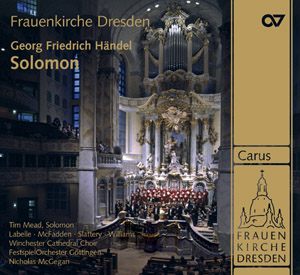
Solomon (1749) is among a series of masterful oratorios which Handel composed beginning in 1749. As with other Handel oratorios, although it does not refer to the political happenings, happenings of his day, this work does have a connection to his times in that Handel pays homage to a wise and religious ruler from antiquity – and in so doing, also to the golden era of England and its king, George II. With its splendidly colorful, finely balanced instrumentation, effective choral writing and virtuoso solos, Solomon displays the complete range and variety of Handel’s expressive capabilities. Following its premiere in 1749, in which the oratorio was drastically shortened, a further performance took place six weeks prior to Handel’s death. The recording presents the complete masterpiece on 3 SACDs, without any deletions, as Handel conceived it. This sets it apart from the myriad of recordings which are either abridged or have altered the sequence of the work. Handel’s Solomon was recorded live in the Dresden Frauenkirche by the Handel scholar Nicholas McGegan, with the Winchester Cathedral Boys Choir, the Festspiel Orchester Göttingen, as well as a highly polished ensemble of soloists, including the outstanding young altus, Tim Mead, who is outstanding on this recording.
Explore
 Listen
(38)
Listen
(38)
- Your harps and cymbals
- Ouverture
- Air (Levite): Praise ye the Lord
- With pious heart
- Air (Solomon): Almighty pow'r
- Air (Zadok): Sacred raptures cheer my breast
- Throughout the land
- Air (Solomon): What though I trace
- Air (Queen): Bless'd the day
- Duet (Queen, Solomon): Welcome
- Air (Zodak): Indulge thy faith
- Air (Solomon): Haste, haste
- Air (Queen): With thee th'unshelter'd moor
- May no rash intruder
- From the censer
- Air (Solomon): When the sun
- Air (Levite): Thrice bless'd
- Trio (First Harlot, Second Harlot, Solomon): Words are weak
- Air (Second Harlot): Thy sentence
- Air (First Harlot): Can I see my infant
- Duet (First Harlot and Solomon): Thrice bless'd be the king
- From the east
- Air (Zadok): See the tall palm
- Air (First Harlot): Beneath the vine
- Swell, swell
- Symphony: Arrival of Queen of Sheba
- Air (Queen of Sheba): Ev'ry sight
- Solo and Chorus (Solomon & Israelites): Music, spread thy voice around
- Solo and Chorus (Solomon & Israelites): Now a diff'rent measure try
- Draw the tear
- Solo and Chorus (Solomon & Israelites): Thus rolling surges rise
- Air (Levite): Pious king
- Air (Zadok): Golden columns
- Praise the Lord
- Air (Solomon): How green
- Air (Queen of Sheba): Will the sun
- Duet (Queen of Sheba & Solomon): Ev'ry joy
- The name of the wicked
Purchase
Additional product information
Contents
-
Composer
Georg Friedrich Händel
| 1685-1759George Frideric Handel put his exceptionally versatile compositional abilities to the test at an early age. After moving to London in 1712, where he was appointed Composer of Musick for His Majesty’s Chapel Royal in 1723, he wrote numerous masterpieces for the royal court as well as his major opere serie. For many years he enjoyed triumphant successes with his operas, which were sung by outstanding performers, with serenades, and later also with oratorios such as Saul and Israel in Egypt. Over the years Handel’s reputation grew far beyond the city where he worked; some of his choral works, particularly Messiah, have enjoyed a performance tradition which remains unbroken to this day, and are sung by choirs throughout the world. Personal details
-
Preface writer
Anthony Hicks
-
Ensemble
Winchester Cathedral Choir
Winchester Cathedral Choir is one of England's leading cathedral choirs with a repertoire extending from Weelkes and Byrd to Howells, Leighton and Tavener. It consists of 16-20 boy choristers and 12 Lay Clerks. The choirboys receive their schooling at The Pilgrims' School, where they learn to play at least one instrument. The Lay Clerks are experienced musicians, often with careers in singing or teaching. The choir's main commitment is to singing at cathedral services. In addition it gives performances at home and abroad, having sung at the Henry Wood Proms in the Royal Albert Hall with the BBC Symphony Orchestra, and recently in Florence Cathedral. In 2003 the choir appeared with The English Concert in Göttingen in a celebrated performance of Handel's Jephtha. Personal details
-
Ensemble
FestspielOrchester Göttingen
The FestpielOrchester Göttingen (FOG) has convinced audiences and critics alike since its foundation in 2006, and it is especially appreciated for the richness of its tone color and its light, flexible and sensual sound. The FOG includes specialists in authentic period performance practice from such internationally famous early music ensembles as Les Arts Florissants, the Akademie für Alte Musik Berlin, Concerto Köln, the Freiburger Barockorchester, the Philharmonia Baroque Orchestra (San Francisco), Il Complesso Barocco, and the Orchestra of the 18th century. Under the direction of Nicholas McGegan they have become a homogeneous ensemble, which has confirmed the reputation of the Internationale Händel-FestspieIe Göttingen as an innovative and first class festival. During the 2008 festival season the orchestra has taken part in the oratorio Samson, giving guest performances in Dresden, Hanover, Kassel and Halle/Saale, which aroused enthusiasm in both the audiences and the press: “The Göttinger play like gods” wrote a critic in the Mitteldeutsche Zeitung following the concert in Halle/Saale. During the Handel celebration year 2009, the 250th anniversary of the composer’s death, the FestspielOrchester Göttingen is taking part in a staged opera production at venues including the Drottningholm Slotstheater in Sweden. Personal details
-
Conductor
Nicholas McGegan
For the London Independent Nicholas McGegan is “one of the finest baroque conductors of his generation,” and for the New Yorker magazine, “an expert in 18th century style.” But the Cleveland Plain Dealer was more direct when it praised Nicholas McGegan for “bringing rhythmic zest to all things baroque.” And as such he is known throughout the world for performances that match authority with enthusiasm, scholarship with joy, and curatorial responsibility with evangelical exuberance. Through more than twenty years as its music director, McGegan has established the San Francisco-based Philharmonia Baroque Orchestra as the leading Baroque ensemble in America – and at the forefront of historical performance practice worldwide, thanks to notable appearances at Carnegie Hall, the London Proms, the Amsterdam Concertgebouw, and the International Handel Festival, Göttingen where he has been artistic director since 1991. In Göttingen and with the PBO he has defined an approach to period style that sets the current standard: probing, serious but undogmatic, recognizing that the music of the past does not belong in a museum or in academia, but in vigorous engagement with an audience, for pleasure and delight on both sides of the stage. He has been a pioneer in the process of exporting historically informed practice beyond the small world of period instruments to the wider one of conventional symphonic forces. His discography includes the world premiere recording of Handel’s oratorio Susanna, which attracted both a Gramophone Award and Grammy nomination, and recent issues on Carus of the same composer’s Solomon, Samson, and Acis and Galatea (the latter a rarity in that it unearths the little-known version adapted by Felix Mendelssohn). Born in England, Nicholas McGegan was educated at Oxford, Cambridge and the Royal College of Music, London. His awards include an honorary professorship at Georg-August University, Göttingen, and an official Nicholas McGegan Day, declared by the Mayor of San Francisco in recognition of two decades of distinguished work with the Philharmonia Baroque. He holds an honorary degree at London’s Royal College of Music and the Handel Prize of the Halle Handel Festival. Personal details
-
Soloist - soprano
Dominique Labelle
Born in Montreal, Dominique Labelle first rose to prominence as Donna Anna in Peter Sellar’s production of Mozart’s Don Giovanni, which she performed in New York, Paris and Vienna. Since then she has been celebrated in a repertoire ranging from Bach to 2006 Pulitzer Prize winner, Yehudi Wyner. She has worked with such conductors as Boulez, Zinman and McGegan and is a regular guest soloist in Europe. Highlighting her wide-ranging repertoire are acclaimed performances of Handel’s Belshazzar and Bach’s St. Matthew Passion, as well as works by Mahler, Verdi’s Requiem and Wyner’s songs. She has been enthusiastically received in Göttingen in several roles, including the title-role in Handel’s Rodelinda (2000) and Armida in Rinaldo (2004), as well as Angelica in Orlando (2008) and in the 2001 world premiere of Handel’s Gloria. Notable successes in the operatic field have included the title-role in Lucia di Lammermoor and Violetta in La Traviata. Her discography features works spanning the 17th and 21st centuries; a recording of Handel’s Arminio was awarded the Handel Prize in 2002. Personal details
-
Soloist - soprano
Claron McFadden
Soprano Claron McFadden trained at the Eastman School of Music in Rochester (New York). Her first appearance at Glyndebourne was in the title role of Alban Berg’s Lulu under Sir Andrew Davis. She has sung the title-role in Handel’s Rodelinda under Trevor Pinnock in Karlsruhe and Semele in Halle, and she has appeared throughout Europe with Les Arts Florissants. As well as performing soprano solos in the major oratorios, Claron McFadden is also a sought-after interpreter of contemporary music, especially the works of Dirk Brossé and Harrison Birtwistle. She sang the Lulu Suite with the Residentie Orchestra under Oliver Knussen as well as solos in Shostakovich’s Symphony No. 14 and Britten’s Les Illuminations in the Concertgebouw. Her numerous CD recordings include Birtwistle’s Paul Celan Songs, Villa-Lobos’s Bachianas Brasileiras, Rameau’s Les Indes Galantes and Purcell’s King Arthur with William Christie, Handel’s Acis and Galatea and Ottone, and a new recording of Alexander Balus with The King’s Consort. Personal details
-
Soloist - alto
Tim Mead
The countertenor Tim Mead was a choral scholar at King’s College, Cambridge, where he received his first musical training, later studying singing with Charles Brett. He continued his studies and won several scholarships to the Royal College of Music in London. The young countertenor is concentrating mainly on opera, singing in works ranging from Claudio Monteverdi to world premieres of contemporary works. His most recent operatic engagements include the title roles in Handel’s Giulio Cesare for Glyndebourne Festival Opera, Siroe under Andreas Spering and Ezio for the London Handel Festival. In sacred vocal music, his repertoire includes works by Bach, Telemann and Handel. Tim Mead has been invited to perform the title role in Admeto at the Handel Festival in Göttingen in 2009. Personal details
-
Soloist - tenor
Michael Slattery
Upon graduating from The Juilliard School, the young American tenor Michael Slattery sang his first Mozart Requiem with Esa-Pekka Salonen and the Los Angeles Philharmonic. He appeared with the LA Phil in 2006 in Philip Glass’s Akhnaten, and his concert career has also included Handel oratorios and Bach cantatas. Recently he has greatly enjoyed giving his first master classes at Universities across the US. The International Herald Tribune has described Slattery as a singer with an “American gusto that would have made Bernstein smile”, and indeed, his knack for the Maestro’s music has taken him all across Europe: from Paris to the Royal Festival Hall in London where he sang the title role in Bernstein’s Candide, a role he premiered in Rome. Recently Michael sang the title role in Monteverdi's L’Orfeo at Glimmerglass Opera, a role he had already performed with Emmanuelle Haïm at the Châtelet Theater in Paris. Outside his musical activities, Michael Slattery devotes much of his spare time to painting; his works were recently exhibited at Glimmerglass Opera. Personal details
-
Soloist - bass
Roderick Williams
Roderick Williams comes from north London and received his operatic training at the Guildhall School of Music. He has sung most of the major Mozart baritone roles for Opera North, as well as Figaro in Rossini's The Barber of Seville. In addition to such English opera composers as Tippett, Birtwistle and Britten, he has performed Henze, Richard Strauss, Stravinsky and Wagner. He has given song recitals at the London Wigmore Hall and at numerous festivals. Recent CD recordings include Lennox Berkeley's A Dinner Engagement, the first recording of Vaughan Williams's Willow Wood with the Royal Liverpool Philharmonic Orchestra, and two discs with the pianist Iain Burnside featuring songs by Finzi and Vaughan Williams. His own compositions have been premiered in the Wigmore Hall and Barbican Hall. Personal details
Reviews
Händel in der Frauenkirche Mit dem im Juni 1748 fertig gestellten Oratorium Solomon arbeitet Händel das bereits in den Oratorien Israel in Egypt, Judas Maccabäus und Joshua bewährte Konzept, den Chor als wirkungsvolle Stimme des Volkes einzusetzen, weiter aus. Somit verwundert es nicht, dass die 13 groß angelegten Chornummern zu den Höhepunkten des Werkes gehören. Händel fasziniert hier mit einer Vielzahl an unterschiedlichen Chorstilen und Satztechniken. Auf Carus erscheint jetzt eine Neueinspielung mit dem ausgewiesenen Händel-Experten Nicholas McGegan, die ebenso gelungen ist wie ihr Aufnahmeort, die Dresdner Frauenkirche.
Quelle: jpc-courier 9/07
[...] Cet ensemble de trois oratorios est vraiment une grande réussite.
PiRath
Pizzicato, 6/2009
[...] This recording is magnificent, and is definitely a worthy rendering of Handel at the peak of his brilliance as an oratorio composer. All of the recordings featuring McGegan with his FestspielOrchester have proven a delight to listen to, and one hopes that more will be forthcoming
Lorin Wilkerson
Northwest Reverb, August 30, 2009
Reviews on our website can only be submitted by customers with a registered user account. A check whether the rated products were actually purchased does not take place.
No feedback available for this product.
Frequent questions about this work
 There are no questions and answers available so far or you were unable to find an answer to your specific question about this work? Then click here and send your specific questions to our Customer Services!