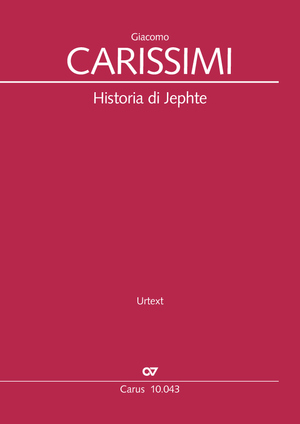
Historia di Jephte
Oratorio 1640 (ca.)
The harrowing Old Testament story of the army commander Jephthah, bound by a sacred vow to kill his daughter, inspired the Roman composer Giacomo Carissimi to create this intense and moving setting. Written in the 1640s, Historia di Jephte is not only one of the earliest oratorios, but also one of its greatest.
Scored for just six solo voices in diverse combinations accompanied by basso continuo, Carissimi presents the Latin biblical text in the recitative style of the early Baroque. He nonetheless repeatedly abandons this style to highlight the plot's tragic events, employing all expressive Affekts he had available to him. The chromatic voice-leading and thrilling harmonization of the lamentations and Jephthah’s dialogue with his doomed daughter create an intense and anguished atmosphere.
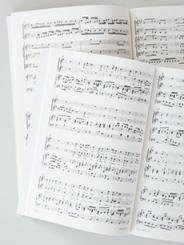
While scholars believe that the choir originally consisted of six solo parts, the work does not suffer when performed by a larger ensemble. Carus is publishing this critical edition based on the copy made by Carissimi’s pupil, Marc-Antoine Charpentier. A continuo realization is included in the score.




-
Composer
Giacomo Carissimi
| 1605-1674Italian composer, 1605-1674. One of the most important oratorio composers of the 17th century. He almost always took the material for his 15 surviving oratorios from the Old Testament (Historia di Jephte, Abraham et Isaac, Jonas). He also wrote sacred and secular cantatas. However, the majority of his manuscripts were lost in the 18th century. Personal details
-
Editor
Wolfgang Hochstein
| 1950
Reviews
… sechs Singstimmen (SSSATB)..., die sowohl solistisch als auch im Ensemble agieren und vom Basso continuo begleitet werden. … Im nutzerfreundlichen Notenteil ist die Continuostimme vom Herausgeber schlicht ausgesetzt.
Württembergische Blätter für Kirchenmusik, Nov/Dez 2024
(Ich kann dieses) Werk nur wärmstens für Aufführungen empfehlen, das mit kleinem Aufwand und sehr schönen Aufgaben für den Chor zu realisieren ist.
Gustav Danzinger, Chor aktuell, Sept 2023
Die Edition ist mustergültig, der ausführliche Kritische Bericht lässt keine Fragen offen.
Antje Wissemann, Musik & Kirche Sept/Okt 2023
Eine lohnende Aufgabe für Liebhaber*innen Alter Musik, die sicher auch von motivierten Laiensänger*innen gut bewältigt werden kann. Monika Fahrnberger, Singende Kirche, Dez 2023
Reviews on our website can only be submitted by customers with a registered user account. A check whether the rated products were actually purchased does not take place.
Frequent questions about this work
 There are no questions and answers available so far or you were unable to find an answer to your specific question about this work? Then click here and send your specific questions to our Customer Services!