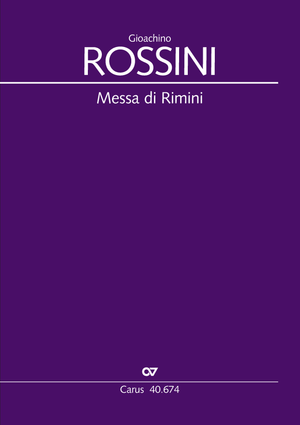
Messa di Rimini
1809


-
Composer
Gioachino Rossini
| 1792-1868Gioachino Antonio Rossini was an Italian composer who is best known today for his operas. Rossini celebrated his first major successes in Venice in 1813 with the opera seria Tancredi and the opera buffa L'italiana in Algeri. The following years continued this success story. From 1830 onwards, Rossini largely withdrew from public life. Although he still composed many works, including the Stabat mater, he devoted most of his time to eating and enjoying life. During his lifetime, Rossini enjoyed enormous fame throughout Europe, but also, thanks to his apparently humorous and affectionate character, popularity among many of his colleagues. Personal details
-
Editor
Guido Johannes Joerg
Reviews
GIOACHINO ROSSINI, Messa di Rimini
Giachino Rossini: Messa di Rimini
Dating from 1809, when Rossini was 17, this is one of a number of sacred vocal pieces now largely forgotten. It takes the form of an unusual Missa brevis, having only a Kyrie and a Gloria, but these two movements are large-scale ones, with the latter having eight submovements. The musical style is a pleasant mixture of late Classic elements predating Rossini’s evolution to the mature style of his Stabat Mater and Petite Messe solonnelle, both harking from later decades; it even continues the Baroque tradition of a figured bass part. Although the music is fairly straightforward, it is rich in melodic beauty and tonal interest.
Quelle: The American Organist 3/1998, S. 80
Giachino Rossini: Messa die Rimini 1809
In jüngster Zeit ist eine recht umfangreiche Werkgruppe von „musica sacra” bei dem eher als Opernkomponist bekannten Rossini aufgetaucht. So gibt es nicht weniger als 9 Messvertonungen (oder Messsatzvertonungen) aus den Jahren 1808 bis 1863 (Petite messe solennelle). Die vorliegende Messa die Rimini aus dem Jahre 1809 ist eine „Messa die Gloria”, vertont also nur Kyrie und Gloria. Das Werk scheint mir eine echte Entdeckung zu sein. Schwungvoll frische Musik zeigt Rossini bei seiner Suche nach seinem persönlichen Kompositionsstil. Da die kleine Besetzung auch „finanztechnisch” gut zu realisieren ist, wird sie sicher viele Liebhaber finden. Liturgisch ist das 45-minütige Werk allerdings schwer einzuordnen, im Konzert wird es wohl eher seinen rechten Platz finden als im Gottesdienst. Ein überaus informatives Vorwort rundet diese sorgfältige Edition ab.
Quelle: Kirchenmusik im Bistum Limburg 2/2000, S. 37
Reviews on our website can only be submitted by customers with a registered user account. A check whether the rated products were actually purchased does not take place.
Frequent questions about this work
 There are no questions and answers available so far or you were unable to find an answer to your specific question about this work? Then click here and send your specific questions to our Customer Services!