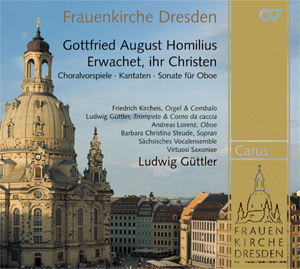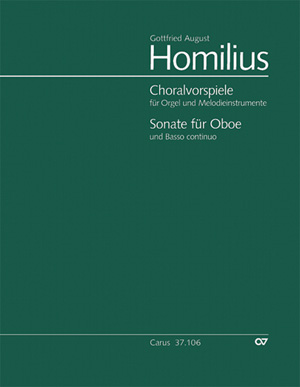
Complete Choral Preludes
für Orgel und Melodieinstrumente
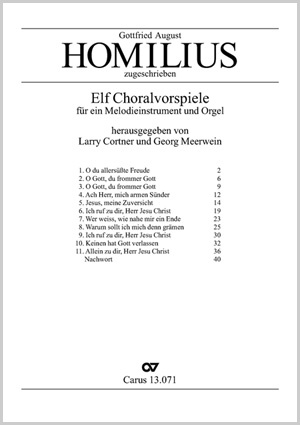
Apart from his 41 chorale arrangements for organ alone, we know of 28 arrangements for organ and melody instrument(s) among Homilius’ works. Most of the works expand the repertoire considerably and are published in this edition for the first time. Several other works which have been ascribed to Homilius are published in an appendix. The edition also contains the only preserved piece of chamber music by Homilius – a Sonata for Oboe and basso continuo.


 Listen
(1)
Listen
(1)
- Allein zu dir, Herr Jesu Christ
Contents


-
Composer
Gottfried August Homilius
| 1714-1785Gottfried August Homilius, the son of a pastor, was born in Rosenthal (Saxony) on 2 February 1714. In May 1735 he enrolled as a law student at Leipzig University. Likewise, it was probably at this time that Homilius was a pupil of Johann Sebastian Bach; the latter fact had been attested to by Johann Adam Hiller. Apart from Bach, Homilius also had contact with Johann Schneider, a Bach pupil and organist at the Nicolaikirche, for whom he also substituted. After unsuccesfully applying for a post as organist in Bautzen, Homilius was appointed organist at the Dresden Frauenkirche in 1742. In 1755 Homilius succeeded Theodor Christlieb Reinhold as Kreuzkantor and music director of the three main churches in Dresden, a position that he occupied until his death on 2 June 1785. Personal details
-
Editor
Uwe Wolf
| 1961As a musicologist, Dr. Uwe Wolf is particularly at home in the 17th and 18th centuries. The focus of his work ranges from the time of Monteverdi and Schütz to Bach and the generation of Bach's sons and pupils through to Viennese Classicism. He has been head of the editorial department at Carus-Verlag since October 2011. Prior to this, he worked in Bach research for over 20 years. Personal details
-
Editor
Ellen Exner
Reviews
In der Kantoreipraxis bieten sich damit viele Möglichkeiten der klanglichen Realisierung.
Klaus-Jürgen Gundlach, Forum Kirchenmusik, 6/2013
Die Konzertkombination „Orgel plus” erfreut sich immer wieder großer Beliebtheit, will man der hörenden Gemeinde nicht pure Orgelmusik „zumuten”. [...] Hier kann dieser Band eine Lücke mit ausgezeichneter Originalliteratur schließen helfen.
Württembergische Blätter für Kirchenmusik, 2/2009
Die umfangreiche Edition mit insgesamt 134 Seiten ist graphisch sehr übersichtlich gestaltet und informiert im Vorwort detailliert über die Geschichte und Aufführungspraxis einer Gattung, die seither in der kirchenmusikalischen Praxis vernachlässigt wurde. Die ausdrucksvollen, klangschönen Stücke dieses Bandes [...] werden in ihrer vielseitigen Verwendbarkeit in der Praxis dankbar aufgenommen werden.
Kirchenmusikalische Mitteilungen der Erzdiözese Freiburg, Mai 2010
Die Edition wird allen Ansprüchen wissenschaftlicher und praktischer Art gerecht.
Josef Dahlberg, DIE TONKUNST, Juli 2009
Reviews on our website can only be submitted by customers with a registered user account. A check whether the rated products were actually purchased does not take place.
Frequent questions about this work
 There are no questions and answers available so far or you were unable to find an answer to your specific question about this work? Then click here and send your specific questions to our Customer Services!