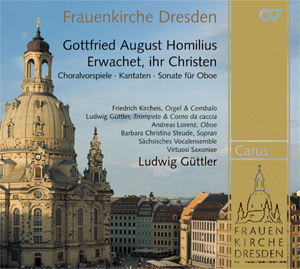
Erwachet, ihr Christen. Choralvorspiele, Kantaten und Sonate für Oboe
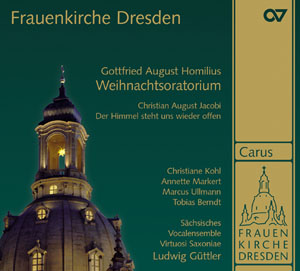
As the organist of the Dresden Frauenkirche, the composing of chorale preludes was one of the main activities of Gottfried August Homilius (1714-1785). In addition to the classical chorale prelude for solo organ, Homilius also cultivated a remarkably unique form: the arranging of a chorale with the use of an obbligato melody instrument. Like no other composer, Homilius concerned himself with this genre. The majority of the twenty-eight known chorale preludes of this type survive in a Dresden manuscript which is preserved in a library in Northampton, Massachusetts. Until a few years ago, the existence of both the autograph, as well as the works it contained was entirely unknown. The present CD has been expanded to include two cantatas, as well as the only known chamber music work by Homilius. Thus Carus continues its series "Music from the Frauenkirche in Dresden" and brings the music of Homilius to life again at the original locations where he worked as a musician. The recording is under the direction of the internationally renowned trumepter and conductor, Ludwig Güttler, who conducts as well as performs here. Güttler was one of the individuals who gave his time and energy to the rebuilding of the Dresden Frauenkirche.
Explore
 Listen
(39)
Listen
(39)
- Allein zu dir, Herr Jesu Christ
- Choralmelodie (Sopran)
- Choralvorspiel HoWV X.26 (Trompete, Orgel)
- Choralmelodie (Tenor)
- Choralvorspiel HoWV X.21 (Oboe, Orgel)
- Choralmelodie (Alt)
- Choralvorspiel HoWV X.1 (Corno da caccia, Orgel)
- Choralmelodie (Alt)
- Choralvorspiel HoWV X.3 (Oboe, Orgel)
- Allegro – Fahre hin, du Lust der Welt
- Recit.: Wohl dem, der seine Lebenszeit
- Allegretto – Liebster Zion
- Choralmelodie (Sopran)
- Choralvorspiel HoWV X.2 (Corno da caccia, Orgel)
- Choralmelodie (Sopran)
- Choralvorspiel HoWV X.17 (Trompete, Orgel)
- Choralmelodie (Sopran)
- Choralvorspiel HoWV X.19 (Corno da caccia, Orgel)
- Choralmelodie (Tenor)
- Choralvorspiel HoWV X.8 (Trompete, Orgel)
- Adagio
- Allegro assai
- Amoroso
- Vivace
- Choralmelodie (Bass)
- Choralvorspiel HoWV X.18 (Corno da caccia, Orgel)
- Choralmelodie (Sopran)
- Choralvorspiel HoWV X.Anh.10 (Oboe, Orgel)
- Choralmelodie (Tenor)
- Choralvorspiel HoWV X.20 (Corno da caccia, Orgel)
- Choralmelodie (Tenor)
- Choralvorspiel HoWV X.22 (Corno da caccia, Orgel)
- Coro: Erwachet, ihr Christen - Choral: Gott, der Vater, wohn uns bei
- Recit. (Tenor): Herr Zebaoth
- Choral: Jesus Christus wohn uns bei
- Recit. (Sopran): Du starker Held
- Choral: Heilger Geist, ach wohn uns bei
- Recit. (Bass): O Geist der Wahrheit
- Coro: So stürmet, ihr Feinde
Purchase
Additional product information
Contents


-
Composer
Gottfried August Homilius
| 1714-1785Gottfried August Homilius, the son of a pastor, was born in Rosenthal (Saxony) on 2 February 1714. In May 1735 he enrolled as a law student at Leipzig University. Likewise, it was probably at this time that Homilius was a pupil of Johann Sebastian Bach; the latter fact had been attested to by Johann Adam Hiller. Apart from Bach, Homilius also had contact with Johann Schneider, a Bach pupil and organist at the Nicolaikirche, for whom he also substituted. After unsuccesfully applying for a post as organist in Bautzen, Homilius was appointed organist at the Dresden Frauenkirche in 1742. In 1755 Homilius succeeded Theodor Christlieb Reinhold as Kreuzkantor and music director of the three main churches in Dresden, a position that he occupied until his death on 2 June 1785. Personal details
-
Preface writer
Uwe Wolf
| 1961As a musicologist, Dr. Uwe Wolf is particularly at home in the 17th and 18th centuries. The focus of his work ranges from the time of Monteverdi and Schütz to Bach and the generation of Bach's sons and pupils through to Viennese Classicism. He has been head of the editorial department at Carus-Verlag since October 2011. Prior to this, he worked in Bach research for over 20 years. Personal details
-
Ensemble
Virtuosi Saxoniae
With the Virtuosi Saxoniae Ludwig Güttler founded a chamber orchestra in 1985 which, through its versatile instrumental forces, affords a wide range of possibilities for concert programs. Made up of leading members of the Sächsische Staatskapelle Dresden, the ensemble has made it its task to promote the works of the golden age of 18th century European music culture, particularly as reflected in Dresden’s court ensemble, theatre, and church music. The ensemble performs on modern instruments, but adopts a historicallyinformed approach to questions of performance practice. After a period of intensive preparation, the chamber orchestra made its public debut at the 1986 Dresden Music Festival. Since then, the Virtuosi Saxoniae have developed an outstanding reputation through numerous concerts both in Germany and abroad. Numerous CD recordings illustrate the ensemble’s musical versatility. Personal details
-
Ensemble
Sächsisches Vocalensemble
The Sächsisches Vocalensemble, founded by Matthias Jung, is known for its model performances of early music, its stylistic reliability, virtuosity and emotional depth. One of the ensemble’s particular concerns is the performance of unknown or seldom performed compositions written for the Dresden court. The interpretation of Johann Sebastian Bach’s oeuvre has attracted international attention – their recording of his motets was awarded the Cannes Classical Award. The ensemble also focuses on music of the contemporary era. The ensemble regularly performs at renowned festivals; concert tours have taken them to France, the Czech Republic, Poland, Italy and Japan. Numerous radio recordings attest to their outstanding musicianship. Furthermore, the ensemble’s CDs include recordings of works by Schütz, Bouzignac, Telemann, Lotti, Hasse, Sarri, Feo, Mendelssohn Bartholdy, Schumann and Pepping, as well as with middle German Christmas cantatas. A CD containing Petr Eben’s sacred choral music was released in 2013. Personal details
-
Conductor
Matthias Jung
| 1964Matthias Jung studied choral and orchestral conducting at the Liszt School of Music in Weimar. Initially he was the assistant conductor of the Tölzer Knabenchor, followed by a similar position with the Dresdner Kreuzchor. From 1994 to 1996 he was the acting Kreuzkantor. He has made accessible numerous musical works which originated in middle Germany. With similar enthusiasm, Matthias Jung has also promoted the performance of contemporary vocal music. He has also worked with prestigious ensembles, such as the radio choirs in Berlin, Hamburg (NDR) and Cologne (WDR). He has had successful engagements as a guest conductor in Europe, the USA and Japan. In addition to the dresdner motettenchor he his presently the permanent conductor of the Knabenchor Dresden and the Sächsisches Vocalensemble. His many CD recordings have been awarded, among others, the Cannes Classical Award and the Deutsche Schallplattenkritik prize. Jung was awarded the sponsorship prize for art and culture by the city of Dresden. Personal details
-
Conductor
Ludwig Güttler
Ludwig Güttler is one of today’s leading virtuosi on the trumpet and corno da caccia. Through his wide and diverse range of interests he has also achieved worldwide renown as a conductor, scholar, promoter, and patron. After studying in Leipzig, he was appointed principal trumpet in the Handel Festival Orchestra, Halle, in 1965. He held a similar position in the Dresden Philharmonic from 1969 to 1980. He has taught at the International Music Seminar in Weimar and as Professor at the Musikhochschule Dresden. He directs opera productions and master classes, and is a regular jury member at leading competitions. As a soloist and conductor, Ludwig Güttler has an enthusiastic following both in Germany and abroad. He has made over fifty highly-acclaimed recordings, where he is featured as a chamber musician, soloist, and conductor. Since the early 1980s he has had a particular interest in the revival of 18th century Saxon court music. Thanks to Güttler’s researches the concert repertoire has been enriched by numerous forgotten or previously unknown works of this period. Following an analysis of the materials used in early instruments, Ludwig Güttler made a considerable contribution to the new development of the corno da caccia. In 1976 he founded the Leipzig Bach-Collegium, in 1978 the Ludwig Güttler Brass ensemble and in 1985 the chamber orchestra Virtuosi Saxoniae, of which he is director and soloist. For the last twenty years, choral symphonic concerts which he directs and guest conducts have formed an increasing part of his activities. Ludwig Güttler has received numerous awards for his many achievements. He was awarded the Record Prize of the Deutsche Phonoakademie Hamburg in 1983 for the “Discovery of the Year,” and in 1989 the Frankfurt Music Prize for exceptional achievements in his specialist area, as well as in national and international musical life. As chairman of the committee of the Society to Support the Reconstruction of the Frauenkirche Dresden, he was awarded the first national prize from the German National Foundation in 1997. In 2000 he received the Claus Brendel Prize for his meritorious service to the works of Johann Adolf Hasse. In March 2006, Ludwig Güttler was awarded the German Fundraising Prize for his dedicated contribution to the reconstruction of the Frauenkirche Dresden. In September 2007 he was awarded the Federal Cross of Merit by President Horst Köhler, and in November 2007, was made an Officer of the Order of the British Empire (OBE). Personal details
-
Soloist - soprano
Barbara Christina Steude
Barbara Christina Steude (soprano) was born in Mühlhausen in Thuringia, one of the cities most closely associated with Bach, where she received her early musical training. She studied church music and singing in Dresden. A much sought-after soloist, she regularly performs with conductors including Ludwig Güttler, Matthias Jung, Roderich Kreile, Georg Christoph Biller, Hans-Christoph Rademann, and Peter Schreier. Guest performances in Germany and abroad have taken her to the Rheingau Music Festival, Dresden Music Festival, to Japan, South Korea, France, Luxembourg, Austria, the Czech Republic, and Switzerland. As well as vocal chamber music and music theatre, she has a particular interest in the music of Bach. Her CD “O Gottes Stadt, o güldnes Licht” (Carus 83.192), released in 2007, with solo cantatas by Dieterich Buxtehude with the Lautten Compagney Berlin was highly acclaimed in the press, and Early Music Review acknowledged Barbara Christina Steude as “a wonderful voice for Buxtehude.” She is a founding member of concerto con voce. Personal details
-
Soloist - oboe
Andreas Lorenz
Andreas Lorenz (oboe), was born in 1952 in Schmatal-Cranzahl (in the Ore Mountains region of Saxony), and studied at the Hochschule für Musik Dresden. After engagements at the Meiningen Theater, Staatskapelle Berlin, and Dresden Philharmonic, in 1982 Lorenz joined the Sächsische Staatskapelle Dresden. He has received international awards, and enjoys a busy solo career performing with ensembles including Concertino Dresden, Virtuosi Saxoniae, Sächsische Oboisten-Company, and Besozzi-Consortium Dresden. In 1997 Lorenz became a professor at the Musikhochschule Dresden. Personal details
-
Soloist - organ
Friedrich Kircheis
Friedrich Kircheis (organ, harpsichord) was born in Aue, Saxony, in 1940. His musical talents were recognized and nurtured from an early age. He began organ lessons at the age of 14 and two years later, while still at school, took up his first appointment as Kantor. In 1959 he began studies at the Hochschule für Musik in Leipzig (organ lessons with Wolfgang Schetelich and Hannes Kästner), taking his final examinations in 1964 (passing in organ with distinction). He worked as a church musician in Grimma and Dresden from 1964–69, was chorus master at the Stadttheater Döbeln from 1969–71, and became Kantor and organist at the Diakonissenhauskirche in Dresden in 1973. He was a prizewinner at the fourth International Johann Sebastian Bach Competition in 1972. Friedrich Kircheis plays organ and harpsichord in several chamber music ensembles: he was harpsichordist with the Dresdner Kammersolisten from 1975–82, has regularly performed as a partner with the trumpeter Ludwig Güttler since 1979, initially in concerts for trumpet and organ, then as harpsichordist with the Leipzig Bach-Collegium from 1984, and since 1986 as harpsichordist with the chamber orchestra Virtuosi Saxoniae. Concert tours have taken him to many European countries, Japan, and America. Personal details
-
Soloist - trumpet
Ludwig Güttler
Ludwig Güttler is one of today’s leading virtuosi on the trumpet and corno da caccia. Through his wide and diverse range of interests he has also achieved worldwide renown as a conductor, scholar, promoter, and patron. After studying in Leipzig, he was appointed principal trumpet in the Handel Festival Orchestra, Halle, in 1965. He held a similar position in the Dresden Philharmonic from 1969 to 1980. He has taught at the International Music Seminar in Weimar and as Professor at the Musikhochschule Dresden. He directs opera productions and master classes, and is a regular jury member at leading competitions. As a soloist and conductor, Ludwig Güttler has an enthusiastic following both in Germany and abroad. He has made over fifty highly-acclaimed recordings, where he is featured as a chamber musician, soloist, and conductor. Since the early 1980s he has had a particular interest in the revival of 18th century Saxon court music. Thanks to Güttler’s researches the concert repertoire has been enriched by numerous forgotten or previously unknown works of this period. Following an analysis of the materials used in early instruments, Ludwig Güttler made a considerable contribution to the new development of the corno da caccia. In 1976 he founded the Leipzig Bach-Collegium, in 1978 the Ludwig Güttler Brass ensemble and in 1985 the chamber orchestra Virtuosi Saxoniae, of which he is director and soloist. For the last twenty years, choral symphonic concerts which he directs and guest conducts have formed an increasing part of his activities. Ludwig Güttler has received numerous awards for his many achievements. He was awarded the Record Prize of the Deutsche Phonoakademie Hamburg in 1983 for the “Discovery of the Year,” and in 1989 the Frankfurt Music Prize for exceptional achievements in his specialist area, as well as in national and international musical life. As chairman of the committee of the Society to Support the Reconstruction of the Frauenkirche Dresden, he was awarded the first national prize from the German National Foundation in 1997. In 2000 he received the Claus Brendel Prize for his meritorious service to the works of Johann Adolf Hasse. In March 2006, Ludwig Güttler was awarded the German Fundraising Prize for his dedicated contribution to the reconstruction of the Frauenkirche Dresden. In September 2007 he was awarded the Federal Cross of Merit by President Horst Köhler, and in November 2007, was made an Officer of the Order of the British Empire (OBE). Personal details
Reviews
[...] Die Einspielung mit zwölf Choralvorspielen wird durch zwei Kantaten und die einzig bekannte Kammermusikkomposition - eine Sonate für Oboe und Basso continuo - ergänzt. Die Weltersteinspielungen werfen ein spannendes Licht auf die kirchenmusikalische Praxis in Dresden zu dieser Zeit.
Christian Albrecht
musik&liturgie, 3/10
Reviews on our website can only be submitted by customers with a registered user account. A check whether the rated products were actually purchased does not take place.
No feedback available for this product.
Frequent questions about this work
 There are no questions and answers available so far or you were unable to find an answer to your specific question about this work? Then click here and send your specific questions to our Customer Services!