

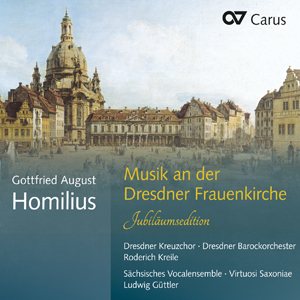
Musik an der Dresdner Frauenkirche. Jubiläumsedition
 Listen
(50)
Listen
(50)
- Coro: Der Herr ist Gott, der uns erleuchtet
- Recitativo (S): Erwürgtes Gotteslamm
- Aria (S): Dir sei Ehr und Preis gegeben
- Recitativo (T): Du heilig Volk
- Coro: Danket dem Herrn, denn er ist freundlich
- Aria (T): Du bist mein Gott
- Recitativo (A): O Geist der Gnaden
- Corale: Richt unser ganzes Leben
- Choral
- Choralvorspiel HoWV X.26
- Choral
- Choralvorspiel HoWV X.21
- Coro. Gott, dich ruehmen unsre Lieder
- Recitativo. Nein, Hirten, nein
- Aria. Fuerchtet euch nicht
- Aria. Die Engel frohlocken
- Recitativo. Hier schlummert er
- Coro. Schlaf, Sohn aus Davids Stamm
- Accompagnato. Wie goettlich laechelt er
- Aria. Kind, ich liebe dich Die Freude der Hirten über die Geburt Jesu. Weihnachtsoratorium - Aria. Kind, ich liebe dich
- Recitativo. Wie wallt mein Herz
- Coro. Heil dem besten Hirten Die Freude der Hirten über die Geburt Jesu. Weihnachtsoratorium - Coro. Heil dem besten Hirten
- Coro. Erwachet, ihr Christen
- Recitativo. Herr Zebaoth, du kennest ja die Deinen
- Choral. Jesus Christus, wohn uns bei
- Recitativo. Du starker Held aus Jacobs Stamm
- Choral. Heilger Geist, ach wohn uns bei
- Recitativo. O Geist der Wahrheit
- Coro. So stuermet, ihr Feinde
- O Gottes Lamm
- Choral
- Choralvorspiel HoWV X.8
- Adagio
- Allegro assai Sonate fuer Oboe und Basso continuo - Allegro assai
- Amoroso
- Vivace
- Choral
- Choralvorspiel HoWV X.18
- Coro: Heilig ist unser Gott, der Herr Gott Zebaoth
- Aria (S): Gott, groß ist deine Güte
- Coro: Heilig ist Jesus Christ
- Aria (A): Ich weiß, an wen ich glaube
- Coro: Heilig ist Gottes Geist
- Aria (T): Schaff du der Christen Tröster
- Coro: Dir sei, Dreieinigkeit
- Coro: Gott fähret auf mit Jauchzen
- Recitativo (S): Nun ist das große Werk vollbracht
- Aria (A): Gebückt verehren dich die Seraphinen
- Recitativo (B): Beglücktes Volk, das Jesu Namen kennt
- Corale: Nur daß ihr den Geist erhebt
 Additional material
-
 Digital text (without sheet music) incl. printing licence, html file, singing text, english translationhtml file, singing text, english translation (Sample)1. Coro
God, our songs praise you
2. Recitativo (Soprano, Alto, Tenore)
in the nighttime,
joyfully we thank you again
when day breaks.
Beasts and mankind are sleeping,
only you do not sleep.
Protect us, God, while sleeping
and be our light.Soprano: No, shepherds, no, the fields around Bethlehem
have never looked so lovely,
you know how often we went astray at night,
perhaps the God of the shepherds comes now,
as, in ancient times,
the seers of God prophesied.
Come, heavenly shepherd, down to earth and restore to us the time of innocence.Alto:
...
-
Digital text (without sheet music) incl. printing licence, html file, singing text, originalhtml file, singing text, original (Sample)
1. Coro Gott, dich rühmen unsre Lieder
2. Recitativo (Soprano, Alto, Tenore)
in der Mitternacht,
freudig danken wir dir wieder,
wenn der Tag erwacht.
Tier und Menschen sind entschlafen,
nur du schlummerst nicht.
Schütze, Gott, uns bei den Schafen
und sei unser Licht.Soprano:
Nein, Hirten, nein, so schön hat noch nicht die Flur um Bethlehem gesehn;
ihr wisst, wie oft wir uns zur Mitternacht verirrten,
vielleicht kömmt jetzt der Gott der Hirten,
dies haben ja seit langer Zeit
die Seher Gottes prophezeit.
Komm, göttlicher Hirte, zur Erde hernieder
und schenke die Zeiten der Vorwelt uns wieder.Alto:
...
-
Digital text (without sheet music) incl. printing licence, html file, Introductory text, frenchhtml file, Introductory text, french (Sample)Avant-propos de l'édition Carus 37.105
Uwe Wolf
Traduction (abrégée) : Sylvie CoquillatGottfried August Homilius, fils de pasteur, naît le 2 février 1714 à Rosenthal (Saxe). En mai 1735, Homilius s’inscrit comme étudiant en droit à l’Université de Leipzig. Il y participe aux représentations des œuvres vocales de Johann Sebastian Bach et fait sans doute partie du cercle direct de ses élèves.
En 1742, Homilius revêt la fonction d’organiste de la nouvelle église Notre-Dame à Dresde et succède enfin en 1755 à Theodor Christian Reinhold au poste de cantor de la Croix et de directeur musical des principales églises de Dresde, fonction qu’il conservera jusqu’à sa mort, le 2 juin 1785.
A leur époque, les compositions d’Homilius sont extrêmement appréciées et très diffusées. Quelques années seulement après sa mort (1790), le lexicographe Ernst Ludwig Gerber en arrive même à dire : « Il fut sans conteste notre plus grand compositeur de musique sacrée ». Aujourd’hui encore, quelques 1400 copies pour la plupart contemporaines de ses cantates témoignent à elles seules de leur diffusion à l’époque.
La musique de Noël Die Freude der Hirten über die Geburt Jesu HoWV I.1 est mise
...
-
Digital text (without sheet music) incl. printing licence, html file, Introductory text, englishhtml file, Introductory text, english (Sample)Foreword of the Edition Carus 31.105
Uwe Wolf
Translation (abridged): John CoombsGottfried August Homilius was born on 2 February 1714 at Rosenthal (Saxony), the son of a clergyman. In May 1735 he entered Leipzig University to study law. There he participated in performances of the vocal works of Johann Sebastian Bach, and he probably became one of Bach’s pupils. In 1742 Homilius was appointed organist of the new Frauenkirche in Dresden, and in 1755 he succeeded Theodor Christian Reinhold as Kreuzkantor and director of music at the principal Dresden churches, remaining in that post until his death on 2 June 1785.
The compositions of Homilius were greatly loved and widely circulated in his lifetime. A few years after Homilius’ death, in 1790, the lexicographer Ernst Ludwig Gerber wrote that: “He was indisputably our greatest church composer”. Some 1400 copies of his cantatas, mainly contemporary, which still exist, demonstrate their widespread popularity.
The Christmas work Die Freude der Hirten über die Geburt Jesu HoWV I.1 was printed at Frankfurt/Oder in 1777; after the Passions-Cantate “Ein Lämmlein geht und trägt die Schuld” of 1775, HoWV I. 2 (recorded on CD Carus 83.262), it was the second major vocal
...
-
Digital text (without sheet music) incl. printing licence, html file, Introductory text, germanhtml file, Introductory text, german (Sample)Vorwort der Ausgabe Carus 37.105
Uwe Wolf
Gottfried August Homilius wurde am 2. Februar 1714 in Rosenthal (Sachsen) als Sohn eines Pfarrers geboren, erhielt seine Schulausbildung aber überwiegend an der Annen-Schule in Dresden, wo er bereits als Schüler zeitweilig den Organistendienst übernahm. Im Mai 1735 wurde Homilius als Jurastudent an der Universität Leipzig immatrikuliert. Auch in Leipzig war er musikalisch aktiv und vertrat offenbar zeitweilig den Nikolai-Organisten Johann Schneider. Dabei wirkte er auch an den Aufführungen der Vokalwerke Johann Sebastian Bachs mit. Laut Johann Adam Hiller zählte er in Leipzig zum direkten Schülerkreis Bachs.
1742 konnte Homilius das Amt des Organisten an der neuen Dresdner Frauenkirche übernehmen. Er erwarb sich in seiner Zeit als Frauenkirchenorganist den Ruf eines hervorragenden Orgelvirtuosen. 1755 schließlich trat Homilius die Nachfolge Theodor Christian Reinholds als Kreuzkantor und Musikdirektor der Dresdner Hauptkirchen an, ein Amt, das er bis zu seinem Tod am 2. Juni 1785 innehatte.
Die Kompositionen von Homilius – erhalten sind zahlreiche Motetten, Kirchenkantaten, Oratorien, Magnificat, Choralsätze, Orgel-Kompositionen, überwiegend Choralvorspiele (teilweise mit
...
Contents


-
Composer
Gottfried August Homilius
| 1714-1785Gottfried August Homilius, the son of a pastor, was born in Rosenthal (Saxony) on 2 February 1714. In May 1735 he enrolled as a law student at Leipzig University. Likewise, it was probably at this time that Homilius was a pupil of Johann Sebastian Bach; the latter fact had been attested to by Johann Adam Hiller. Apart from Bach, Homilius also had contact with Johann Schneider, a Bach pupil and organist at the Nicolaikirche, for whom he also substituted. After unsuccesfully applying for a post as organist in Bautzen, Homilius was appointed organist at the Dresden Frauenkirche in 1742. In 1755 Homilius succeeded Theodor Christlieb Reinhold as Kreuzkantor and music director of the three main churches in Dresden, a position that he occupied until his death on 2 June 1785. Personal details
-
Preface writer
Karsten Blüthgen
-
Ensemble
Dresdner Kreuzchor
The Dresden Kreuzchor is one of the world’s oldest and most famous boys’ choirs. Its most important task in its 800 years of existence is still the musical accompaniment of the vespers and services at Dresden’s Kreuzkirche. Not only on religious holidays but also throughout the entire church year the Kreuzchor accompanies half of all liturgical services in the famous church on the old market. The impressive architecture of the Kreuzkirche is an added attraction for the 3000 spectators of its choir concerts. As the city’s oldest and critically acclaimed cultural institution, the Dresden Kreuzchor has marked Dresden’s musical life in a very special way and spreads the city’s reputation as a cultural metropolis throughout the world as one of its most prominent ambassadors. Several times a year, the Dresden Kreuzchor goes on national and international concert tours beyond Germany and Europe’s borders to Israel, Canada, Japan, South America and the USA. Moreover, it performs at international music festivals as well as on countless radio and television recordings. A very wide repertoire ranging from early Baroque to world premieres of contemporary music has enabled it to make more than 800 recordings in the last 80 years for prestigious record labels such as Deutsche Grammophon, Teldec, Capriccio and Berlin Classics. There is a constant cooperation with famous orchestras such as the Dresden Philharmonic and the Sächsische Staatskapelle Dresden. Renowned opera houses regularly employ members of the choir as soloists for roles such as the three boys in the Magic Flute. The Kreuzchor singers, called “Kruzianer,” still pursue their education and graduate from the Kreuzschule; about half of them live in the adjacent boarding school. In addition to their regular classes, the 150 singers aged nine to eighteen have weekly singing and instrumental lessons. Their daily rehearsals and the specific sound of the choir are the basis of the success and the fame of the Dresden Kreuzchor. Personal details
-
Ensemble
Virtuosi Saxoniae
With the Virtuosi Saxoniae Ludwig Güttler founded a chamber orchestra in 1985 which, through its versatile instrumental forces, affords a wide range of possibilities for concert programs. Made up of leading members of the Sächsische Staatskapelle Dresden, the ensemble has made it its task to promote the works of the golden age of 18th century European music culture, particularly as reflected in Dresden’s court ensemble, theatre, and church music. The ensemble performs on modern instruments, but adopts a historicallyinformed approach to questions of performance practice. After a period of intensive preparation, the chamber orchestra made its public debut at the 1986 Dresden Music Festival. Since then, the Virtuosi Saxoniae have developed an outstanding reputation through numerous concerts both in Germany and abroad. Numerous CD recordings illustrate the ensemble’s musical versatility. Personal details
-
Ensemble
Sächsisches Vocalensemble
The Sächsisches Vocalensemble, founded by Matthias Jung, is known for its model performances of early music, its stylistic reliability, virtuosity and emotional depth. One of the ensemble’s particular concerns is the performance of unknown or seldom performed compositions written for the Dresden court. The interpretation of Johann Sebastian Bach’s oeuvre has attracted international attention – their recording of his motets was awarded the Cannes Classical Award. The ensemble also focuses on music of the contemporary era. The ensemble regularly performs at renowned festivals; concert tours have taken them to France, the Czech Republic, Poland, Italy and Japan. Numerous radio recordings attest to their outstanding musicianship. Furthermore, the ensemble’s CDs include recordings of works by Schütz, Bouzignac, Telemann, Lotti, Hasse, Sarri, Feo, Mendelssohn Bartholdy, Schumann and Pepping, as well as with middle German Christmas cantatas. A CD containing Petr Eben’s sacred choral music was released in 2013. Personal details
-
Orchestra
Dresdner Barockorchester
One of the distinguishing features of the Dresdner Barockorchester, founded in 1991, is the fact that its membership includes both early music specialists and orchestral musicians drawn from the Dresdner Staatskapelle and the Dresdner Philharmonie. Working together with baroque instruments, with their specific clarity of sound and articulation they achieve a variegated, eloquent music-making in which their different areas of musical experience are combined. The musicians are united in their desire to follow the splendid example set by the Dresden Court Orchestra of Augustus the Strong. The heritage of that era is the music of such conductors and instrumentalists of the Court Orchestra as Hasse, Heinichen, Zelenka, Quantz and Pisendel, whose works have a prominent place in the repertoire of the Dresdner Barockorchester. This repertoire extends from the end of the 17th century through Mozart. The Dresdner Barockorchester works closely with the Dresdner Kammerchor and its conductor Hans- Christoph Rademann. Personal details
-
Conductor
Roderich Kreile
For centuries the position as cantor of the Dresdner Kreuzchor (Choir of the Church of the Holy Cross) has been among the most honorable and renowned positions in Protestant church music. Roderich Kreile has served as the 28th post-Reformation cantor of the Dresdner Kreuzchor since 1997. He was born in 1956 and studied church music and choral conducting in Munich. Roderich Kreile quickly achieved nationwide recognition as a church musician. He taught at the Munich Conservatoire between 1989 and 1996, eventually as a professor, and led two choirs. Furthermore, in 1994 he took over the position as Director of the Munich Philharmonic Choir. As an organist and tutor he has received invitations from both within Germany and from abroad. Kreuzkantor Roderich Kreile all music performances in the church as well as the concerts and tours of the Dresdner Kreuzchor. There, he has established with the members of the choir – named “Kruzianer” –, a wide-ranging repertoire of religious and secular choral works from throughout the history of music. In the last few years he has given many compositions their first performances. He has also strengthened ties with renowned orchestras and produced numerous radio and CD recordings. In previous centuries the area of responsibility of the cantor of the Dresdner Kreuzchor was concentrated primarily on the leadership of the religious services, as is still the case. Nowadays, however, the remit of the Kantor far exceeds purely artistic responsibility; as the leader of the Dresdner Kreuzchor, Roderich Kreile also has the responsibility of being a community representative. Personal details
-
Conductor
Ludwig Güttler
Ludwig Güttler is one of today’s leading virtuosi on the trumpet and corno da caccia. Through his wide and diverse range of interests he has also achieved worldwide renown as a conductor, scholar, promoter, and patron. After studying in Leipzig, he was appointed principal trumpet in the Handel Festival Orchestra, Halle, in 1965. He held a similar position in the Dresden Philharmonic from 1969 to 1980. He has taught at the International Music Seminar in Weimar and as Professor at the Musikhochschule Dresden. He directs opera productions and master classes, and is a regular jury member at leading competitions. As a soloist and conductor, Ludwig Güttler has an enthusiastic following both in Germany and abroad. He has made over fifty highly-acclaimed recordings, where he is featured as a chamber musician, soloist, and conductor. Since the early 1980s he has had a particular interest in the revival of 18th century Saxon court music. Thanks to Güttler’s researches the concert repertoire has been enriched by numerous forgotten or previously unknown works of this period. Following an analysis of the materials used in early instruments, Ludwig Güttler made a considerable contribution to the new development of the corno da caccia. In 1976 he founded the Leipzig Bach-Collegium, in 1978 the Ludwig Güttler Brass ensemble and in 1985 the chamber orchestra Virtuosi Saxoniae, of which he is director and soloist. For the last twenty years, choral symphonic concerts which he directs and guest conducts have formed an increasing part of his activities. Ludwig Güttler has received numerous awards for his many achievements. He was awarded the Record Prize of the Deutsche Phonoakademie Hamburg in 1983 for the “Discovery of the Year,” and in 1989 the Frankfurt Music Prize for exceptional achievements in his specialist area, as well as in national and international musical life. As chairman of the committee of the Society to Support the Reconstruction of the Frauenkirche Dresden, he was awarded the first national prize from the German National Foundation in 1997. In 2000 he received the Claus Brendel Prize for his meritorious service to the works of Johann Adolf Hasse. In March 2006, Ludwig Güttler was awarded the German Fundraising Prize for his dedicated contribution to the reconstruction of the Frauenkirche Dresden. In September 2007 he was awarded the Federal Cross of Merit by President Horst Köhler, and in November 2007, was made an Officer of the Order of the British Empire (OBE). Personal details
-
Soloist - soprano
Vasiljka Jezovsek
-
Soloist - soprano
Barbara Christina Steude
Barbara Christina Steude (soprano) was born in Mühlhausen in Thuringia, one of the cities most closely associated with Bach, where she received her early musical training. She studied church music and singing in Dresden. A much sought-after soloist, she regularly performs with conductors including Ludwig Güttler, Matthias Jung, Roderich Kreile, Georg Christoph Biller, Hans-Christoph Rademann, and Peter Schreier. Guest performances in Germany and abroad have taken her to the Rheingau Music Festival, Dresden Music Festival, to Japan, South Korea, France, Luxembourg, Austria, the Czech Republic, and Switzerland. As well as vocal chamber music and music theatre, she has a particular interest in the music of Bach. Her CD “O Gottes Stadt, o güldnes Licht” (Carus 83.192), released in 2007, with solo cantatas by Dieterich Buxtehude with the Lautten Compagney Berlin was highly acclaimed in the press, and Early Music Review acknowledged Barbara Christina Steude as “a wonderful voice for Buxtehude.” She is a founding member of concerto con voce. Personal details
-
Soloist - soprano
Christiane Kohl
The soprano Christiane Kohl was born in Frankfurt am Main. After completing her schooling she studied at the Salzburg Mozarteum, graduating with distinction in 2003. She has won prizes at several international competitions and she made her stage debut at the 2001 Salzburg Festival. In 2002 she became a permanent member of the company at the Zurich opera house, and there she has been heard in many roles ranging from Mozart by way of Puccini to Shostakovich. This young singer has appeared in many concerts at such venues as the Alte Oper in Frankfurt, the KKL in Lucerne, and the Berlin Philharmonie. Personal details
-
Soloist - soprano
Dorothea Wagner
-
Soloist - alto
Anne Buter
-
Soloist - alto
Annette Markert
Annette Markert, born in Thuringia, studied at the Musikhochschule “Felix Mendelssohn Bartholdy” in Leipzig, was engaged by the opera companies in Halle and Leipzig, and since 1996 has been a free-lance opera and concert singer. This mezzo-soprano has sung with the New York Philharmonic and the Leipzig Gewandhaus Orchestra under Kurt Masur, with the Vienna Philharmonic under Philippe Herreweghe and the International Bachakademie Stuttgart under Helmuth Rilling. She has also sung regularly with the Dresden Kreuzchor and the Leipzig Thomanerchor. For her participation in Handel operas she was awarded the Händel-Preis of the city of Halle. A wide range of CD productions, some with Ton Koopman and Ludwig Güttler, round off her activities. Personal details
-
Soloist - tenor
Marcus Ullmann
-
Soloist - tenor
Hubert Nettinger
-
Soloist - tenor
Clemens Volkmar
-
Soloist - bass
Christian Hilz
-
Soloist - bass
Tobias Berndt
Tobias Berndt began his musical education in the Dresden Kreuzchor. He studied with Christian Polster in Leipzig and continued his training with Rudolf Piernay in Mannheim. He also studied with Dietrich Fischer-Dieskau and Thomas Quasthoff. He was a laureate in numerous renowned singing competitions, winning – among others – the International Das Lied Competition in Berlin, the International Brahms Competition and the Cantilena Singing Competition. Tobias Berndt has also established himself abroad as an opera and concert singer. He has collaborated with conductors such as Philippe Herreweghe, Helmuth Rilling, Frieder Bernius, Teodor Currentzis, Marcus Creed, Hans-Christoph Rademann, Andrea Marcon, Marek Janowski and Sir Roger Norrington and has performed at the Berliner Philharmonie, the Tonhalle in Zurich, the Concertgebouw Amsterdam, the Leipzig Gewandhaus, the Tchaikovsky Concert Hall in Moscow, the Teatro Colon in Buenos Aires and at Lincoln Center in New York. He has also performed at important festivals such as the Prague Spring, the Rheingau Musik Festival, the Händel Festivals in Göttingen und Halle, the Bachfest Leipzig, the Oregon Bach Festival and the International Music Festival in Peking. An extensive discography attests to his versatile artistic activities. Personal details
-
Soloist - bass
Philip Brömsel
-
Soloist - oboe
Andreas Lorenz
Andreas Lorenz (oboe), was born in 1952 in Schmatal-Cranzahl (in the Ore Mountains region of Saxony), and studied at the Hochschule für Musik Dresden. After engagements at the Meiningen Theater, Staatskapelle Berlin, and Dresden Philharmonic, in 1982 Lorenz joined the Sächsische Staatskapelle Dresden. He has received international awards, and enjoys a busy solo career performing with ensembles including Concertino Dresden, Virtuosi Saxoniae, Sächsische Oboisten-Company, and Besozzi-Consortium Dresden. In 1997 Lorenz became a professor at the Musikhochschule Dresden. Personal details
-
Soloist - organ
Friedrich Kircheis
Friedrich Kircheis (organ, harpsichord) was born in Aue, Saxony, in 1940. His musical talents were recognized and nurtured from an early age. He began organ lessons at the age of 14 and two years later, while still at school, took up his first appointment as Kantor. In 1959 he began studies at the Hochschule für Musik in Leipzig (organ lessons with Wolfgang Schetelich and Hannes Kästner), taking his final examinations in 1964 (passing in organ with distinction). He worked as a church musician in Grimma and Dresden from 1964–69, was chorus master at the Stadttheater Döbeln from 1969–71, and became Kantor and organist at the Diakonissenhauskirche in Dresden in 1973. He was a prizewinner at the fourth International Johann Sebastian Bach Competition in 1972. Friedrich Kircheis plays organ and harpsichord in several chamber music ensembles: he was harpsichordist with the Dresdner Kammersolisten from 1975–82, has regularly performed as a partner with the trumpeter Ludwig Güttler since 1979, initially in concerts for trumpet and organ, then as harpsichordist with the Leipzig Bach-Collegium from 1984, and since 1986 as harpsichordist with the chamber orchestra Virtuosi Saxoniae. Concert tours have taken him to many European countries, Japan, and America. Personal details
-
Soloist - trumpet
Ludwig Güttler
Ludwig Güttler is one of today’s leading virtuosi on the trumpet and corno da caccia. Through his wide and diverse range of interests he has also achieved worldwide renown as a conductor, scholar, promoter, and patron. After studying in Leipzig, he was appointed principal trumpet in the Handel Festival Orchestra, Halle, in 1965. He held a similar position in the Dresden Philharmonic from 1969 to 1980. He has taught at the International Music Seminar in Weimar and as Professor at the Musikhochschule Dresden. He directs opera productions and master classes, and is a regular jury member at leading competitions. As a soloist and conductor, Ludwig Güttler has an enthusiastic following both in Germany and abroad. He has made over fifty highly-acclaimed recordings, where he is featured as a chamber musician, soloist, and conductor. Since the early 1980s he has had a particular interest in the revival of 18th century Saxon court music. Thanks to Güttler’s researches the concert repertoire has been enriched by numerous forgotten or previously unknown works of this period. Following an analysis of the materials used in early instruments, Ludwig Güttler made a considerable contribution to the new development of the corno da caccia. In 1976 he founded the Leipzig Bach-Collegium, in 1978 the Ludwig Güttler Brass ensemble and in 1985 the chamber orchestra Virtuosi Saxoniae, of which he is director and soloist. For the last twenty years, choral symphonic concerts which he directs and guest conducts have formed an increasing part of his activities. Ludwig Güttler has received numerous awards for his many achievements. He was awarded the Record Prize of the Deutsche Phonoakademie Hamburg in 1983 for the “Discovery of the Year,” and in 1989 the Frankfurt Music Prize for exceptional achievements in his specialist area, as well as in national and international musical life. As chairman of the committee of the Society to Support the Reconstruction of the Frauenkirche Dresden, he was awarded the first national prize from the German National Foundation in 1997. In 2000 he received the Claus Brendel Prize for his meritorious service to the works of Johann Adolf Hasse. In March 2006, Ludwig Güttler was awarded the German Fundraising Prize for his dedicated contribution to the reconstruction of the Frauenkirche Dresden. In September 2007 he was awarded the Federal Cross of Merit by President Horst Köhler, and in November 2007, was made an Officer of the Order of the British Empire (OBE). Personal details
-
Soloist - violoncello
Friedwart Dittmann
Reviews
[…] these church pieces are sung with the appropriate directness and sincerity, not too formal or schooled, and touched here and there with a little rusticity that does justice to the composer on his 300-year jubilee.
Brian Morton, Choir & Organ, Mai/Juni 2014
Reviews on our website can only be submitted by customers with a registered user account. A check whether the rated products were actually purchased does not take place.
Frequent questions about this work
 There are no questions and answers available so far or you were unable to find an answer to your specific question about this work? Then click here and send your specific questions to our Customer Services!