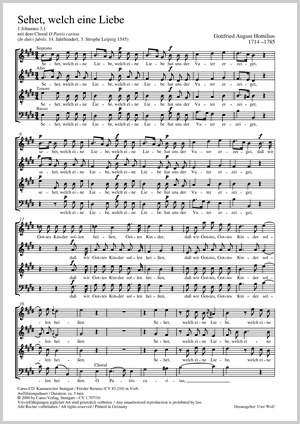
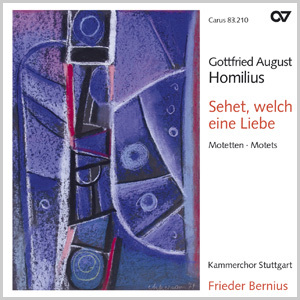
Sehet, welch eine Liebe. Motets
“This CD is an absolute must (at least) for ever lover of choir music. … That the music of the CD can, at times, unfold with such a lasting, outright magical effect, lies naturally not solely on the music itself, but also on the masterful interpretation: Frieder Bernius has intentionally refrained from using any instruments in order to achieve the purest interpretation possible.”
Awarded the Preis der deutschen Schallplattenkritik
 Listen
(17)
Listen
(17)
- See now, what kind of love
- Da es nun Abend ward
- He who weeping soweth
- Was hast du, Mensch
- Herr, wenn Trübsal da ist
- Die richtig für sich gewandelt haben (1)
- Ihr sollt nicht sorgen und sagen
- Let all the gates be raised
- Wünschet Jerusalem Glück (2)
- So gehst du nun, mein Jesu, hin
- See now, this is God's own Lamb
- Herr, lehre uns bedenken
- Unser Leben währet siebenzig Jahr
- Blest are the departed
- Ob jemand sündiget
- Seid fröhlich in Hoffnung
- Unser Vater in dem Himmel
Contents


-
Composer
Gottfried August Homilius
| 1714-1785Gottfried August Homilius, the son of a pastor, was born in Rosenthal (Saxony) on 2 February 1714. In May 1735 he enrolled as a law student at Leipzig University. Likewise, it was probably at this time that Homilius was a pupil of Johann Sebastian Bach; the latter fact had been attested to by Johann Adam Hiller. Apart from Bach, Homilius also had contact with Johann Schneider, a Bach pupil and organist at the Nicolaikirche, for whom he also substituted. After unsuccesfully applying for a post as organist in Bautzen, Homilius was appointed organist at the Dresden Frauenkirche in 1742. In 1755 Homilius succeeded Theodor Christlieb Reinhold as Kreuzkantor and music director of the three main churches in Dresden, a position that he occupied until his death on 2 June 1785. Personal details
-
Preface writer
Uwe Wolf
| 1961As a musicologist, Dr. Uwe Wolf is particularly at home in the 17th and 18th centuries. The focus of his work ranges from the time of Monteverdi and Schütz to Bach and the generation of Bach's sons and pupils through to Viennese Classicism. He has been head of the editorial department at Carus-Verlag since October 2011. Prior to this, he worked in Bach research for over 20 years. Personal details
-
Preface writer
Frieder Bernius
| 1947Frieder Bernius’s work has earned great worldwide recognition. He is in demand internationally as a conductor and as a teacher. His principal artistic collaborators are the ensembles he founded himself, the Kammerchor Stuttgart, the Barockorchester Stuttgart, the Hofkapelle Stuttgart and the Klassische Philharmonie Stuttgart. As a guest conductor, he has collaborated repeatedly with, for example, the SWR Vokalensemble Stuttgart, the Deutsche Kammerphilharmonie Bremen, the Stuttgarter Kammerorchester and the Streicherakademie Bozen. Great stylistic versatility is Frieder Bernius’s hallmark. Whether he conducts vocal works by Monteverdi, Bach, Händel, Mozart, Beethoven, Fauré and Ligeti, stage music by Mendelssohn or symphonies by Haydn, Burgmüller and Schubert, his work always aims for a sound that is at once unmistakably personal and at the same time oriented towards the original period sound ideal. He devotes himself equally to the rediscovery of 18th century operas and to first performances of contemporary compositions. He is particularly interested in the musical history of southwestern Germany. Carus-Verlag has awarded Frieder Bernius a Golden CD for his complete recording of the sacred music of Felix Mendelssohn Bartholdy. The award was presented to him during the German Choir Festival in Stuttgart 2016. The sale of over 250,000 recordings, which has been acclaimed with a number of awards, has made a not insignificant contribution to what today is the obvious presence of Mendelssohn's complete œuvre in the concert repertoire. Personal details
-
Choir
Kammerchor Stuttgart
The Kammerchor Stuttgart is regarded as one of the best ensembles of its kind. Over its fifty-year existence, Frieder Bernius has developed the choir into an exceptional ensemble acclaimed by audiences and press alike. This has led to invitations for the choir to perform at all the important European festivals. In Germany the chamber choir performs at festivals and in concert halls in repertoire ranging from the 17th to the 21st century. Frieder Bernius and his ensemble have received numerous accolades for their contribution to new music. The Kammerchor Stuttgart has made over 80 CDs and LPs, numerous of which have been awarded international recording prizes (including the Edison award, Diapason d’or, Gramophone Choice, Classical Internet Award, International Classical Music Award, and German Record Critics’ Award prizes). The International Federation for Choral Music has invited the ensemble to sing at the 1st, 4th and 10th World Symposia on Choral Music in Vienna, Sydney and Seoul. Regular tours of North America and Asia since 1988 and a South America tour reflect the Kammerchor Stuttgart’s international reputation. Since 1984 the top ensemble has also been invited to Israel biennially. Personal details
-
Conductor
Frieder Bernius
| 1947Frieder Bernius’s work has earned great worldwide recognition. He is in demand internationally as a conductor and as a teacher. His principal artistic collaborators are the ensembles he founded himself, the Kammerchor Stuttgart, the Barockorchester Stuttgart, the Hofkapelle Stuttgart and the Klassische Philharmonie Stuttgart. As a guest conductor, he has collaborated repeatedly with, for example, the SWR Vokalensemble Stuttgart, the Deutsche Kammerphilharmonie Bremen, the Stuttgarter Kammerorchester and the Streicherakademie Bozen. Great stylistic versatility is Frieder Bernius’s hallmark. Whether he conducts vocal works by Monteverdi, Bach, Händel, Mozart, Beethoven, Fauré and Ligeti, stage music by Mendelssohn or symphonies by Haydn, Burgmüller and Schubert, his work always aims for a sound that is at once unmistakably personal and at the same time oriented towards the original period sound ideal. He devotes himself equally to the rediscovery of 18th century operas and to first performances of contemporary compositions. He is particularly interested in the musical history of southwestern Germany. Carus-Verlag has awarded Frieder Bernius a Golden CD for his complete recording of the sacred music of Felix Mendelssohn Bartholdy. The award was presented to him during the German Choir Festival in Stuttgart 2016. The sale of over 250,000 recordings, which has been acclaimed with a number of awards, has made a not insignificant contribution to what today is the obvious presence of Mendelssohn's complete œuvre in the concert repertoire. Personal details
Reviews
Homilius: Sehet, welch eine Liebe

So sollte es eigentlich immer sein: Einer vorbildlichen Edition folgt in zeitlich kurzem Abstand eine ebenso vorbildliche und zugleich maßstabsetzende Einspielung. [...] Dass Frieder Bernius, wie er im Booklet bekennt, „von Homilius’ originären Schöpfungen fasziniert” ist und der exzellente Kammerchor Stuttgart seine Begeisterung voll und ganz teilt, belegt die Aufnahme in jeglicher Hinsicht. [...] Es wäre wünschenswert, wenn von dieser makellosen und zugleich beispielhaften Aufnahme eine Initialzündung ausgehen würde. Denn – so Bernius – sind aus Homilius’ 62 Motetten noch längst nicht „alle Rosinen herausgepickt“.
Ingeborg Allihn
Musik und Kirche 1/2005
Diese CD ist ein absolutes Muss (mindestens) für jeden Chormusikfreund. [...]
Marcus Stäbler
PHONO FORUM 01/05
[...] I have sung the praises of Frieder Bernius and his choir in several previous issues of this publication and I am proud to say this carries on their exceptional tradition. [...]
Michael Carter
Fanfare, March 2005
Ein fabelhafter Chor mit einem unbekannten, lohnenden Repertoire in perfekter Interpretation
Markus Dippold
Stuttgarter Zeitung, 30.11.2004, Rubrik Leckerbissen
[...] Ein Blick in die Partituren entlarvt diese zeitlosen und hochwertigen Stücke ohne weiteres als eine der bedeutendsten Beiträge des Motettenschaffens im späteren 18. Jahrhundert – rein handwerklich. Bernius hat ihnen mit den faszinierenden Aufnahmen einen Odem eingehaucht, der einen sinnschmeichelnd und überaus nachhaltig umgibt. Man merke sich den Namen Homilius!
klassik.com, 31.12.2004
[...] Zu Recht hat diese Aufnahme den Preis der Deutschen Schallplattenkritik verliehen bekommen.
Bayern 4 Klassik, Susette Clausing, 25.2.2005
[...] Es erfüllt uns eine Mischung aus Glück und Vertrauen, von Bernius auf dieser Ohrenweide zu all den hübschen, liebevollen und auch frechen Details geführt zu werden, die er mit einer disziplinierten Leichtigkeit für uns aufdeckt. [...]
Gabriele Pilhofer
klassik.com, 31.12.2004
Reviews on our website can only be submitted by customers with a registered user account. A check whether the rated products were actually purchased does not take place.
Frequent questions about this work
 There are no questions and answers available so far or you were unable to find an answer to your specific question about this work? Then click here and send your specific questions to our Customer Services!