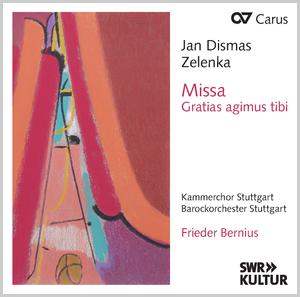
Missa Gratias agimus tibi
It is the story of a renaissance. Sorely neglected for many years, the music of Jan Dismas Zelenka has in recent decades regained its place on the concert stage thanks to newly edited scores and enthusiastic performers. Born in Bohemia, trained in Prague and later reaching his full maturity in Dresden, Zelenka placed his own unique stamp on the music of his age, already enjoying great admiration during his lifetime.
Having discovered Zelenka early in his career, Frieder Bernius has been a regular interpreter of his music. This recording features the festive Missa gratias agimus tibi of 1730, scored for trumpets and timpani. The 17 short movements of this Mass illustrate Zelenka’s ingenuity and technical mastery.
The Kammerchor Stuttgart, the Stuttgart Baroque Orchestra and soloists Hannah Morrison, Franziska Bobe, David Allsopp, Thomas Hobbs and Jonathan Sells are conducted by Frieder Bernius.
 Listen
(24)
Listen
(24)
- Kyrie
- Gloria: Gloria in excelsis Deo
- Gloria: Laudamus te
- Gloria: Qui tollis peccata mundi
- Gloria: Quoniam tu solus Sanctus
- Gloria: Cum Sancto Spiritu
- Gloria: Amen
- Credo: Credo in unum Deum
- Credo: Et incarnatus est
- Credo: Crucifixus
- Credo: Et resurrexit
- Sanctus: Sanctus
- Sanctus: Benedictus
- Sanctus: Osanna
- Agnus Dei: Agnus Dei I
- Agnus Dei: Agnus Dei II
- Agnus Dei: Agnus Dei III et Dona nobis pacem
- Magnificat anima mea Dominum
- Suscepit Israel
- Amen
- Laudate pueri Dominum in F
- Beatus vir
- Gloria Patri
- Amen
Contents

-
Composer
Jan Dismas Zelenka
| 1679-1745The Bohemian composer Jan Dismas Zelenka was a double bass player and church music composer at the Saxon court of the Elector August the Strong and his son Friedrich August II. In the years after 1721 he composed an extensive repertoire of Catholic church music together with the Kapellmeister Johann David Heinichen. These works, together with the Dresden operas composed by Johann Adolf Hasse in quick succession from 1731 onwards, established the reputation of the Saxon court as one of the most important musical centers of the late Baroque period. Personal details
-
Choir
Kammerchor Stuttgart
The Kammerchor Stuttgart is regarded as one of the best ensembles of its kind. Over its fifty-year existence, Frieder Bernius has developed the choir into an exceptional ensemble acclaimed by audiences and press alike. This has led to invitations for the choir to perform at all the important European festivals. In Germany the chamber choir performs at festivals and in concert halls in repertoire ranging from the 17th to the 21st century. Frieder Bernius and his ensemble have received numerous accolades for their contribution to new music. The Kammerchor Stuttgart has made over 80 CDs and LPs, numerous of which have been awarded international recording prizes (including the Edison award, Diapason d’or, Gramophone Choice, Classical Internet Award, International Classical Music Award, and German Record Critics’ Award prizes). The International Federation for Choral Music has invited the ensemble to sing at the 1st, 4th and 10th World Symposia on Choral Music in Vienna, Sydney and Seoul. Regular tours of North America and Asia since 1988 and a South America tour reflect the Kammerchor Stuttgart’s international reputation. Since 1984 the top ensemble has also been invited to Israel biennially. Personal details
-
Orchestra
Barockorchester Stuttgart
The Barockorchester Stuttgart, which was founded by Bernius in 1985, specializes in 18th century music. The musicians are among the leading representatives of historical performance practice and perform exclusively on original instruments. The ensemble dedicates itself to a large extent to the revival of 18th century operas. It has performed at numerous international festivals, among others in Rome, Dresden and Göttingen. Personal details
-
Conductor
Frieder Bernius
| 1947Frieder Bernius’s work has earned great worldwide recognition. He is in demand internationally as a conductor and as a teacher. His principal artistic collaborators are the ensembles he founded himself, the Kammerchor Stuttgart, the Barockorchester Stuttgart, the Hofkapelle Stuttgart and the Klassische Philharmonie Stuttgart. As a guest conductor, he has collaborated repeatedly with, for example, the SWR Vokalensemble Stuttgart, the Deutsche Kammerphilharmonie Bremen, the Stuttgarter Kammerorchester and the Streicherakademie Bozen. Great stylistic versatility is Frieder Bernius’s hallmark. Whether he conducts vocal works by Monteverdi, Bach, Händel, Mozart, Beethoven, Fauré and Ligeti, stage music by Mendelssohn or symphonies by Haydn, Burgmüller and Schubert, his work always aims for a sound that is at once unmistakably personal and at the same time oriented towards the original period sound ideal. He devotes himself equally to the rediscovery of 18th century operas and to first performances of contemporary compositions. He is particularly interested in the musical history of southwestern Germany. Carus-Verlag has awarded Frieder Bernius a Golden CD for his complete recording of the sacred music of Felix Mendelssohn Bartholdy. The award was presented to him during the German Choir Festival in Stuttgart 2016. The sale of over 250,000 recordings, which has been acclaimed with a number of awards, has made a not insignificant contribution to what today is the obvious presence of Mendelssohn's complete œuvre in the concert repertoire. Personal details
-
Soloist - soprano
Franziska Bobe
Franziska Bobe studied singing in Würzburg. As a concert singer, she has developed a wideranging repertoire that extends from the historically informed performance practice of Baroque music (St. Matthew Passion in the Thomaskirche Leipzig, Christmas Oratorio in the Alte Oper in Frankfurt and St. Paul at the European Festival for Church Music in Schwäbisch Gmünd) to contemporary music (e.g., the world premiere of lieder by Uwe Strübing). Her collaboration with renowned conductors is documented on CDs and numerous radio recordings. Franziska Bobe has worked with Frieder Bernius and the Kammerchor Stuttgart for many years. Personal details
-
Soloist - soprano
Hannah Morrison
The Icelandic-Scottish soprano Hannah Morrison studied voice and piano in Maastricht, completed her training in Cologne and graduated with a Masters in Music Performance from London’s Guildhall School of Music and Drama. Her concert activities have taken her to the Paris Philharmonic Hall, the Royal Albert Hall, the Wigmore Hall, the Musikverein Vienna, the NHK Tokyo and festivals such as the Tanglewood Festival, the Utrecht Oude Muziek Festival and the Bachfest Leipzig. She regularly works with Frieder Bernius as well as with a number of other internationally renowned conductors. Hannah’s repertoire ranges from Renaissance and Baroque to Classical and Romantic. Personal details
-
Soloist - alto
Philipp Cieslewicz
Philipp Cieslewicz. Born and raised in Munich. Long-standing member and soloist of the Tölzer Knabenchor, numerous appearances worldwide with Claudio Abbado, Georg Solti, Leonard Bernstein and others. Studied jazz piano in Munich and Weimar with Leonid Chichik. Works as a freelance pianist and singer, teaches piano and music theory at the HMTM Hanover. Started singing as a countertenor in 2008 (lessons with Gundula Anders and Regina Jakobi). Regular member of renowned ensembles such as the Kammerchor Stuttgart, the Gächinger Kantorei, Vocalconsort Berlin and the Vokalensemble Rastatt. CD recordings with the Kammerchor Stuttgart, the Gächinger Kantorei and Vox Nostra (Berlin ensemble for medieval music). Philipp Cieslewicz lives in Berlin. Personal details
-
Soloist - alto
David Allsopp
David Allsopp underwent the typical English training as a singer: he began as a choirboy in Rochester and was a choral scholar at King’s College, Cambridge. After completing his studies, he moved to Westminster Cathedral in London before venturing out on a freelance career. He works closely with groups such as Tenebrae, Polyphony, the Gabrieli Consort and Gallicantus. Thanks to his career path, he is just as familiar with the music of the Middle Ages, the Renaissance and the Baroque (especially Bach and Handel) as he is with the music of contemporary composers. Personal details
-
Soloist - tenor
Thomas Hobbs
In the course of his short career, the young English tenor Thomas Hobbs has already earned consider - able esteem. Still as a student, he was was awarded numerous prizes and scholarships. In addition to developing his solo career, Hobbs has sung in some of England’s leading vocal ensembles, such as The Cardinall’s Musick, The Tallis Scholars, I Fagiolini, and The Sixteen. In the genre of opera, he has performed Acis and other roles in Handel’s Acis and Galathea, Ferrando in Cosi fan tutte and, most recently, the title role in Britten’s Albert Herring at the Royal Academy Opera. During the 2010/11 season he made his debut at the English National Opera in Monteverdi’s Il ritorno d'Ulisse. Thomas Hobbs regularly gives Lieder recitals; his repertoire in cludes Vaughan- Williams’s On Wenlock Edge as well as Schubert’s Die schöne Müllerin and Schumann’s Liederkreis. He is also much in demand as a concert soloist. In 2009, he participated in the Academy of the Festival Aix-en-Provence and performed with the Camerata Salzburg under Louis Langrée. Personal details
-
Soloist - bass
Jonathan Sells
Jonathan Sells is a concert and opera singer, artistic director and conductor. The British-Swiss bassbaritone has performed in some of the world’s most famous concert halls, including the Sydney Opera House, Royal Albert Hall, Lincoln Center and Carnegie Hall, collaborating with, among others, William Christie, John Eliot Gardiner, Ton Koopman, Roger Norrington and Frieder Bernius. He has appeared on the opera stage at the Teatro Real in Madrid, Glyndebourne Festival Opera and Zurich Opera, among others. After studying music and musicology at the University of Cambridge and singing and opera at the Guildhall School in London, Jonathan Sells attended the International Opera Studio in Zurich. In 2008, Sells founded the British collective Solomon’s Knot, a group that performs music from the 17th and 18th centuries with an innovative programming approach. The ensemble does without a conductor and sings from memory in order to communicate the special power of the music as directly as possible. Personal details
Reviews
Der Kammerchor und das Barockorchester Stuttgart widmen sich seit Jahren dem weitgehend unbekannten Werk von Jan Dismas Zelenka. … Mit dem Kammerchor Stuttgart klingt diese Musik, wie sie klingen soll: prächtig und farbenfroh.
ORF, Sendereihe Vorgestellt, 24.03.2025
… Frieder Bernius dringt nun technisch wie musikalisch in ganz andere Dimensionen vor. Bei ihm hat alles den richtigen Schwung, seine geschmeidigen Phrasierungen bringen die Sache auf den Punkt...
Musik & Kirche, 03/2025
Herausragende professionelle Qualität... eine lockere, lebendige Singkultur, Deutlichkeit im Text und eine fein durchgebildete Phrasierung.
CHOR aktuell, 03/2025
...kann das Barockorchester Stuttgart wieder einmal zeigen, wie präzise Bernius es zur Umsetzung von auch kleinen Affektnuancen angeleitet hat.
Reinmar Emans, Fono Forum, 02/2025
… überaus abwechslungsreiche Abfolge von festlichen Arien, Chören und Chorfugen… brillant einstudiert und eingesungen. Geschmeidig gelingen die Fugen, der helle Grundton der Partitur wird wunderbar eingefangen.
Johannes Mundry, Chorzeit, 01/2025
... Die Aufführungen sind geradezu ideal. … Die Tutti sind brillant gesungen, und das Orchester liefert farbige und dynamisch differenzierte Interpretationen. ... Alle Liebhaber von Zelenkas Musik ... sollten diese CD in ihre Sammlung aufnehmen.
Johan van Veen, MusicWeb International, 01/2025
... Harmonisch, hier und da herrlich vertrackt, vermittelt sich die Lust des Komponisten an originellen Wendungen besonders gut, wenn sie so glänzend dargeboten wird.
Raliza Nikolov, NDR Kultur, 12/2024
Perfekt zur Weihnachtszeit passt auch … der polyphone Stil des Barockkomponisten Jan Dismas Zelenka. … vokale Stimmigkeit unter der wie immer temperamentvollen Leitung von Frieder Bernius…
Michael Lehnert, Opernglas, 12/2024
... Die 17 kurzen Sätze dieser Missa zeigen Zelenkas Einfallsreichtum und Satzkunst, aber auch seine Fähigkeit, strahlende Akzente mit besinnlichen Momenten zu vereinen.
Karin Zehetleitner, Austria Presse Agentur, 12/2024
… Diese Musik lohnt sich, … ihr vollkommen eigenständiger, ausdrucksintensiver Stil ... Großartige Musik, großartige Interpretation. Die CD ist eine ultimative Weihnachtsbaum-Empfehlung.
Susanne Benda, Kesseltöne, 11/2024
Reviews on our website can only be submitted by customers with a registered user account. A check whether the rated products were actually purchased does not take place.
Frequent questions about this work
 There are no questions and answers available so far or you were unable to find an answer to your specific question about this work? Then click here and send your specific questions to our Customer Services!