King of heaven, be most welcome
Cantata for Palm Sunday or for the Annunciation BWV 182, 1714
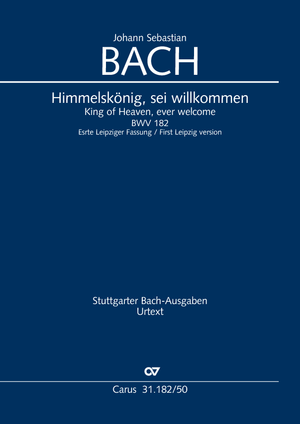
The cantata King of heaven, be most welcome BWV 182 holds a special place in Johann Sebastian Bach's biography. He had been employed as organist and chamber musician at the court of Weimar since 1708; on March 2 1714, he was appointed concert master of the court. With this new post came the responsibility of performing a new original cantata every four weeks at the church service of the Weimar court. Bach’s opening work was King of heaven, be most welcome. The cantata was first performed on Palm Sunday, March 25 1714, which also marked the annual celebration of the Feast of the Annunciation. The text of the cantata addresses both occasions, although the Palm Sunday event, with its focus on the Passion of Jesus, is the central theme.
The newly appointed concert master demonstrated his abilities in his debut composition of 1714: the eight movements contain a multitude of beautiful and rewarding challenges for choir and vocal soloists alike, and in addition there is the unusual attraction of a virtuoso solo part for the recorder.
Bach performed this cantata several times - always revising and amending it - both in Weimar and in Leipzig. This is the Weimar version of the cantata. Bach's performance material is bitonal: the recorder part is in B major (relative to the low chamber pitch), all other parts in G major (relative to choir pitch). Since the recorder part can only be played in B major on an F instrument, and B major would place the cantata in a very high register (at a1=440 Hz), this edition uses A major as the main key. For a performance at a1=440 Hz, a recorder tuned to a1=415 Hz can play its part in B major.
For the Leipzig version – where strings and woodwinds played at the same chamber pitch – Bach adapted the recorder part so that everyone could play in G major; this version is also available from Carus (31.182/50).
Explore


 Additional material
- Purchase additional material as a download product.
-
 Digital text (without sheet music) incl. printing licence, html file, singing text, english translationhtml file, singing text, english translation (Sample)1 Sonata 2 Coro King of Heaven, be most welcome,
let us now your Zion be,
Dwell in me!
You have made our hearts your kingdom,
King of Heaven, be most welcome.
3 Recitativo (Basso) Now behold, I am coming,
God's word has told you about me:
Always your will, my God,
I do gladly.
4 Aria (Basso) Loving passion,
that caused you, God's only son
down to come
from your throne in earthly fashion,
fervent loving,
...
-
Digital text (without sheet music) incl. printing licence, html file, singing text, originalhtml file, singing text, original (Sample)1 Sonata 2 Coro Himmelskönig, sei willkommen,
lass auch uns dein Zion sein!
Komm herein!
Du hast uns das Herz genommen.
3 Recitativo (Basso) Siehe, ich komme. Im Buch ist von mir geschrieben:
Deinen Willen, mein Gott, tu ich gerne.
4 Aria (Basso) Starkes Lieben,
das dich, großer Gottessohn,
von dem Thron
deiner Herrlichkeit getrieben,
Starkes Lieben,
dass du dich zum Heil der Welt
als ein Opfer fürgestellt,
dass du dich mit Blut verschrieben!
...
Purchase
Additional product information
-
Composer
Johann Sebastian Bach
| 1685-1750Johann Sebastian Bach is one of the most important composers of Western music history. He came from a widely ramified musical dynasty, which produced numerous musicians and organists in the Thuringian-Saxon area.
Bach vocal
Ever since Carus-Verlag was founded in 1972, publishing the music of Johann Sebastian Bach has been a special focus for us. In the 2017 Reformation anniversary year we completed the Bach vocal project. Bach's complete sacred vocal works are now available in modern Urtext editions, together with performance material. A complete edition of all the full scores is also available in a high quality box set. Personal details
-
Editor
Reinhold Kubik
| 1942-2024
-
Songwriter / Librettist
Salomon Franck
| 1659-1725
-
Continuo realization
Paul Horn
| 1922-2016Paul Horn war ein deutscher Kirchenmusiker, Organist, Komponist und Musikwissenschaftler. Er studierte Kirchenmusik und Orgel an der Evangelischen Kirchenmusikschule Esslingen am Neckar bei Hans-Arnold Metzger und Musikwissenschaft, Theologie und Geschichte an der Universität Tübingen. Seine berufliche Laufbahn begann als Kantor an der Evangelischen Michaelskirche in Stuttgart-Degerloch. 1954 wurde er Kantor an der Evangelischen Stadtkirche Ravensburg, eine Position, die er bis zu seiner Pensionierung innehatte. Als Musikwissenschaftler arbeitete Horn bis ins hohe Alter eng mit Carus zusammen. So stammen zahlreiche Carus-Klavierauszüge aus seiner Feder. Personal details
-
Translator
Vernon Wicker
| 1934-2024
Reviews on our website can only be submitted by customers with a registered user account. A check whether the rated products were actually purchased does not take place.
No feedback available for this product.
Frequent questions about this work
 There are no questions and answers available so far or you were unable to find an answer to your specific question about this work? Then click here and send your specific questions to our Customer Services!