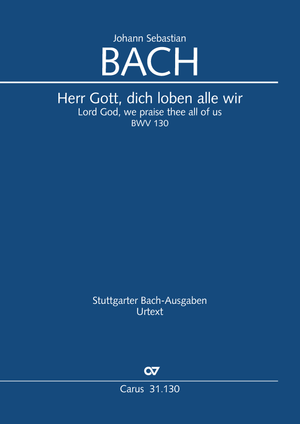
Lord God, we praise thee all of us
Cantata for St. Michael BWV 130 (BWV3 130.1), 1724
As in all cantatas for St. Michael the chorale cantata Lord God, we praise thee all of us BWV 130 from 1724 is a magnificent composition. Not only in the opening chorus and the final chorale do the three trumpets and timpani play a role, but the first aria “In hell the serpent, hot with hate" is even accompanied solely by trumpets, timpani and continuo. The second aria, “Thou, of cherubim the master", brings an unexpected contrast in which, besides the tenor and continuo, on a solo flute is heard. The original set of parts were separated from each other in the 19th century and today are scattered throughout the world. For the first time, some of the parts were taken into consideration in preparing this edition.
Explore
 View
View

 Additional material
- Purchase additional material as a download product.
-
 Digital text (without sheet music) incl. printing licence, html file, singing text, english translationhtml file, singing text, english translation (Sample)1 Coro
Lord God, we praise thee all of us
2 Recitativo (Alto)
with just and hearty thankfulness;
that thou hast there an angel band,
to serve and guard at thy command.Their splendor bright and lofty wisdom shows
3 Aria (Basso)
how God his grace on man bestows
to give us such a mighty legion
for our protection.
To honor him they never rest,
but go and come at his divine behest.
They serve, Lord Christ, at thy command
and guard thy feeble faithful band.
How sore we need them in our plight
to baffle Satan’s might!In hell the serpent, hot with hate,
forever plots our evil fate,
and hopes thy little band to sever....
-
Digital text (without sheet music) incl. printing licence, html file, singing text, originalhtml file, singing text, original (Sample)1 Coro
Herr Gott, dich loben alle wir
2 Recitativo (Alto)
und sollen billig danken dir
für dein Geschöpf der Engel schon,
die um dich schwebn um deinen Thron.Ihr heller Glanz und hohe Weisheit zeigt,
3 Aria (Basso)
wie Gott sich zu uns Menschen neigt,
der solche Helden, solche Waffen
vor uns geschaffen.
Sie ruhen ihm zu Ehren nicht;
ihr ganzer Fleiß ist nur dahin gericht',
dass sie, Herr Christe, um dich sein
und um dein armes Häufelein:
Wie nötig ist doch diese Wacht
bei Satans Grimm und Macht?Der alte Drache brennt vor Neid
und dichtet stets auf neues Leid,
dass er das kleine Häuflein trennet....
Purchase
Additional product information
-
Composer
Johann Sebastian Bach
| 1685-1750Johann Sebastian Bach is one of the most important composers of Western music history. He came from a widely ramified musical dynasty, which produced numerous musicians and organists in the Thuringian-Saxon area.
Bach vocal
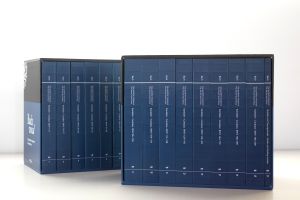
Ever since Carus-Verlag was founded in 1972, publishing the music of Johann Sebastian Bach has been a special focus for us. In the 2017 Reformation anniversary year we completed the Bach vocal project. Bach’s complete sacred vocal works are now available in modern “Urtext” editions, together with performance material. A complete edition of all the full scores is also available in a high quality box set.
Personal details
-
Editor
Uwe Wolf
| 1961As a musicologist, Dr. Uwe Wolf is particularly at home in the 17th and 18th centuries. The focus of his work ranges from the time of Monteverdi and Schütz to Bach and the generation of Bach's sons and pupils through to Viennese Classicism. He has been head of the editorial department at Carus-Verlag since October 2011. Prior to this, he worked in Bach research for over 20 years. Personal details
-
Continuo realization
Paul Horn
| 1922-2016Paul Horn war ein deutscher Kirchenmusiker, Organist, Komponist und Musikwissenschaftler. Er studierte Kirchenmusik und Orgel an der Evangelischen Kirchenmusikschule Esslingen am Neckar bei Hans-Arnold Metzger und Musikwissenschaft, Theologie und Geschichte an der Universität Tübingen. Seine berufliche Laufbahn begann als Kantor an der Evangelischen Michaelskirche in Stuttgart-Degerloch. 1954 wurde er Kantor an der Evangelischen Stadtkirche Ravensburg, eine Position, die er bis zu seiner Pensionierung innehatte. Als Musikwissenschaftler arbeitete Horn bis ins hohe Alter eng mit Carus zusammen. So stammen zahlreiche Carus-Klavierauszüge aus seiner Feder. Personal details
Reviews
Wunderbare Musik, die wie immer bei Bach einen geübten Chor und gute Solisten braucht.
Singende Kirche, 3/2016
Reviews on our website can only be submitted by customers with a registered user account. A check whether the rated products were actually purchased does not take place.
No feedback available for this product.
Frequent questions about this work
 There are no questions and answers available so far or you were unable to find an answer to your specific question about this work? Then click here and send your specific questions to our Customer Services!