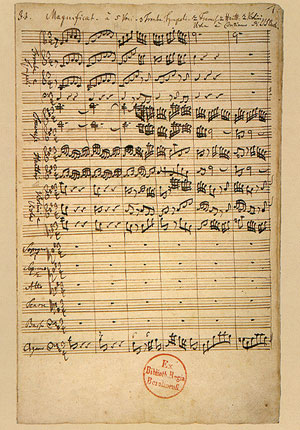
Bach composed particularly demanding and difficult works in his first year in Leipzig in 1723. These include the Magnificat, first written in E flat major for a Christmas performance and reworked about eight years later into the present D major version. This work requires an experienced chorus, as the parts are almost instrumentally conceived and rich in coloratura writing. The extremely agile vocal parts, with many large interval leaps, need to be thoroughly understood, and the position of each line within the dense web of other parts securely grasped. Examples of such tricky passages include the rapidly following entries at “Omnes generationes”, and the long coloratura sixteenth note passages at “Fecit potentiam”.
Note: The insert movements for the Magnificat are not included.
The underlying recording was made using a historical tuning. It sounds approximately a semitone lower than our modern piano tuning.
Simply practice. Anytime. Everywhere.
Whether at home on your tablet or PC or on the road on your smartphone: with carus music, the Choir Coach, you always have your choral works with you to practice! With the carus music choir app, you can listen to your score together with a first-class recording on any device and easily practice your own choir part with a coach. With carus music, your concert preparation is easy, efficient and fun to master!
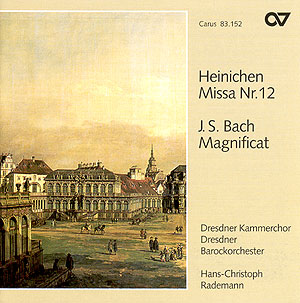
Performers: Monika Frimmer (soprano), Kerstin Klein (soprano), Kai Wessel (alto), Hermann Oswald (tenore), Andreas Scheibner (basso) – Dresdner Kammerchor, Dresdner Barockorchester – Hans-Christoph Rademann
Explore
 Listen
(12)
Listen
(12)
- Magnificat
- Et exsultavit
- Quia respexit
- Omnes generationes
- Quia fecit
- Et misericordia
- Fecit potentiam
- Deposuit potentes
- Esurientes
- Suscepit Israel
- Sicut locutus est
- Gloria patri
 Practise
-
 carus music, the Choir Coach
Üben mit carus music
carus music, the Choir Coach
Üben mit carus music
-
Practice aids
-
Practice aids voice part soprano
- Magnificat (Choir Coach, soprano 1)
- Magnificat (Choir Coach, Slow mode, soprano 1)
- Magnificat (Choir Coach, soprano 2)
- Magnificat (Choir Coach, Slow mode, soprano 2)
- Omnes generationes (Choir Coach, soprano 1)
- Omnes generationes (Choir Coach, Slow mode, soprano 1)
- Omnes generationes (Choir Coach, soprano 2)
- Omnes generationes (Choir Coach, Slow mode, soprano 2)
- Fecit potentiam (Choir Coach, soprano 1)
- Fecit potentiam (Choir Coach, Slow mode, soprano 1)
- Fecit potentiam (Choir Coach, soprano 2)
- Fecit potentiam (Choir Coach, Slow mode, soprano 2)
- Suscepit Israel (Choir Coach, soprano 1)
- Suscepit Israel (Choir Coach, Slow mode, soprano 1)
- Suscepit Israel (Choir Coach, soprano 2)
- Suscepit Israel (Choir Coach, Slow mode, soprano 2)
- Sicut locutus est (Choir Coach, soprano 1)
- Sicut locutus est (Choir Coach, Slow mode, soprano 1)
- Sicut locutus est (Choir Coach, soprano 2)
- Sicut locutus est (Choir Coach, Slow mode, soprano 2)
- Gloria patri (Choir Coach, soprano 1)
- Gloria patri (Choir Coach, Slow mode, soprano 1)
- Gloria patri (Choir Coach, soprano 2)
- Gloria patri (Choir Coach, Slow mode, soprano 2)
-
Practice aids voice part alto
- Magnificat (Choir Coach)
- Magnificat (Choir Coach, Slow mode)
- Omnes generationes (Choir Coach)
- Omnes generationes (Choir Coach, Slow mode)
- Fecit potentiam (Choir Coach)
- Fecit potentiam (Choir Coach, Slow mode)
- Suscepit Israel (Choir Coach)
- Suscepit Israel (Choir Coach, Slow mode)
- Sicut locutus est (Choir Coach)
- Sicut locutus est (Choir Coach, Slow mode)
- Gloria patri (Choir Coach)
- Gloria patri (Choir Coach, Slow mode)
-
Practice aids voice part tenore
- Magnificat (Choir Coach)
- Magnificat (Choir Coach, Slow mode)
- Omnes generationes (Choir Coach)
- Omnes generationes (Choir Coach, Slow mode)
- Fecit potentiam (Choir Coach)
- Fecit potentiam (Choir Coach, Slow mode)
- Sicut locutus est (Choir Coach)
- Sicut locutus est (Choir Coach, Slow mode)
- Gloria patri (Choir Coach)
- Gloria patri (Choir Coach, Slow mode)
-
Practice aids voice part basso
- Magnificat (Choir Coach)
- Magnificat (Choir Coach, Slow mode)
- Omnes generationes (Choir Coach)
- Omnes generationes (Choir Coach, Slow mode)
- Fecit potentiam (Choir Coach)
- Fecit potentiam (Choir Coach, Slow mode)
- Sicut locutus est (Choir Coach)
- Sicut locutus est (Choir Coach, Slow mode)
- Gloria patri (Choir Coach)
- Gloria patri (Choir Coach, Slow mode)
-
 Additional material
- Purchase additional material as a download product.
-
 Digital text (without sheet music) incl. printing licence, html file, singing text, german translationhtml file, singing text, german translation (Sample)
1. Magnificat (Coro SSATB) Hoch erhebt meine Seele den Herren.
2. Et exsultavit (Aria Soprano II) In Gott, meinem Heiland, jubelt mein Geist.
3. Quia respexit (Aria Soprano I) / 4. Omnes generationes (Coro) Er hat in Gnaden geschaut auf seine niedrige Magd,
Siehe, von nun an nennen mich selig alle Geschlechter.5. Quia fecit (Aria Basso) Großes hat der Gewaltige an mir getan,
dessen Name heilig ist.6. Et misericordia (Aria Alto, Tenore) Und sein Erbarmen währt von Geschlecht zu Geschlecht über die,
welche ihn fürchten.7. Fecit potentiam (Coro) Macht hat er geübt mit seinem Arm
und zerstreuet, die stolzen Herzens sind.8. Deposuit (Aria Tenore) Herrscher hat er vom Thron gestürzt,
...
-
Digital text (without sheet music) incl. printing licence, html file, singing text, originalhtml file, singing text, original (Sample)
1. Magnificat (Coro SSATB) Magnificat anima mea Dominum.
2. Et exsultavit (Aria Soprano II) Et exsultavit spiritus meus in Deo salutari meo
3. Quia respexit (Aria Soprano I) / 4. Omnes generationes (Coro) Quia respexit humilitatem ancillae suae,
ecce enim ex hoc beatam me dicent omnes generationes.5. Quia fecit (Aria Basso) Quia fecit mihi magna qui potens est,
et sanctum nomen eius.6. Et misericordia (Aria Alto, Tenore) Et misericordia a progenie in progenies
timentibus eum.7. Fecit potentiam (Coro) Fecit potentiam in bracchio suo,
dispersit superbos mente cordis sui.8. Deposuit (Aria Tenore) Deposuit potentes de sede
et exaltavit humiles....
-
Digital text (without sheet music) incl. printing licence, html file, Introductory text, frenchhtml file, Introductory text, french (Sample)Texte du livret du CD Carus 83.152
Katrin Bemmann
Traduction (abrégée) : Jean Paul MénièreDepuis le Vle siècle, le « Magnificat », chant de louange à Marie, qui vient d’apprendre qu’elle va être la mère du Christ, constitue dans la liturgie catholique le point culminant des Vêpres. Avec la Réforme, les Vêpres, et avec elle le Magnificat, ont été reprises dans la liturgie protestante.
Le Magnificat latin de Johann Sebastian Bach existe en deux versions. La première, en mi bémol majeur, fut écrite en 1723, l’année où Bach entra en fonction à Leipzig, et conçue pour les Vêpres de Noël. Conformément aux circonstances, cette version fut augmentée de quatre séquences de Noël et les flûtes à bec prenaient, en raison de leur caractère pastoral, la place des flûtes traversières. Quelques années plus tard, Bach entreprit une révision de l’œuvre. Il changea la tonalité en ré majeur, supprima les quatre pièces rajoutées et confia
...
-
Digital text (without sheet music) incl. printing licence, html file, Introductory text, englishhtml file, Introductory text, english (Sample)Text from the CD Carus 83.152
Katrin Bemmann
Translation (abridged): John CoombsThe “Magnificat” – the song of praise of the Virgin Mary on hearing that she is to become the mother of Christ – has formed the climactic point of the service of Vespers in the liturgy of the Catholic Church since the 6th century. Following the Reformation Vespers, including the Magnificat, retained a place in the Protestant liturgy.
Johann Sebastian Bach’s Latin Magnificat exists in two versions. The first, in E flat major, was written in 1723, the year when he took up his position in Leipzig, and was intended for use in the Christmas Vespers. In view of that intention four Christmas pieces were added to this version, and instead of flutes Bach used recorders, with their pastoral character. A few years later Bach revised the work. He transposed it to D major, removed the Christmas pieces, and replaced the recorders by flutes, whose
...
-
Digital text (without sheet music) incl. printing licence, html file, Introductory text, germanhtml file, Introductory text, german (Sample)Booklet-Text der CD Carus 83.152
Katrin Bemmann
Das „Magnificat“ – der Lobgesang Marias, nachdem sie erfahren hat, dass sie die Mutter Christi wird – bildet seit dem 6. Jahrhundert in der Liturgie der katholischen Kirche den Höhepunkt der Vesper. Musikalisch entwickelte sich aus der einstimmigen Psalmodie nach und nach eine vielfältige Palette von Formen, sei es als Lied, mehrstimmige Motette oder kantatenähnliche Vertonung mit Instrumentalbegleitung. Mit der Reformation wurde die Vesper und damit auch das Magnificat in die protestantische Liturgie übernommen.
Von Johann Sebastian Bachs lateinischem Magnificat existieren zwei Fassungen. Die erste in Es-Dur entstand in Bachs Leipziger Antrittsjahr 1723 und war für die Weihnachtsvesper bestimmt. Dem Anlass entsprechend war diese Fassung um vier weihnachtliche Einlagesätze erweitert, und statt Traversflöten fanden Blockflöten mit ihrem pastoralen Charakter Verwendung. Einige Jahre später nahm Bach eine Überarbeitung vor. Er änderte die Tonart in D-Dur, strich die vier zusätzlichen Stücke und übertrug den nunmehr besetzten Traversflöten größere Aufgaben.
...
Purchase
Additional product information
Contents


-
Composer
Johann Sebastian Bach
| 1685-1750Johann Sebastian Bach is one of the most important composers of Western music history. He came from a widely ramified musical dynasty, which produced numerous musicians and organists in the Thuringian-Saxon area.
Bach vocal
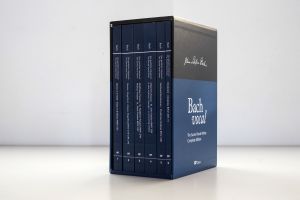
Ever since Carus-Verlag was founded in 1972, publishing the music of Johann Sebastian Bach has been a special focus for us. In the 2017 Reformation anniversary year we completed the Bach vocal project. Bach’s complete sacred vocal works are now available in modern “Urtext” editions, together with performance material. A complete edition of all the full scores is also available in a high quality box set.
Personal details
-
Continuo realization
Paul Horn
| 1922-2016Paul Horn war ein deutscher Kirchenmusiker, Organist, Komponist und Musikwissenschaftler. Er studierte Kirchenmusik und Orgel an der Evangelischen Kirchenmusikschule Esslingen am Neckar bei Hans-Arnold Metzger und Musikwissenschaft, Theologie und Geschichte an der Universität Tübingen. Seine berufliche Laufbahn begann als Kantor an der Evangelischen Michaelskirche in Stuttgart-Degerloch. 1954 wurde er Kantor an der Evangelischen Stadtkirche Ravensburg, eine Position, die er bis zu seiner Pensionierung innehatte. Als Musikwissenschaftler arbeitete Horn bis ins hohe Alter eng mit Carus zusammen. So stammen zahlreiche Carus-Klavierauszüge aus seiner Feder. Personal details
-
Translator
Jean Lunn
Reviews on our website can only be submitted by customers with a registered user account. A check whether the rated products were actually purchased does not take place.
No feedback available for this product.
Frequent questions about this work
 There are no questions and answers available so far or you were unable to find an answer to your specific question about this work? Then click here and send your specific questions to our Customer Services!