Song of the Fates
Arrangement for chamber orchestra (arr. U. Stäuble) op. 89, 1882
Goethe’s “Lied der Parzen” tells us “So sangen die Parzen” (Thus sang the Parcae). These were the goddesses of destiny in Greek and Roman mythology. The excerpt from the play Iphigenie auf Tauris inspired Johannes Brahms to create his Gesang der Parzen (Song of the Fates) op. 89, a gripping and volcanic work that describes the struggle to overcome the mythical curse through the purity of righteous, noble action and the power of hope.
This arrangement for chamber orchestra reduces the wind section to a quintet of solo flute, oboe, clarinet, bassoon and horn. The string section can also be performed by solo instruments, although doubling of parts is also possible. In this way, the symphonic character and the differentiation of the instrumental timbres is retained even when performed by small ensembles. The choral part is identical to the original version, so that both the original choral and vocal scores can be used.
This work can be combined in concert with chamber versions of Brahms’ A German Requiem (Carus 27.055/50) or Schicksalslied (Carus 10.399/50), for example, which are available with the same instrumentation.
The original version is available under Carus 10.400/00.
| Original version | Arrangement for Chamber Orchestra |
| Coro SAATBB, 2 Fl (Pic), 2 Ob, 2 Clt, 2 Fg, Cfg, 4 Cor, 2 Tr, 3 Trb, Tb, Timp, 2 Vl, Va, Vc, Cb | Coro SAATBB, Fl (Pic), Ob, Clt, Fg, Cor, Timp, 2 Vl, Va, Vc, Cb |



-
Composer
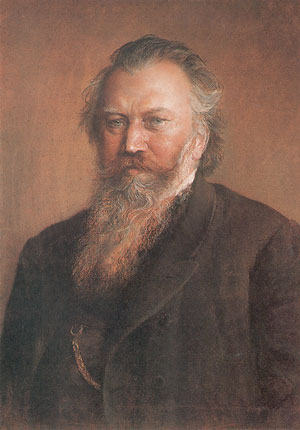
Johannes Brahms
| 1833-1897Johannes Brahms' study of musical tradition was of crucial importance to his output: he combined church modes, canonic technique, Baroque style and diction, Bach's counterpoint and Beethoven's thematic-motivic work with the harmonic and expressive achievements of Romanticism to form his own distinctive style. In this respect his choral songs and vocal quartets (e.g. the “Liebeslieder Waltzes” and “New Liebeslieder Waltzes”), often to folk song texts, in which a musical microcosm unfolds, are examplary. His “Deutsches Requiem”, available from Carus in several different versions, constitutes one of the most fascinating confessions of faith in the history of music. Personal details
-
Songwriter / Librettist
Johann Wolfgang von Goethe
| 1749-1832
-
Arranger
Urs Stäuble
| 1951Urs Stäuble studied at the Conservatory of the Music Academy in Basel (organ with Eduard Müller, piano with Klaus Linder) and at the University of Music in Vienna (organ with Michael Radulescu, orchestral conducting with Karl Österreicher, choral conducting with Günther Theuring). In addition to teaching at the Basel Music Academy (1980–2016), he worked as an organist and choir and orchestra conductor in various European countries and Australia. Personal details
Reviews
Ulrich Barthel, Chorzeit, 01/2026
Reviews on our website can only be submitted by customers with a registered user account. A check whether the rated products were actually purchased does not take place.
Frequent questions about this work
Can the string parts of the original version (Carus 10.400/00) also be used for the arrangement?
 There are no questions and answers available so far or you were unable to find an answer to your specific question about this work? Then click here and send your specific questions to our Customer Services!