Stabat Mater
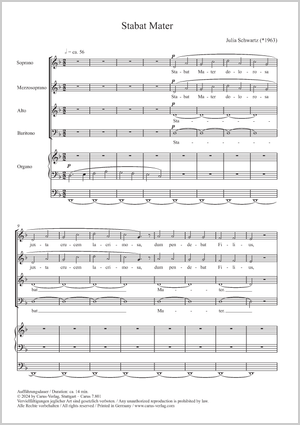
The heavily symbolic language of the hymn Stabat mater, which probably dates back to the 13th century, describes Mary’s suffering at her son’s crucifixion. The text has inspired composers throughout the ages. The scoring of this setting by Julia Schwartz already gives an indication of her musical approach. Soprano, mezzo-soprano, alto and baritone are accompanied by an organ part that is frequently restricted to resting notes and motivic interjections. Short and slowly evolving melodic lines on the organ form a dialog with the choir. Unostentatious and largely homophonic, the choral writing is both transparent and emotionally powerful. Two voice groups are coupled in the short polyphonic sections to form a kind of colloquy. The music gains in intensity, increasingly disturbing the initially rather meditative and restrained atmosphere. The organ accompaniment also becomes denser, supporting the choral dynamics to slowly reveal Mary’s unfathomable pain.
- Transparent and moving setting of Stabat Mater
- Unusual choral scoring (SMsABar)
- Attractive and easy to read
- Sensitive and effective organ accompaniment



-
Composer
Julia Schwartz
| 1963Julia Schwartz studied singing at Oberlin College Conservatory in Ohio, USA. From 1985 she continued her training in singing and music theory in Munich and Zurich and between 2014 and 2021 she completed further training in choral and orchestral conducting. She composes in practically all genres, is an active singer of mainly contemporary music and chansons and gives private singing lessons. She lives in Frauenfeld, in eastern Switzerland.
We asked the composer 6 questions, read them here in our blog: https://blog.carus-verlag.com/en/personalities/6-questions-for-julia-schwartz/
Personal details
Reviews
Singende Kirche, 12/2024
Reviews on our website can only be submitted by customers with a registered user account. A check whether the rated products were actually purchased does not take place.
Frequent questions about this work
 There are no questions and answers available so far or you were unable to find an answer to your specific question about this work? Then click here and send your specific questions to our Customer Services!