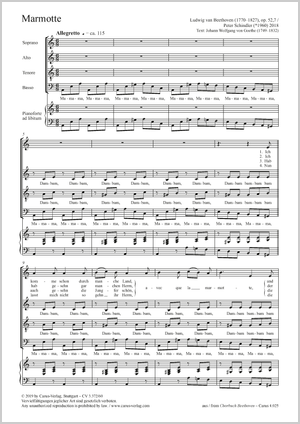
Der Text des Marmotte-Liedes, dessen erste Strophe Beethoven in einem seiner Acht Lieder op. 52 vertonte, stammt aus dem Theaterstück
„Das Jahrmarktsfest zu Plundersweilern“ (1773/78) von Johann Wolfgang von Goethe und wird dort von einem Bettelknaben vorgetragen.
Im 18. Jahrhundert sah man auf Jahrmärkten häufig arme Wanderkinder aus Savoyen und der Schweiz, die als Straßenmusiker auftraten und
Kunststücke mit dressierten Murmeltieren aufführten, um etwas Geld zu verdienen.
Explore


 Listen
(1)
Listen
(1)
- Marmotte
Purchase
Additional product information
-
Composer
Ludwig van Beethoven
| 1770-1827Ludwig van Beethoven was without doubt one of the most influential composers in the history of music. His works formed the culmination of many genres – particularly instrumental – of Viennese classicism, and laid the foundation for the following decades. But Beethoven’s vocal works set standards too: the late Missa Solemnis is one of the most impressive choral works of its time; but his earlier Mass in C also opens up new worlds of expression for the liturgical text, and set the benchmark for the further development in the composition of the mass. And with the final chorus of the Ninth Symphony, the setting of Schiller’s Ode to Joy, Beethoven created one of the most frequently-performed and best known choral pieces of all, writing a timeless musical memorial to himself. Personal details
-
Editor
Jan Schumacher
| 1980Professor Jan Schumacher is Director of Music at Goethe University in Frankfurt am Main and conductor of Camerata Musica Limburg. He has been teaching choral conducting to beginners and advanced students for over twenty years, regularly leads international conducting courses and master classes and is active worldwide as a guest conductor, adjudicator and seminar leader. He is Chairman of the Choral Advisory Board of the German Music Council and Vice President of the International Federation for Choral Music (IFCM). As an author and editor he has been associated with Carus-Verlag for many years. Personal details
-
Songwriter / Librettist
Johann Wolfgang Goethe
| -1832Johann Wolfgang von Goethe is today a dazzling figure in world literature. He was born in Frankfurt am Main and initially studied law, but then followed his inclination towards poetry. With the drama Götz von Berlechingen and the epistolary novel The Sorrows of Young Werther, he made important contributions to the literary movement of Sturm und Drang.
From 1775 onwards, Goethe was employed at the court of Duke Carl August in Weimar. In addition to his work at court as a minister and director of the Weimar Court Theatre, he wrote his major works here, including the drama Faust, other novels and many poems, which are still a source of inspiration for musical adaptations today. His poems were a source of inspiration for composers, especially in the 19th century, such as Franz Schubert. Schubert alone set 52 of Goethe's works to music, the best known of which are probably the songs Gretchen am Spinnrade and Erlkönig. Goethe also became acquainted with several composers of the time. He was particularly enthusiastic about the young Felix Mendelssohn-Bartholdy, who also set Goethe's lines to music in the ballad Die erste Walpurgisnacht (The First Walpurgis Night). Personal details
-
Arranger
Peter Schindler
| 1960Composer, pianist and organist Peter Schindler writes and performs music for ballets and theatrical performances, films and dramatic recordings, instrumental and choral arrangements, chansons and sacred works. He is particularly passionate about his compositions for children and young adults, which has come to comprise hundreds of humourous children’s songs (Kinderhits mit Witz). His full-length musicals include Geisterstunde auf Schloss Eulenstein (Witching Hour at Eulenstein Castle), Max und die Käsebande (Max and the Cheese Gang), König Keks (Cookie King), Zirkus Furioso (Circus Allegro), and SCHOCKORANGE. These musicals are some of the most frequently played pieces of their kind by children’s and youth choirs in German-speaking theaters and schools. With his first English musical Circus Allegro, Peter’s hugely sucessful work for all kids under 100 is now also accessible to audiences around the world.
For further information visit: http://peter-schindler.de/
We asked the composer 6 questions, read them here in our blog: https://blog.carus-verlag.com/en/personalities/5-questions-for-peter-schindler/
Personal details
Reviews on our website can only be submitted by customers with a registered user account. A check whether the rated products were actually purchased does not take place.
No feedback available for this product.
Frequent questions about this work
 There are no questions and answers available so far or you were unable to find an answer to your specific question about this work? Then click here and send your specific questions to our Customer Services!