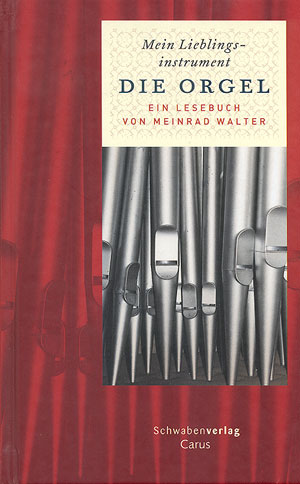
Mein Lieblingsinstrument - Die Orgel
Ein Lesebuch von Meinrad Walter
-
Author (contribution)
Christian Friedrich Daniel Schubart
| 1739-1791
-
Author (contribution)
Johann Wolfgang von Goethe
| 1749-1832
-
Author (contribution)
Friedrich Rückert
| 1788-1866Friedrich Rückert, born 1788 in Schweinfurt, died 1866 near Coburg. Poet and translator. Professor of oriental philology in Erlangen. Personal details
-
Author (contribution)
Ludwig Uhland
| 1787-1862
-
Author (contribution)
Clemens Brentano
| 1778-1842Auch Clemens von Brentano Personal details
-
Author (contribution)
Johann Gottfried Herder
| 1744-1803
-
Author (contribution)
Angelus Silesius
| 1624-1677auch Johannes Scheffler Personal details
-
Author (contribution)
Petr Eben
| 1929-2007
-
Author (contribution)
Theodor Fontane
| 1819-1898
-
Author (contribution)
Friedrich Hebbel
| 1813-1863Christian Friedrich Hebbel was a German playwright, poet and storyteller. Hebbel's work is classified as Vormär, and later also as Realism. His best-known works include the drama Die Nibelungen and the tragedies Agnes Bernauer and Maria Magdalena. Personal details
-
Author (contribution)
Christian Morgenstern
| 1871-1914Christian Morgenstern was born in Munich in 1871 and was a poet who became particularly well known for his comic poetry. He suffered from serious health problems throughout his life. Nevertheless, he travelled extensively and worked not only as a poet, but also as a writer and translator. Many of his works were published by his wife Margareta Gosebruch von Liechtenstern after his early death in 1914. Numerous settings of his poems have been composed. Personal details
-
Author (contribution)
Stefan Zweig
| 1881-1942
-
Author (contribution)
Arnold Schönberg
| 1874-1951Arnold Schoenberg was an Austrian composer, music theorist and painter who is considered one of the most influential composers of the 20th century.
Schoenberg grew up in Vienna and took violin lessons from the age of nine. He began experimenting with composition at an early age. He initially worked as a bank clerk, but decided to pursue a career as a composer at the turn of the century. Friede auf Erden (Peace on Earth), Op. 13, one of the few choral works of the Second Viennese School, is considered Arnold Schoenberg's last tonal composition before he developed atonality between 1906 and 1909. Around 1920, he formulated the twelve-tone technique, which had a decisive influence on 20th-century music. As a central figure of the Second Viennese School and teacher of important composers such as Alban Berg and Anton Webern, Schoenberg's innovations influenced the development of serial and electronic music. In 1933, Schoenberg emigrated to the United States and became an American citizen in 1941. He died on 13 July 1951 in Los Angeles.
Personal details
-
Author (contribution)
Ign. H. von Wessenberg
-
Author (contribution)
Ludwig Tieck
-
Author (contribution)
Johann Sebastian Bach
| 1685-1750Johann Sebastian Bach is one of the most important composers of Western music history. He came from a widely ramified musical dynasty, which produced numerous musicians and organists in the Thuringian-Saxon area.
Bach vocal
Ever since Carus-Verlag was founded in 1972, publishing the music of Johann Sebastian Bach has been a special focus for us. In the 2017 Reformation anniversary year we completed the Bach vocal project. Bach’s complete sacred vocal works are now available in modern “Urtext” editions, together with performance material. A complete edition of all the full scores is also available in a high quality box set.
Personal details
-
Author (contribution)
Felix Mendelssohn Bartholdy
| 1809-1847Felix Mendelssohn Bartholdy (1809–1847) is regarded as one of the most important composers of the Romantic period. His compositions combine the formal clarity of the Viennese Classical period with the heightened expressiveness of the 19th century. His engagement with the music of Johann Sebastian Bach was particularly influential; he played a key role in its rediscovery through the performance of the St Matthew Passion in 1829.
Among his best-known vocal works are his two oratorios, Paulus and Elias, as well as his chorale cantata Verleih uns Frieden gnädiglich. Furthermore, Mendelssohn worked as a conductor, pianist and music teacher, and made a significant contribution to the professionalisation of the concert scene and to the development of the Leipzig Conservatoire. His work occupies a central position in 19th-century music history and combines a sense of tradition with Romantic sound aesthetics.
Personal details
-
Author (contribution)
Wolfgang Amadeus Mozart
| 1756-1791As the son of the deputy Kapellmeister to the Salzburg Prince-Archbishop, Mozart was constantly surrounded by church music in his youth. On his travels Mozart became familiar with Italian church music, and later in Vienna he studied the works of Bach and Handel. After moving to Vienna he was faced with the new challenges of composing opera and piano concertos, and significantly the “C Minor Mass” KV 427, the greatest sacred work of the first Vienna years, remained unfinished. The last period of his life again shows a change of direction to church music: Mozart successfully applied to succeed the terminally ill Leopold Hoffmann as Kapellmeister at St Stephen's Cathedral, but he was unable to take up the position as he died before Hoffmann. A gem such as the “Ave verum” KV 618 and the incomplete Requiem KV 626 give us an idea of what Mozart might have achieved as a composer of sacred music if he had taken up this important position. Personal details
-
Author (contribution)
Johann Mattheson
| 1681-1764
-
Author (contribution)
Albert Schweitzer
| 1875-1965
-
Author (contribution)
Maarten t'Hart
| 1944
-
Author (contribution)
Martin Vogt
| 1781-1854
-
Author (contribution)
Charles-Marie Widor
| 1844-1937
-
Author (contribution)
Louis Vierne
| 1870-1937Louis Vierne, who was from birth practically blind with cataracts, received his first piano instruction at the early age of six. His first moving encounter with the sound of a church organ also dates from this time. From October 1880 he studied with the blind piano teacher, Louis Specht, who taught at the Institution Nationale des Jeunes Aveugles (National Institute for Young Blind People) in Paris. When Vierne first heard César Franck (later his teacher at the Conservatoire for a short time) at the organ of Sainte-Clotilde, it was a profound experience for him: “I was left speechless and went into a kind of ecstasy.” Following the death of César Franck, it was Charles-Marie Widor who continued to further his development as an organist. In 1892 he appointed him as his assistant at the great Cavaillé-Coll organ in Saint-Sulpice. Although he was passed over several times when applying for positions as organist, in May 1900 he was unanimously elected by a prominent jury as organist of Notre Dame Cathedral, a position he held until the day he died. Travelling was a burden to him, but despite this in the 1920s he went on concert tours of Europe, Canada and the USA, where he was acclaimed as a composer and organist. He used these trips to collect contributions for the maintenance and rebuilding of his organ at Notre Dame. On 2 June 1937 Vierne presented an organ concert in Notre Dame together with Maurice Duruflé. As he was about to begin an improvisation he suffered a heart attack from which he died soon after. The funeral service was held in Notre Dame Cathedral on 5 June - his organ remained silent. // Complete Organ Works, see Carus 18.150 Personal details
-
Author (contribution)
Olivier Messiaen
| 1908-1992
-
Author (contribution)
Daniel Gottlob Türk
| 1750-1813
-
Author (contribution)
Harald Schmidt
| 1957
-
Author (contribution)
Jean Guillou
| 1930
-
Author (contribution)
Colombra
| 1922
-
Author (contribution)
Hans Magnus Enzensberger
| 1929
-
Author (contribution)
Hermann Hesse
| 1877-1962
-
Author (contribution)
Reinold Amann
| 1954
-
Author (contribution)
Georg Britting
| 1891-1964
-
Author (contribution)
Georg Trakl
| 1887-1914
-
Author (contribution)
Alex Grendelmeier
| 1944
-
Author (contribution)
Jakob Brandl
-
Author (contribution)
Johann Nikolaus Forkel
| 1749-1818
-
Author (contribution)
Dom Bedos
| 1709-1779
-
Author (contribution)
Ernst Lissauer
| 1882-1937
-
Author (contribution)
Wulf Kirsten
| 1934
-
Author (contribution)
Oskar Walcker
| 1869-1948
-
Author (contribution)
M. Christoph Frick
| 1577-1640
-
Author (contribution)
Friedrich Jakob
| 1932
-
Author (contribution)
Hans Haselböck
| 1928-2021Born 1928. 1963-1996 Teaching at the Vienna University of Music, 1963-1987 Head of the Department of Church Music at the Vienna University of Music, 1972 Appointment as Professor of Organ and Improvisation. Personal details
-
Author (contribution)
Hans Maier
| 1931
-
Author (contribution)
Karl Straube
| 1873-1950
-
Author (contribution)
Jacob Adlung
| 1699-1762
-
Author (contribution)
Arnolt Schlick
| 1455-1525
-
Author (contribution)
Reiner Kunze
| 1933
-
Author (contribution)
Johannes Gillhoff
| 1861-1930
-
Author (contribution)
Heinrich Wismeyer
| 1898-1985
-
Author (contribution)
Hermann Klein
| 1805-1889
-
Author (contribution)
Hugo Hartung
| 1902-1972
-
Author (contribution)
Peter Rosegger
| 1843-1918
-
Author (contribution)
Franciscus Nagler
| 1873-1957
-
Author (contribution)
Thomas Mann
| 1875-1912
-
Author (contribution)
Karl May
| 1842-1912
-
Author (contribution)
Joris-Karl Huysmans
| 1848-1907
-
Author (contribution)
Carl Zuckmayer
| 1896-1977
-
Author (contribution)
Robert Schneider
| 1961
-
Author (contribution)
Andreas Nohr
| 1952
-
Author (contribution)
Jan Lurvink
| 1965
-
Author (contribution)
Gerard Bunk
| 1888-1958
-
Author (contribution)
Otto Wangemann
| 1848-1914
-
Author (contribution)
H. W. Schonnefeld
-
Author (contribution)
Charles Burney
| 1726-1814
-
Author (contribution)
Günther Anders
| 1902-1992
-
Author (contribution)
Jean Francaix
| 1912-1997
-
Author (contribution)
Gustave Flaubert
| 1821-1880
-
Author (contribution)
Gerold Späth
| 1939
-
Author (contribution)
Athanasius Kircher
| 1602-1680
-
Author (contribution)
Hans Heinrich Eggebrecht
| 1919-1999
-
Author (contribution)
Emile Michel Cioran
| 1911-1995
-
Author (contribution)
Fritz Usinger
| 1895-1982
-
Author (contribution)
Michael Praetorius
| -1621Michael Praetorius (Schultheis) was born around 1571 in Creuzburg/Werra. His father Michael Schultheis had been a teacher alongside Johann Walter at the Latin school in Werra when he was young, and later studied theology with Martin Luther and Philipp Melanchton in Wittenberg. In the times of unrest following Luther’s death, he – as an orthodox Lutheran – was forced to change his place of residence several times; from 1569 to 1573, he was a pastor in Creuzburg. Praetorius initially also studied theology under the aegis of his brother Andreas, who held a professorship in Frankfurt/Oder. After the death of his brother in 1586, he accepted an organist’s post in order to secure his livelihood. In 1589 we find him as a student at the University of Helmstedt. In 1593, finally, he entered the service of Duke Heinrich Julius in nearby Wolfenbüttel, serving as court organist from 1594, and as court kapellmeister from 1604. The duke’s death in 1613 largely terminated Praetorius’s work at the court and in Wolfenbüttel. In the same year, Praetorius was “lent” to Dresden, where he remained until 1616. He was responsible for numerous “Festmusiken” (festive music events), some of which he organized together with Heinrich Schütz (who, from 1614 onwards, had likewise initially been “lent” to Dresden from Kassel). From 1616, Praetorius led the life of an itinerant organ expert, ensemble (re)organizer and organizer of musical festivities at numerous courts in North and Central Germany. In 1619, already marked by illness, he returned to settle in Wolfenbüttel, where he died on 15 February 1621. Personal details
-
Author (contribution)
Johann Joachim Quantz
| 1697-1773
-
Author (contribution)
Max Reger
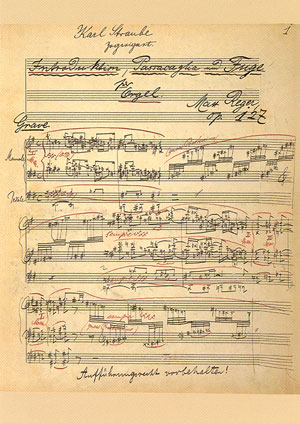
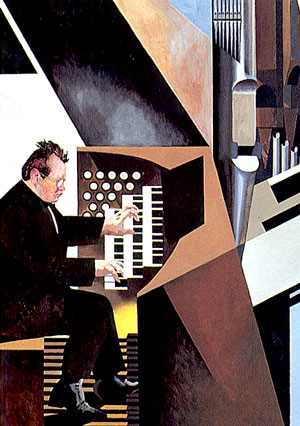
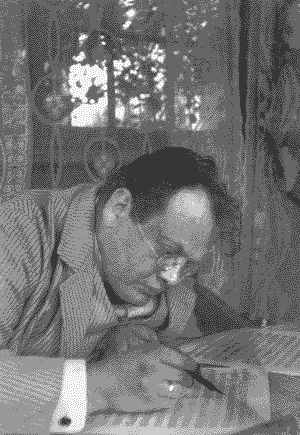
| 1873-1916Born in Brand, Bavaria, in 1873, Reger studied music in Munich and Wiesbaden with Hugo Riemann. From 1905 on he worked at the Academy in Munich as a teacher for organ and composition. He moved in 1907 to Leipzig to become the music director of the university until 1908 and professor of composition at the conservatory until his early death in 1916. Personal details
-
Author (contribution)
Robert Schumann
| 1810-1856Robert Schumann is still primarily known as a composer of piano and lieder and as a symphonic composer. In his later creative years, however, he saw the composition of choral music as an important focus of his work. Even today, it is important to discover a largely unknown Schumann, whose choral music masterfully combines popular appeal and artistic ambition. Carus offers Schumann's complete works for mixed choir and for female choir a cappella and with piano. They demonstrate his love of experimentation, his sensitivity in the selection and musical realisation of the texts and, last but not least, his independent choral style, which places particular emphasis on refined details in the composition. Personal details
-
Author (contribution)
Hector Berlioz
| 1803-1869
-
Author (contribution)
Andreas Werckmeister
| 1645-1706
-
Author (contribution)
Helmut Bornefeld
| 1906-1990Helmut Bornefeld wurde am 14. Dezember 1906 in Stuttgart-Untertürkheim geboren. Er studierte Komposition, Klavier und Kirchenmusik an der Musikhochschule in Stuttgart. Er war von 1937 bis 1971, mit einer sechsjährigen Unterbrechung durch Kriegsdienst, Kantor und Organist an der Pauluskirche in Heidenheim. 1951 übernahm er dort die Stelle als Kirchenmusikdirektor. Zusammen mit Siegfried Reda organisierte er 1946-1960 die „Heidenheimer Arbeitstage für Neue Kirchenmusik“. 1976 wurde er zum Professor ernannt. Helmut Bornefeld verstarb am 11. Februar 1990 in Heidenheim. Personal details
-
Author (contribution)
Anonymus
unbekannter Komponist Personal details
-
Author (contribution)
Martin Luther
| 1483-1546
-
Author (contribution)
Wolfgang Bretschneider
| 1941-2021deutscher Theologe, Organist und Hochschullehrer für Musik- und Liturgiewissenschaft an den Musikhochschulen Düsseldorf und Köln, Präsident des ACV Deutschland Personal details
-
Author (contribution)
Friedrich Spee von Langenfeld
| 1591-1635auch Spee, Friedrich Personal details
-
Editor
Meinrad Walter
| 1959Prof. Dr. Meinrad Walter ist ein ausgewiesener Kenner im interdisziplinären Gespräch zwischen Musik und Theologie. Er promovierte über Johann Sebastian Bachs geistliche Vokalmusik und war anschließend in Wissenschaft, Journalismus, Musikmanagement und Verlagswesen tätig. Von 2002 bis 2025 war er Referent und stellv. Leiter im Amt für Kirchenmusik der Erzdiözese Freiburg. Hier war er u.a. zuständig für die Freiburger Notenausgaben im Carus-Verlag, wo auch seine Einführung in J. S. Bachs Johannes-Passion erschienen ist. Seit 2008 lehrt er Musikwissenschaft, Theologie und Liturgik an der Hochschule für Musik Freiburg, die ihn 2012 zum Honorarprofessor ernannt hat. Zahlreiche Publikationen, Workshops und Radiosendungen zu Kirchenmusik, Hymnologie und Musikvermittlung. Personal details
Reviews
Meinrad Walter: Mein Lieblingsinstrument – Die Orgel
Rundum zu empfehlen ist diese Anthologie, sei es für Organisten, die während der fünften Trauung am Samstag eine Gemütserfrischung brauchen, sei es für Orgelfreunde, denen man ein reizvolles Geschenk machen möchte.Martin Weyer, Musik und Kirche, 4/04 Ein wirklich köstliches Buch, das sich auch bestens als kleines Mitbringsel und Geschenk eignet!
Walter Sengstschmid, Singende Kirche, 3/2004 ... Diese und über 100 weitere kleinere und größere Geschichten, Anekdoten, Quellen und Meinungen über und um die Orgel, das Orgelspiel und den Organisten bietet dieses kleine Büchlein - eine interessante, unterhaltsame und kurzweilige Lektüre für unter die Bettdecke oder an die Orgelbank.
Württembergische Blätter für Kirchenmusik, 6/2004
Reviews on our website can only be submitted by customers with a registered user account. A check whether the rated products were actually purchased does not take place.
Frequent questions about this work
 There are no questions and answers available so far or you were unable to find an answer to your specific question about this work? Then click here and send your specific questions to our Customer Services!