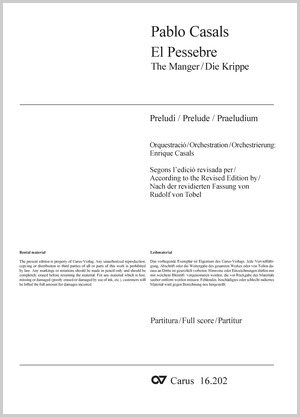
The Manger
Oratorio 1943-45/60
Pablo Casals is considered one of the greatest cellists of all times, but he also worked as a conductor and composer. His Christmas oratorio "El Pessebre" (text by the Catalan poet Joan Alavedra) is written in a moderately modern musical style and is essentially characterized by songlike elements throughout. It was composed under the impression of the Spanish Civil War and the Second World War and is a musical memorial to peace and humanity.
The oratorio is available in three versions:
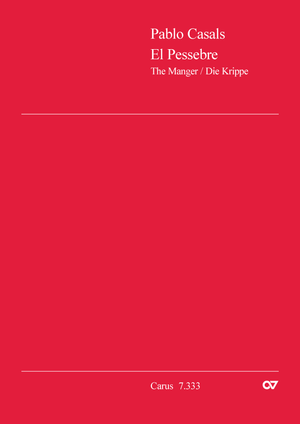
- The original version in the orchestration by Enrique Casals (Carus 7.333/00)
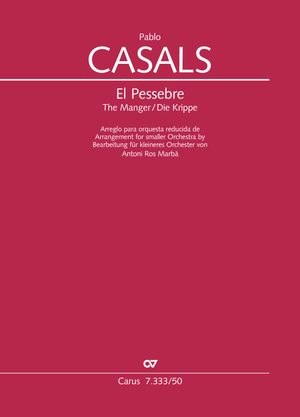
- An arrangement for smaller orchestra by Antoni Ros Marbà based on the original version (Carus 7.333/50), with reduction proposal from 120 to 90 min
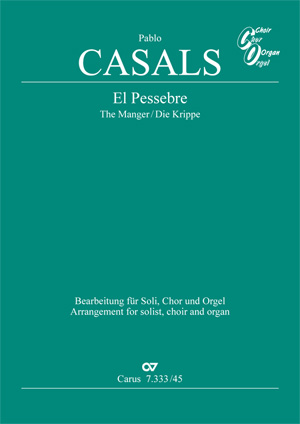
- A version for soli, choir and organ by Klaus Rothaupt (Carus 7.333/45)
Vocal scores and choral scores are compatible with all versions.



-
Composer
Pablo Casals
| 1876-1973Pablo Casals was a world-famous cellist, composer and conductor.
Born on December 29, 1876 in El Vendrell (Catalonia), Casals received his first musical training from his father, who was himself an organist. He received his first cello lessons at the age of eleven and quickly developed into an outstanding cellist. He completed his studies at the Madrid Conservatory.
In 1899, he began his international career in Paris as the soloist in a performance of É. Lalo's cello concerto. Many other concerts and tours followed, including a performance for Queen Victoria. He founded a piano trio with Alfred Cortot and Jacques Thibaud, which recorded works by Beethoven, Schumann and Schubert with great success. He was also active as a conductor and founded the Orquesta Pau Casals in Barcelona in 1919. Due to the Spanish Civil War, he went into exile in France in 1936 and later emigrated to Puerto Rico, where he lived and worked until his death on October 22, 1973.
Throughout his life Casals campaigned for peace, democracy and freedom. This can also be seen in his musical works such as the oratorio El Pessebre (The Crib), which was written under the influence of the Spanish Civil War and the Second World War. He also wrote smaller works for orchestra, songs and chamber music. Colleagues such as G. Fauré and A. Schönberg dedicated compositions to him.
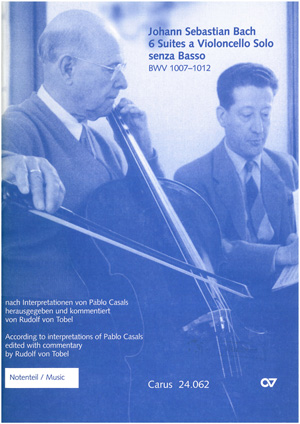
Pablo Casals is considered the most important cellist of his time, revolutionized playing technique and gave numerous master classes. He was the first to bring J.S. Bach's Six Suites for Violoncello solo, which are so popular today, to the great concert halls of the 20th century.
Personal details
-
Editor
Rudolf von Tobel
| 1903-1995
-
Songwriter / Librettist
Joan Alavedra
-
Translator
Helga W. Pfeiffer
-
Translator
Marta Casals Istomin
Reviews
Casals
Casals, Pablo: El Pessebre I Die Krippe
Ein zwei Stunden dauerndes Weihnachtsoratorium ist erschienen, 1962 erstmals aufgelegt, die deutsche Fassung stammt von 1970, hier liegt die Chorpartitur vor, eine Würdigung des ganzen Werkes wird an anderer Stelle geschehen. Die Aufgaben für den Chor sind vielgestaltig: Anfangs singen die Männer unisono kurze Cantilenen, der Frauenchor betritt in Abschnitt VI „Der Stern” erstmals die „Bühne”, dreistimmig, die Männer greifen das von den Frauen Gesungene auf. Im Folgenden wird klar, dass man für dieses Werk einen großen Chor zur Verfügung haben sollte: Beide Chorgruppen singen vierstimmig, in der Regel homophon, in volkstümlicher Klangwelt. Die Weisen kommen zu dritt, deshalb singen alle Frauen eine Stimme, imitatorisch das von den Herren Angestimmte aufgreifend, der erste „richtige” Chorsatz! Gegen Ende vor allem vierstimmige choraliter angelegte Aufgaben, die Sopranistinnen sollten unangestrengt über b2 verfügen, bei den Bässen wünscht sich der Komponist Kontra-B! Für die Orientierung ist sehr nützlich, dass die Chorpartitur einen den chorischen Aufgaben entsprechend abgespeckten Klavierauszug enthält. Der Verlag hat den Grundstock für eine erfolgreiche Einstudierung gelegt, nun sind die Verantwortlichen in den Chören gefragt, ob sie sich an dieses Werk wagen, obwohl der Chor hier keine zentrale Rolle inne hat.
Reinhard Krämer
Quelle: Württembergische Blätter für Kirchenmusik 1/2001, S. 25/26
Reviews on our website can only be submitted by customers with a registered user account. A check whether the rated products were actually purchased does not take place.
Frequent questions about this work
 There are no questions and answers available so far or you were unable to find an answer to your specific question about this work? Then click here and send your specific questions to our Customer Services!