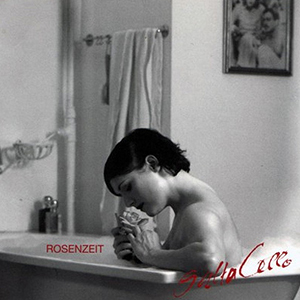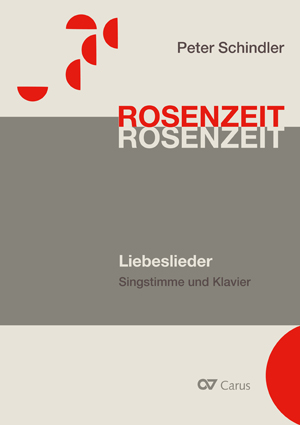
Rosenzeit.
Love songs for voice and piano
Texts by Matthias Claudius, Paul Fleming, Johann Wolfgang von Goethe, Heinrich Heine, Eduard Mörike, Friedrich Rückert, Friedrich Schiller and Oswald von Wolkenstein.
The song cycle Rosenzeit (rose time) uses jazz-inspired music to bring texts from the Middle Ages, Baroque, Classical and Romantic periods to life. Peter Schindler has released most of the songs from Rosenzeit on CD with his group Saltacello and singer Sandra Hartmann. These chansons based on love poems are now published here for the first time in an edition for voice (middle register) and piano. They can be performed in a classical song-like manner and unamplified with a microphone and can be interpreted by both a woman and a man. A sophisticated piano accompaniment makes the pieces playable for any experienced pianist - whether coming from a classical or jazz background.
 View
View

 Listen
(15)
Listen
(15)
- Rosenzeit
- Erstes Liebeslied eines Mädchens
- Frage und Antwort
- Nimmersatte Liebe
- Um Mitternacht
- Abschiedsnacht
- Sehnsucht
- Ein Stündlein wohl vor Tag
- Lebe wohl
- Das verlassene Mägdelein
- Die Tochter der Heide
- Zwei Liebchen
- Verborgenheit
- Der Feuerreiter
- Wie er wolle geküsset sein
Contents

-
Composer
Peter Schindler
| 1960Composer, pianist and organist Peter Schindler writes and performs music for ballets and theatrical performances, films and dramatic recordings, instrumental and choral arrangements, chansons and sacred works. He is particularly passionate about his compositions for children and young adults, which has come to comprise hundreds of humourous children’s songs (Kinderhits mit Witz). His full-length musicals include Geisterstunde auf Schloss Eulenstein (Witching Hour at Eulenstein Castle), Max und die Käsebande (Max and the Cheese Gang), König Keks (Cookie King), Zirkus Furioso (Circus Allegro), and SCHOCKORANGE. These musicals are some of the most frequently played pieces of their kind by children’s and youth choirs in German-speaking theaters and schools. With his first English musical Circus Allegro, Peter’s hugely sucessful work for all kids under 100 is now also accessible to audiences around the world.
For further information visit: http://peter-schindler.de/
We asked the composer 6 questions, read them here in our blog: https://blog.carus-verlag.com/en/personalities/5-questions-for-peter-schindler/
Personal details
-
Songwriter / Librettist
Matthias Claudius
| 1740-1815
-
Songwriter / Librettist
Friedrich Rückert
| 1788-1866Friedrich Rückert, born 1788 in Schweinfurt, died 1866 near Coburg. Poet and translator. Professor of oriental philology in Erlangen. Personal details
-
Songwriter / Librettist
Walther von der Vogelweide
| 1170-1230
-
Songwriter / Librettist
Heinrich Heine
| 1797-1856Heinrich Heine (1797–1856) is regarded as one of the most important German poets of the 19th century. He was born in Düsseldorf and is best known for his lyric poetry, which combines Romanticism with sharp social criticism. Many of his works deal with love, nature and freedom. Because of his political views, Heine lived in exile in Paris for many years.
He also occupies a prominent place in the history of music. His lyrical texts were set to music by numerous composers and had a particularly profound influence on the Romantic art song. Robert Schumann, Franz Schubert, Felix Mendelssohn Bartholdy and Hugo Wolf, in particular, created musical works of enduring significance based on Heine’s poems. The poetic combination of linguistic simplicity, emotional depth and often ironic ambiguity offered composers a wide range of possibilities for musical interpretation. As a result, Heine’s poetry became a central part of the Romantic art-song repertoire and continues to influence vocal music to this day.
Personal details
-
Songwriter / Librettist
Friedrich Schiller
| 1759-1805
-
Songwriter / Librettist
Paul Fleming
| 1609-1640
-
Songwriter / Librettist
Eduard Mörike
| 1804-1875Eduard Mörike was a German poet and writer of the Schwäbische Dichterschule. He studied theology at Tübingen Abbey and then worked as a vicar and parish administrator in various parishes. In 1834, Mörike was appointed pastor of Cleversulzbach until he took early retirement in 1843. From then on, he devoted his time entirely to his literary work and also began teaching literature at the Katharinenstift in Stuttgart in 1851. He lived and worked in Stuttgart until his death in 1875.
Eduard Mörike is considered one of the most important poets between Romanticism and Realism. His best-known works include the novel Maler Nolten, the novella Mozart auf der Reise nach Prag and numerous poems, including the popular Er ist's. His lyrical works deal with personal experiences and observations of nature, but his subjects also include mythological and religious motifs. His texts are characterized by a deep emotionality and musical quality, which has led to many musical settings of Mörike's poems. Josef G. Rheinberger, Robert Schumann, Max Bruch, Max Reger, Hugo Wolf, Peter Schindler and many others have used Mörike's texts for their compositions. Personal details
-
Songwriter / Librettist
Johann Wolfgang Goethe
| -1832Johann Wolfgang von Goethe is today a dazzling figure in world literature. He was born in Frankfurt am Main and initially studied law, but then followed his inclination towards poetry. With the drama Götz von Berlechingen and the epistolary novel The Sorrows of Young Werther, he made important contributions to the literary movement of Sturm und Drang.
From 1775 onwards, Goethe was employed at the court of Duke Carl August in Weimar. In addition to his work at court as a minister and director of the Weimar Court Theatre, he wrote his major works here, including the drama Faust, other novels and many poems, which are still a source of inspiration for musical adaptations today. His poems were a source of inspiration for composers, especially in the 19th century, such as Franz Schubert. Schubert alone set 52 of Goethe's works to music, the best known of which are probably the songs Gretchen am Spinnrade and Erlkönig. Goethe also became acquainted with several composers of the time. He was particularly enthusiastic about the young Felix Mendelssohn-Bartholdy, who also set Goethe's lines to music in the ballad Die erste Walpurgisnacht (The First Walpurgis Night). Personal details
Reviews
... Eine intensive Beschäftigung mit den alten und neuen Liedern dieses Zyklus lohnt. Wer sich mit Schindlers zahlreichen Kinderliedern beschäftigt hat, kennt seine Vielseitigkeit. Hier ist ein hochsensibler Künstler mit einem gesunden Selbstbewusstsein am Werk, der als zeitgenössischer Liedkomponist etwas zu sagen hat.
Wolfgang Layer, Weblog des Schwäbischen Chorverbandes
Reviews on our website can only be submitted by customers with a registered user account. A check whether the rated products were actually purchased does not take place.
Frequent questions about this work
 There are no questions and answers available so far or you were unable to find an answer to your specific question about this work? Then click here and send your specific questions to our Customer Services!