Ruggiero Leoncavallo: Pagliacci - Sheet music | Carus-Verlag
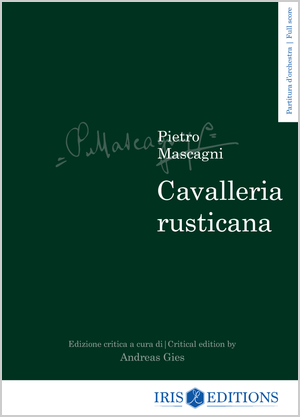
Iris Editions

Ruggiero Leoncavallo Pagliacci

Der Bajazzo 1892

Read and write feedback
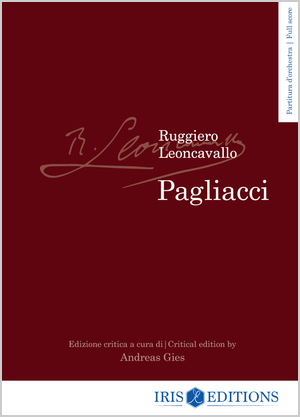
Ruggiero Leoncavallo’s Pagliacci from 1892, considered the highest expression of musical verismo, is always mentioned in the same breath as its historical counterpart, Pietro Mascagni’s Cavalleria rusticana, and the two operas are frequently performed together in a double bill. Pagliacci is unquestionably Leoncavallo’s masterpiece. The 2021 edition by Andreas Gies includes a critical report in Italian and English. The editor corrects ambiguous and erroneous readings that have arisen over time due to inconsistencies in the autograph and offers practical guidance for today’s performers.
Purchase
Full score, for hire Carus 97.402/00 362 pages, 25,2 x 35,0 cm, paperback
Vocal score, for hire Carus 97.402/03 268 pages, DIN A4, paperback
Set of parts, complete orchestral parts, for hire, also available in digital form Carus 97.402/19
  • 1 x Set of parts, harmony parts, for hire, flute 1, flute 2, flute 3 / piccolo , oboe 1, oboe 2 / english horn, clarinet 1, clarinet 2, bass clarinet, bassoon 1, bassoon 2, bassoon 3, french horn 1 and 2, french horn 3 and 4, trumpet 1 and 2, trumpet 3, trombone 1 and 2, trombone 3 / tuba, timpani, harp 1, harp 2, percussion (97.402/09)
     
    16 x Individual part, violin 1, for hire (97.402/11)
     
    14 x Individual part, violin 2, for hire (97.402/12)
     
    12 x Individual part, viola, for hire (97.402/13)
     
    18 x Individual part, violoncello / double bass, for hire (97.402/14)
     
    1 x Set of parts, on stage, for hire (97.402/79)
     
Full score digital (download), pdf file, for hire Carus 97.402/00-010-000 362 pages, 25,2 x 35,0 cm, without cover
Vocal score digital (download), pdf file, for hire Carus 97.402/03-010-000 268 pages, DIN A4, without cover
Choral score digital (download), pdf file, Choir with piano, for hire Carus 97.402/05-010-000
Set of parts digital (download), zip file, pdf file, complete orchestral parts, for hire Carus 97.402/19-010-000
  • 1 x Set of parts digital (download), zip file, pdf file, harmony parts, for hire (97.402/09-010-000)
     
    16 x Individual part digital (download), pdf file, violin 1, for hire (97.402/11-010-000)
     
    14 x Individual part digital (download), pdf file, violin 2, for hire (97.402/12-010-000)
     
    12 x Individual part digital (download), pdf file, viola, for hire (97.402/13-010-000)
     
    18 x Individual part digital (download), pdf file, violoncello / double bass, for hire (97.402/14-010-000)
     
    1 x Set of parts digital (download), zip file, pdf file, on stage, for hire (97.402/79-010-000)
     
In the prologue, Tonio explains that although characters from the commedia dell’arte appear in the upcoming play, they are also human beings of flesh and blood. A troupe of actors arrives in the village of Montalto. They are led by Canio, who invites the locals to the evening’s performance. On stage, he portrays the dim-witted clown Pagliaccio, who is being cheated on by Colombina. In real life, however, Canio is a vengeful husband, who will not tolerate infidelity on the part of his wife, Nedda (Colombina). Tonio – playing the buffoon Taddeo in the comedy – immediately gets a taste of this when Canio slaps him for gallantly helping Nedda down from the cart. When Tonio’s further advances are met with whiplashes from Nedda, he swears revenge on them both. Observing Nedda meeting her lover, Silvio, he alerts Canio. Infuriated, Canio chases Silvio, who manages to escape. Nedda refuses to reveal her lover’s name even when threatened at knifepoint. The performance begins, and everyone must take to the stage to act out a nearly identical scene, now as comedy: After Pagliaccio goes out, his wife Colombina receives her lover, Arlecchino. When Pagliaccio unexpectedly returns home, Arlecchino gives him the slip (just as Silvio did), and Pagliaccio demands to know the name of his rival. Colombina refuses to disclose it. Naturally, Canio feels transported back to the identical (real life) situation from before the show. Increasingly, he breaks character and becomes ever more violent toward Nedda. The audience does not realize that the on-stage comedy is turning into a horrific tragedy; instead, they are thrilled by the intensity of the “performance.” Finally, Canio gives Nedda a choice: give up the name of her lover or her life. When she still refuses, he stabs her. In the throes of death, Nedda calls out for Silvio, who Canio also kills. Devastated, he allows himself to be disarmed and arrested. Tonio has the final word: “La commedia è finita!” (“The comedy is over!”)
  • Ruggiero Leoncavallo was born in Naples in 1857 and was primarily an opera composer and librettist. Today, his work is largely forgotten. Only his verismo opera Pagliacci is still regularly performed. In his day, many of his works were successful and Leoncavallo was highly regarded, especially as a librettist. Personal details
  • Ruggiero Leoncavallo was born in Naples in 1857 and was primarily an opera composer and librettist. Today, his work is largely forgotten. Only his verismo opera Pagliacci is still regularly performed. In his day, many of his works were successful and Leoncavallo was highly regarded, especially as a librettist. Personal details

Reviews on our website can only be submitted by customers with a registered user account. A check whether the rated products were actually purchased does not take place.

No feedback available for this product.

Frequent questions about this work

Pencil symbol There are no questions and answers available so far or you were unable to find an answer to your specific question about this work? Then click here and send your specific questions to our Customer Services!