Musik an der Dresdner Frauenkirche - Kantaten I (Kreile)
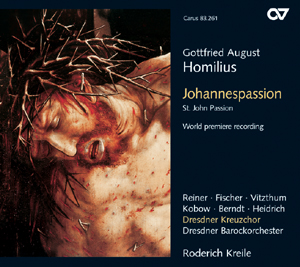
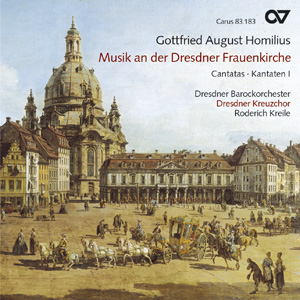
The rebuilding of the Dresden Frauenkirche has gained widespread public attention throughout Europe and in the USA. Recently the bells were dedicated in a formal ceremony and the church was crowned with its ornamental tower. The present CD is dedicated to discovering the “traces of sound” through the music which was composed for this church. When the Kreuzkirche, the main church of the city, was destroyed in July 1760, the Frauenkirche moved into the forefront as the first parish church in the old town of Dresden. Gottfried August Homilius is considered the most significant and compositionally productive Kreuzkantor. His work also found a widespread acceptance outside the capital of Saxony. Although he was music director of the Kreuzkirche, due to its destruction he spent three quarters of his tenure working in the Frauenkirche, where previously he had been the organist for 13 years. Most of his works were written directly for this church. The present CD features four festive cantatas for the feast of Whitsun in interpretations by the internationally renowned Dresdner Kreuzchor under their conductor, Roderich Kreile. The Kreuzchor is accompanied by the Dresdner Barockorchester.
Explore
 Listen
(18)
Listen
(18)
- Coro: Der Herr ist Gott, der uns erleuchtet
- Aria (S): Dir sei Ehr und Preis gegeben
- Coro: Danket dem Herrn, denn er ist freundlich
- Aria (T): Du bist mein Gott
- Corale: Richt unser ganzes Leben
- Coro: Selig seid ihr, wenn ihr geschmähet werdet
- Aria (T): Geduldig beuge deinen Rücken
- Corale: Sein Geist spricht meinem Geiste
- Coro: Heilig ist unser Gott, der Herr Gott Zebaoth
- Aria (S): Gott, groß ist deine Güte
- Coro: Heilig ist Jesus Christ
- Aria (A): Ich weiß, an wen ich glaube
- Coro: Heilig ist Gottes Geist
- Aria (T): Schaff du der Christen Tröster
- Coro: Dir sei, Dreieinigkeit
- Coro: Gott fähret auf mit Jauchzen
- Aria (A): Gebückt verehren dich die Seraphinen
- Corale: Nur daß ihr den Geist erhebt
Purchase
Additional product information
Contents

-
Composer
Gottfried August Homilius
| 1714-1785Gottfried August Homilius, the son of a pastor, was born in Rosenthal (Saxony) on 2 February 1714. In May 1735 he enrolled as a law student at Leipzig University. Likewise, it was probably at this time that Homilius was a pupil of Johann Sebastian Bach; the latter fact had been attested to by Johann Adam Hiller. Apart from Bach, Homilius also had contact with Johann Schneider, a Bach pupil and organist at the Nicolaikirche, for whom he also substituted. After unsuccesfully applying for a post as organist in Bautzen, Homilius was appointed organist at the Dresden Frauenkirche in 1742. In 1755 Homilius succeeded Theodor Christlieb Reinhold as Kreuzkantor and music director of the three main churches in Dresden, a position that he occupied until his death on 2 June 1785. Personal details
-
Preface writer
Gerhard Poppe
-
Ensemble
Dresdner Kreuzchor
The Dresden Kreuzchor is one of the world’s oldest and most famous boys’ choirs. Its most important task in its 800 years of existence is still the musical accompaniment of the vespers and services at Dresden’s Kreuzkirche. Not only on religious holidays but also throughout the entire church year the Kreuzchor accompanies half of all liturgical services in the famous church on the old market. The impressive architecture of the Kreuzkirche is an added attraction for the 3000 spectators of its choir concerts. As the city’s oldest and critically acclaimed cultural institution, the Dresden Kreuzchor has marked Dresden’s musical life in a very special way and spreads the city’s reputation as a cultural metropolis throughout the world as one of its most prominent ambassadors. Several times a year, the Dresden Kreuzchor goes on national and international concert tours beyond Germany and Europe’s borders to Israel, Canada, Japan, South America and the USA. Moreover, it performs at international music festivals as well as on countless radio and television recordings. A very wide repertoire ranging from early Baroque to world premieres of contemporary music has enabled it to make more than 800 recordings in the last 80 years for prestigious record labels such as Deutsche Grammophon, Teldec, Capriccio and Berlin Classics. There is a constant cooperation with famous orchestras such as the Dresden Philharmonic and the Sächsische Staatskapelle Dresden. Renowned opera houses regularly employ members of the choir as soloists for roles such as the three boys in the Magic Flute. The Kreuzchor singers, called “Kruzianer,” still pursue their education and graduate from the Kreuzschule; about half of them live in the adjacent boarding school. In addition to their regular classes, the 150 singers aged nine to eighteen have weekly singing and instrumental lessons. Their daily rehearsals and the specific sound of the choir are the basis of the success and the fame of the Dresden Kreuzchor. Personal details
-
Orchestra
Dresdner Barockorchester
One of the distinguishing features of the Dresdner Barockorchester, founded in 1991, is the fact that its membership includes both early music specialists and orchestral musicians drawn from the Dresdner Staatskapelle and the Dresdner Philharmonie. Working together with baroque instruments, with their specific clarity of sound and articulation they achieve a variegated, eloquent music-making in which their different areas of musical experience are combined. The musicians are united in their desire to follow the splendid example set by the Dresden Court Orchestra of Augustus the Strong. The heritage of that era is the music of such conductors and instrumentalists of the Court Orchestra as Hasse, Heinichen, Zelenka, Quantz and Pisendel, whose works have a prominent place in the repertoire of the Dresdner Barockorchester. This repertoire extends from the end of the 17th century through Mozart. The Dresdner Barockorchester works closely with the Dresdner Kammerchor and its conductor Hans- Christoph Rademann. Personal details
-
Conductor
Roderich Kreile
For centuries the position as cantor of the Dresdner Kreuzchor (Choir of the Church of the Holy Cross) has been among the most honorable and renowned positions in Protestant church music. Roderich Kreile has served as the 28th post-Reformation cantor of the Dresdner Kreuzchor since 1997. He was born in 1956 and studied church music and choral conducting in Munich. Roderich Kreile quickly achieved nationwide recognition as a church musician. He taught at the Munich Conservatoire between 1989 and 1996, eventually as a professor, and led two choirs. Furthermore, in 1994 he took over the position as Director of the Munich Philharmonic Choir. As an organist and tutor he has received invitations from both within Germany and from abroad. Kreuzkantor Roderich Kreile all music performances in the church as well as the concerts and tours of the Dresdner Kreuzchor. There, he has established with the members of the choir – named “Kruzianer” –, a wide-ranging repertoire of religious and secular choral works from throughout the history of music. In the last few years he has given many compositions their first performances. He has also strengthened ties with renowned orchestras and produced numerous radio and CD recordings. In previous centuries the area of responsibility of the cantor of the Dresdner Kreuzchor was concentrated primarily on the leadership of the religious services, as is still the case. Nowadays, however, the remit of the Kantor far exceeds purely artistic responsibility; as the leader of the Dresdner Kreuzchor, Roderich Kreile also has the responsibility of being a community representative. Personal details
-
Soloist - soprano
Vasiljka Jezovsek
-
Soloist - alto
Anne Buter
-
Soloist - tenor
Hubert Nettinger
-
Soloist - bass
Christian Hilz
Reviews
Homilius: Musik für die Dresdner Frauenkirche - Kantaten I
Die Kantaten [...] sind beredtes und erfreulich frisch musiziertes Zeugnis dafür, dass diese so genannte Gebrauchsmusik auch über ihren engen zeitlichen und gedanklichen Rahmen hinaus bis heute Bestand haben kann. Als Teil einer kulturellen Kontinuität und Identität.Kerstin Leiße
Dresdner Neueste Nachrichten, 29./30. Januar 2005
[...] wunderschöne Kirchenmusikwerke in einer guten Einspielung, die es wert sind, der allgemeinen Öffentlichkeit wieder zugänglich zu machen!
Singende Kirche 2005, Heft 2, S. 133
Reviews on our website can only be submitted by customers with a registered user account. A check whether the rated products were actually purchased does not take place.
No feedback available for this product.
Frequent questions about this work
 There are no questions and answers available so far or you were unable to find an answer to your specific question about this work? Then click here and send your specific questions to our Customer Services!