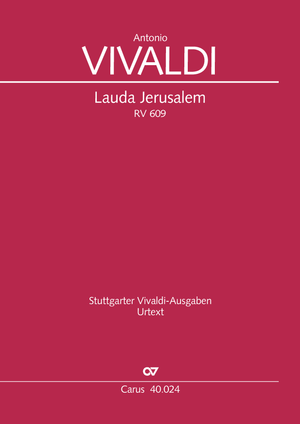
Lauda Jerusalem
RV 609
Psalm 147 “Lauda Jerusalem” features prominently in the liturgical year, including in vespers on Marian feasts. Antonio Vivaldi’s only setting of this vesper psalm is rather unusual in being written for double choir, each accompanied by an instrumental choir of strings and basso continuo. Unlike many of his other psalm settings, this work is not divided into several movements. Solo and tutti sections are juxtaposed, with the composer employing a kind of ritornello structure to maintain the musical unity.
Vivaldi’s students at Venice’s “Ospedale della Pietà” performed the work in the 1730s. The autograph score shows that the solo passages were performed by two singers, probably for pedagogical reasons. Even today, these solo parts can be assigned to one or more good choral sopranos.


-
Composer
Antonio Vivaldi
| 1678-1741Antonio (Lucio) Vivaldi was an Italian composer and violinist of the Baroque period.
It is assumed that his father, who was a musician himself, was responsible for Vivaldi's musical education. However, he began his professional career as a priest, which earned him the nickname Il prete rosso (the red-haired priest).
From 1703, Vivaldi worked intermittently as a violin teacher and composer at the Ospedale della Pietà, an orphanage for girls in Venice, until shortly before his death. Initially, he also worked there as a priest, but relinquished this role after three years. He wrote numerous chamber music works and concertos for his pupils at the Pietà. The famous Four Seasons are particularly well-known and often performed today. Vivaldi also composed sacred and secular vocal music and was an opera composer and director.
Of over 800 works known today, only 135 were published during Vivaldi's lifetime. After his death, Vivaldi's compositions were initially largely forgotten. Many of his works were rediscovered and published, particularly in the 20th century. Among them is the Gloria in D RV 589, the very first sheet music edition published by Carus-Verlag.
Personal details
-
Editor
Uwe Wolf
| 1961As a musicologist, Dr. Uwe Wolf is particularly at home in the 17th and 18th centuries. The focus of his work ranges from the time of Monteverdi and Schütz to Bach and the generation of Bach's sons and pupils through to Viennese Classicism. He has been head of the editorial department at Carus-Verlag since October 2011. Prior to this, he worked in Bach research for over 20 years. Personal details
-
Continuo realization
Andreas Gräsle
| 1964Andreas Gräsle (harmonium) studied church music in Stuttgart (organ: Jon Laukvik) and took his concert diploma in organ with Daniel Roth in Saarbrücken, followed by early music studies with Andrea Marcon. He was a scholarship holder of the German Academic Exchange Service (DAAD), and a prizewinner at the International Johann Pachelbel Competition in Nuremberg in 1991. From 1996 to 2003 he was choirmaster and organist at the Augustinuskirche in Schwäbisch Gmünd, and in April 2003 he became district choirmaster in Ditzingen. In addition, he is much in demand as chamber music partner, organist and harpsichordist. He has made several CDs of organ and chamber music, and his own improvisations and arrangements of children’s songs round off his musical activities. He has taught score reading at the Musikhochschule Stuttgart since 1997. Personal details
Reviews on our website can only be submitted by customers with a registered user account. A check whether the rated products were actually purchased does not take place.
Présentation de l’œuvre
Le Lauda Jerusalem RV 609 est l’un des deux grands psaumes solennels pour double chœur, double orchestre et orgue que Vivaldi composa pour les Vêpres de l’Immaculée Conception à l’Ospedale della Pietà de Venise (l’autre étant le RV 608, plus court).
Écrit vers 1730-1735 (période tardive de Vivaldi), il s’inscrit dans la série des grandes œuvres sacrées vénitiennes (avec le Gloria RV 589, le Magnificat RV 610/611, le Dixit Dominus RV 594 ou 595).
Le texte latin du psaume 147 (« Laudate Dominum quoniam bonus est psalmus… ») célèbre la grandeur et la miséricorde de Dieu sur Jérusalem. Vivaldi en fait une fresque grandiose en sept mouvements alternant chœurs homophones puissants, fugues rapides et épisodes solistiques virtuoses, dans la pure tradition du stile concertato vénitien hérité de Monteverdi et Gabrieli.
Note d’harmonie : 9,5 / 10
Justification :
Harmonie parfaitement tonale, d’une cohérence absolue dans le cadre baroque tardif vénitien.
Tonalité centrale : mi mineur (ton sombre et dramatique, très apprécié de Vivaldi pour les œuvres sacrées grandioses).
Utilisation très maîtrisée des appoggiatures (suspensions 4-3, 9-8, 7-6) dans les parties vocales et instrumentales, créant des dissonances expressives toujours préparées et résolues selon les règles classiques (Rameau les théoriserait quelques années plus tard).
Seule petite « entorse » à la consonance parfaite : quelques frottements secondaires (secondes mineures) dans les fugues rapides et les passages en imitation serrée, mais toujours au service de l’énergie dramatique et résolus avec élégance.
Description du timbre
Couleur sonore : riche, chaleureuse et majestueuse, avec une tension dramatique sous-jacente.
Le double chœur et le double orchestre (cordes + hautbois + trompettes dans certains mouvements) produisent une texture épaisse, presque « symphonique » avant l’heure.
Le mi mineur confère une teinte sombre et recueillie, contrebalancée par des éclats brillants dans les sections « Alleluia » en mi majeur final.
L’orgue en continuo renforce la profondeur et la chaleur, tandis que les trompettes (dans le manuscrit autographe) ajoutent une brillance triomphale.
Frequent questions about this work
 There are no questions and answers available so far or you were unable to find an answer to your specific question about this work? Then click here and send your specific questions to our Customer Services!