

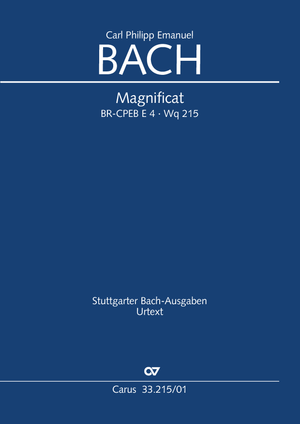
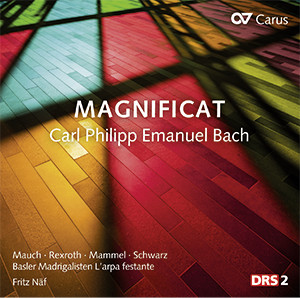
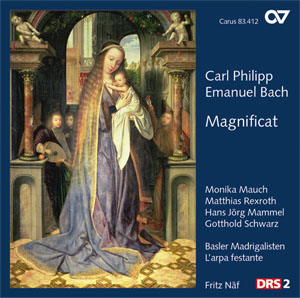
C. P. E. Bach’s nine-movement Magnificat (1749), the first great vocal work from his Berlin years, is among the most magnificent sounding, in which the solo vocal parts are also among the most ambitious settings of the “Hymn to the Virgin Mary” (Luke 1). The work fulfills all the criteria required for a larger sacred composition: grandeur, dignity, polyphonic and concertante choral movements, sensitive (“empfindsam”) and expressive arias, a long concluding double fugue. This richly scored Magnificat (with 3 trumpets and timp. ad. lib.), which is almost one hour in duration, would be well suited, for example, as the central work on every Christmas or pre-Christmas concert programme.
Explore

 Listen
(9)
Listen
(9)
- Magnificat anima mea
- Quia respexit
- Quia fecit
- Et misericordia
- Fecit potentiam
- Deposuit potentes
- Suscepit Israel
- Gloria patri
- Sicut erat in principio
 Additional material
- Purchase additional material as a download product.
-
 Digital text (without sheet music) incl. printing licence, html file, singing text, originalhtml file, singing text, original (Sample)
1. Tutti: Magnificat (SATB) Magnificat anima mea Dominum,
et exultavit spiritus meus in Deo salutari meo.2. Aria: Quia respexit (Soprano) Quia respexit humilitatem ancillae suae.
Ecce enim ex hoc beatam me dicent omnes generationes.3. Aria: Quia fecit mihi magna (Tenore) Quia fecit mihi magna, qui potens est,
et sanctum nomen eius.4. Tutti: Et misericordia eius Et misericordia eius a progenie in progenies
timentibus eum.5. Aria: Fecit potentiam (Basso) Fecit potentiam in brachio suo,
dispersit superbos mente cordis sui.6. Duetto: Deposuit potentes de sede (Alto e Tenore) Deposuit potentes de sede,
et exaltavit humiles.
Esurientes implevit bonis
et divites dimisit inanes....
-
Digital text (without sheet music) incl. printing licence, html file, singing text, english translationhtml file, singing text, english translation (Sample)
1. Tutti: Magnificat (SATB) All my spirit exalts the Lord,
and I sing joyously to my God, my own Saviour.2. Aria: Quia respexit (Soprano) For he hath regarded the humility of his handmaid:
for behold from henceforth all generations shall call me blessed.3. Aria: Quia fecit mihi magna (Tenore) Because he that is mighty hath done great things to me,
and holy is his name.4. Tutti: Et misericordia eius And his mercy is from generations unto generations,
to them that fear him.5. Aria: Fecit potentiam (Basso) He hath shewed might in his arm
and he hath scattered the proud in the conceit of their heart.6. Duetto: Deposuit potentes de sede (Alto e Tenore) He hath put down the mighty from their seat
and hath exalted the humble.
He hath filled the hungry with good things
and the rich he hath sent empty away....
-
Digital text (without sheet music) incl. printing licence, html file, singing text, german translationhtml file, singing text, german translation (Sample)
1. Tutti: Magnificat (SATB) Meine Seele erhebt den Herrn
und mein Geist freuet sich Gottes, meines Heilandes.2. Aria: Quia respexit (Soprano) Denn er hat die Niedrigkeit seiner Magd angesehen.
Siehe von nun an werden mich selig preisen alle Kindeskinder.3. Aria: Quia fecit mihi magna (Tenore) Denn er hat große Dinge an mir getan,
der da mächtig und des Name heilig ist.4. Tutti: Et misericordia eius Und seine Barmherzigkeit währet immer für und für
bei denen, die ihn fürchten.5. Aria: Fecit potentiam (Basso) Er übet Gewalt mit seinem Arm
und zerstreut, die hoffärtig sind in ihres Herzens Sinn.6. Duetto: Deposuit potentes de sede (Alto e Tenore) Er stößet die Gewaltigen vom Thron
...
-
Digital text (without sheet music) incl. printing licence, html file, Introductory text, englishhtml file, Introductory text, english (Sample)Text from the CD Carus 83.412
Christine Blanken
Translation (abridged): John CoombsUntil a few years ago Carl Philipp Emanuel Bach was completely overshadowed as a vocal composer by his father J. S. Bach. Most of the works of his Hamburg years (1768–1788) had been lost. Since 1999, when the archive of the Berlin Singakademie was discovered in Kiev, the picture has changed: C. P. E. Bach’s important instrumental music has been joined by many cantatas – including, above all, the “Quartalsmusiken” (music performed quarterly) for the great Church festivals – and Passions. His first great vocal work (following several lost pieces written during his student years at Frankfurt on Oder) dates from 1749. At that time Court harpsichordist at Potsdam, he probably composed the Magnificat to support his unsuccessful application for the post of Thomaskantor in Leipzig. His elder brother Wilhelm Friedemann (1710–1784) composed an Advent cantata at that time, also probably in connection with an application for a position in Leipzig.
The Magnificat was composed in 1749 and is a work with widely differing characteristics: brilliant coloratura arias and a duet are contrasted by a lyrical,
...
-
Digital text (without sheet music) incl. printing licence, html file, Introductory text, germanhtml file, Introductory text, german (Sample)Booklet-Text der CD Carus 83.412
Christine Blanken
Carl Philipp Emanuel Bach stand als Vokalkomponist bis vor wenigen Jahren ganz im Schatten seines Vaters, nur wenige Werke waren bekannt – darunter zwar zwei große Oratorien und zwei Passionsmusiken –, doch die Mehrzahl seiner Werke, vor allem aus der Hamburger Zeit (ab 1768), galt als verschollen. Seit dem Jahr 1999, als in Kiew das Archiv der Singakademie zu Berlin entdeckt wurde, hat sich das Bild gewandelt: Dem gewichtigen Instrumentalmusik-Œuvre treten nun zahlreiche Kantaten, „Quartalsmusiken“ zu den Kirchenfesten, Passion und andere Vokalmusik aus mehr als zwanzig Schaffensjahren gegenüber. Die während Bachs Frankfurter Studienzeit komponierten Kantataten bleiben allerdings weiterhin verschollen.
Mit dem Magnificat liegt das früheste erhaltene große Vokalwerk Carl Philipp Emanuel Bachs vor, komponiert im Jahre 1749. Bereits im Juni dieses Jahres, also noch zu Lebzeiten Johann Sebastian Bachs, hatte sich der Rat der Stadt Leipzig mit der Frage eines möglichen Nachfolgers für den schwer erkrankten Thomaskantor beschäftigt und hatte Gottlob Harrer aus Dresden mit der Gewährung einer
...
Purchase
Additional product information
Contents

-
Composer
Carl Philipp Emanuel Bach
| 1714-1788Carl Philipp Emanuel Bach (1714–1788) was an extremely prolific composer who enjoyed a high reputation during his lifetime with the result that his music became known far and wide. The early works were influenced by the Berlin School. In his later works, however, this composer developed a thoroughly individual style, independent of contemporary fashions, which is to be found especially in the sacred vocal works written during his years as Director of Music in Hamburg (1768–1788). Personal details
-
Editor
Günter Graulich
| 1926The publisher, church musician and teacher Günter Graulich is one of the major personalities in German publishing of the post-war period. With his wife Waltraud he founded Carus-Verlag Stuttgart in 1972, which he built up from a 2-person family firm to a medium-sized business with around 60 employees. A trained church musician and Kantor for many years at the Matthäuskirche Stuttgart, he also directed the Motettenchor Stuttgart for 50 years. With his choir he made LP and CD recordings, and undertook numerous concert tours to other European countries and America. Personal details
-
Preface writer
Uwe Wolf
| 1961As a musicologist, Dr. Uwe Wolf is particularly at home in the 17th and 18th centuries. The focus of his work ranges from the time of Monteverdi and Schütz to Bach and the generation of Bach's sons and pupils through to Viennese Classicism. He has been head of the editorial department at Carus-Verlag since October 2011. Prior to this, he worked in Bach research for over 20 years. Personal details
Reviews on our website can only be submitted by customers with a registered user account. A check whether the rated products were actually purchased does not take place.
No feedback available for this product.
Frequent questions about this work
Which version of the piece does the Carus edition contain?
The edition allows both the Hamburg version with trumpets and timpani as well as the Leipzig version without these instruments to be performed. The only fundamentally different movement – the Et misericordias eius – is contained in both versions.
Can the earlier Et misericordias from the main part of the edition also be combined with the version with trumpets?
Of course! C.P.E. Bach replaced the Et misericordias, because he had used it in a prominent place in the Passion cantata often performed in Hamburg; the replacement of the movement was therefore a workaround solution. But the original variant is a high point of the composition – and in the version with trumpets too.
 There are no questions and answers available so far or you were unable to find an answer to your specific question about this work? Then click here and send your specific questions to our Customer Services!