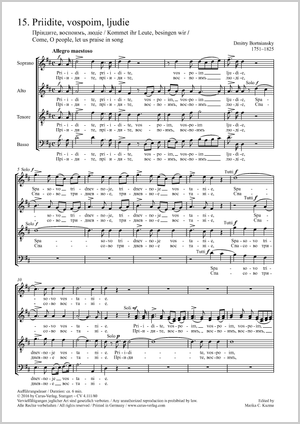
Dimitri Stepanowitsch Bortniansky (1751–1825) seems to have composed the majority of his liturgical works and most of his Sacred Concertos in the 1780s and 1790s, before he was appointed Kapellmeister to the court ensemble in St. Petersburg.
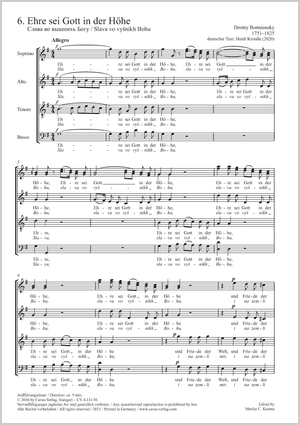
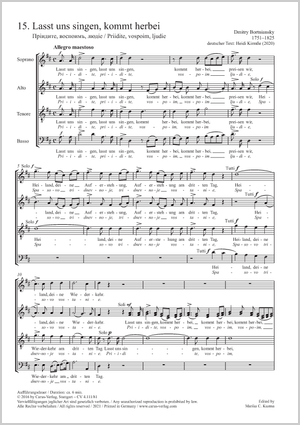
Heidi Kirmße has added a German singing text to the five most popular pieces from the complete volume (CV 4.111). The festive Concerto no. 6 Ehre sei Gott in der Höhe is for Christmas, and no. 9 Heut ist der Tag, den Gott, der Herr, gemacht for Easter. No. 15 Lasst uns singen, kommt herbei is in the major key and is a very effective piece. Tchaikovsky edited Bortniansky’s sacred works and is said to have particularly admired no. 32 O lass mich, Herr, mein Gott, erkennen mein Ziel. Bortniansky himself probably best liked no. 33 Sag, meine Seele, warum verzagest du? The work was sung at his funeral.
- addition to the choral repertoire with works from the Orthodox liturgy/ Eastern Europe
- includes the original Church Slavonic text underlaid (in transliteration).
- effective solo/tutti alternations
Explore


 Practise
-
Pronouncing Aid
- Priidite, vospoim, ljudie
Purchase
Additional product information
-
Composer
Dimitri Stepanowitsch Bortniansky
| 1751-1825Dmitri Stepanovich Bortniansky was a Russian composer who was employed at the court of Catherine the Great, among others. His sacred works in particular had a major influence on (church) music in the 19th century. He combined Russian and Western influences in his church music. Personal details
-
Editor
Marika Kuzma
-
Translator
Heidi Kirmße
| 1925-2021Heidi Kirmße (1925–2021) studierte Schulmusik in Weimar und lebte dort als freischaffende Schriftstellerin, Herausgeberin und Übersetzerin. Für den Carus-Verlag erstellte sie insbesondere zahlreiche singbare deutsche Nachdichtungen aus unterschiedlichen Sprachen, u.a. für Kompositionen von Marc-Antoine Charpentier, Antonín Dvorák, Gabriel Fauré, Edvard Grieg, Georg Friedrich Händel, Jules Massenet, Sergei Rachmaninow, Max Reger, Gioachino Rossini, Veljo Tormis, Giuseppe Verdi u.a., doch trat sie auch mit eigenen Texten in Erscheinung. Über 500 mittlerweile unveröffentlichte oder mittlerweile vergriffene Texte ihres umfangreichen Schaffens als Dichterin und Übersetzerin sind bei Carus in einer separaten Datenbank erfasst und können bei Interesse erfragt werden. Von ihrem bewussten, hinterfragenden Umgang mit Worten zeugt Heidi Kirmßes Gedicht mit dem gleichlautenden Titel:
Worte
So viele Worte werden viel zu oft gesagt,
so viele Fragen werden nicht genug gefragt.
Wo keine Frage steht, wird niemals eine Antwort sein,
und durch Gewöhnung wird der Sinn der Worte klein.
Und ist das Wort verbraucht, sein Inhalt leer und fad,
so wird es nie mehr Ansporn sein zur Tat.
Wir stehn verwundert, geben auf und fühlen uns beschämt
und merken nicht, dass wir doch selbst die Kraft gelähmt.
Drum wolln wir sorgen, dass Gewohnheit uns nicht trügt,
wir wollen fragen, bis die Antwort uns genügt,
wir wollen jedes Wort genau auf seinen Sinn durchschaun
und nur auf solchem festen Boden sicher baun.Heidi KirmßePersonal details
Reviews on our website can only be submitted by customers with a registered user account. A check whether the rated products were actually purchased does not take place.
No feedback available for this product.
Frequent questions about this work
Does the German singing text correspond with the translation help in the complete volume CV 4.111?
No. The translation help is word-for-word, as close to the original as possible. It matches the original text line for line, to facilitate the understanding of the sung text. The new German singing text is orientated towards the melodic writing and vocal aspects. The content and meaning are the same, but it is accordingly freer in its subtleties of language.
 There are no questions and answers available so far or you were unable to find an answer to your specific question about this work? Then click here and send your specific questions to our Customer Services!