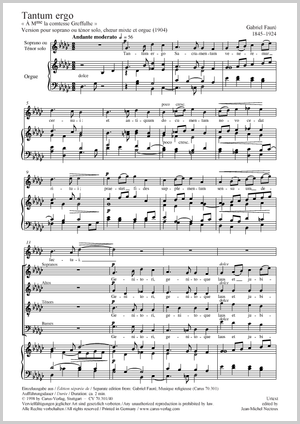
Between completing his education at the École de musique classique et religieuse in Paris and being appointed head of the Paris Conservatoire, Gabriel Fauré worked mainly as a church musician. As a result of his conviction that spiritual music is “an expression of humanity”, he usually preferred more intimate chamber music ensembles to large monumental works. In accordance with the resources available where he worked, he wrote much for mixed choir, frequently supported by soloists and organ or harmonium and sometimes enriched by harp or double bass. For festive occasions, further instruments were added: preferably a string quintet, sometimes augmented by wind instruments. The chamber music-like “human” character was, however, always retained.


Purchase
Additional product information
-
Composer
Gabriel Fauré
| 1845-1924French composer, 1845-1924.
He was a pupil of Camille Saint-Saëns and studied at the Paris School of Sacred Music. Fauré worked as an organist and choirmaster and gave piano lessons and recitals in Parisian salons. He was able to improvise brilliantly on the piano, which is also reflected in his compositions. He was director of the Paris Conservatoire from 1905 to 1920.
Fauré mainly wrote vocal, piano and chamber music. He is best known for his piano songs for solo voice and his Requiem, which was also performed at his own funeral service.
Personal details
-
Editor
Jean-Michel Nectoux
Reviews on our website can only be submitted by customers with a registered user account. A check whether the rated products were actually purchased does not take place.
No feedback available for this product.
Frequent questions about this work
 There are no questions and answers available so far or you were unable to find an answer to your specific question about this work? Then click here and send your specific questions to our Customer Services!