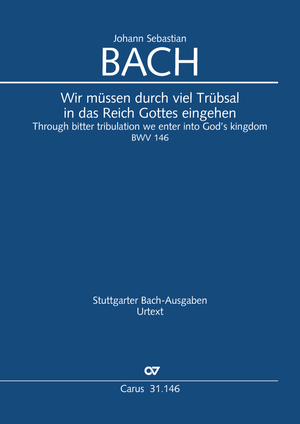
Through bitter tribulation we enter into God's kingdom
Cantata for the Sunday Jubilate BWV 146, 1728?
It is evident from the sources that the cantata was written for the 3rd Sunday after Easter. The text, the identity of whose author is unknown, is based on the comparison between sadness and joy prescribed in the Gospel for that Sunday. This cantata has survived only in copies made after 1750, but undoubtedly the cantata dates from Bachs's years in Leipzig.
Explore
 View
View


 Additional material
- Purchase additional material as a download product.
-
 Digital text (without sheet music) incl. printing licence, html file, singing text, english translationhtml file, singing text, english translation (Sample) Sinfonia 2 Coro
Through bitter tribulation we enter into God’s kingdom.
3 Aria (Alto)Up to heaven will I fly,
4 Recitativo (Soprano)
wicked Sodom, thou and I
must henceforth be parted.
Here would I no longer stay;
peace for me is far away
far from thee forever.Ah! now would I to heaven go!
How hateful to me this wicked world.
At morn I rise in tears,
and lay me down at ev’ning weeping,
oppress’d by base deceit and fears!
Lord! Harken if thou wilt.
Abhorred am I, though free from guilt,
the wickedness of man
would shame and even slay me;...
-
Digital text (without sheet music) incl. printing licence, html file, singing text, originalhtml file, singing text, original (Sample)1 Sinfonia 2 Coro
Wir müssen durch viel Trübsal in das Reich Gottes eingehen.
3 Aria (Alto)Ich will nach dem Himmel zu,
4 Recitativo (Soprano)
schnödes Sodom, ich und du
sind nunmehr geschieden.
Meines Bleibens ist nicht hier,
denn ich lebe doch bei dir
nimmermehr in Frieden.Ach! wer doch schon im Himmel wär,
wie dränget mich nicht die böse Welt.
Mit Weinen steh ich auf,
mit Weinen leg ich mich zu Bette,
wie trüglich wird mir nachgestellt!
Herr! merke, schaue drauf,
sie hassen mich, und ohne Schuld,
als wenn die Welt die Macht,
mich gar zu töten hätte;...
Purchase
Additional product information
-
Composer
Johann Sebastian Bach
| 1685-1750Johann Sebastian Bach is one of the most important composers of Western music history. He came from a widely ramified musical dynasty, which produced numerous musicians and organists in the Thuringian-Saxon area.
Bach vocal
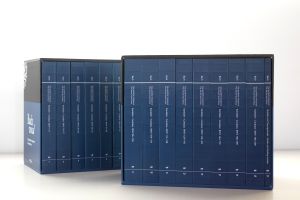
Ever since Carus-Verlag was founded in 1972, publishing the music of Johann Sebastian Bach has been a special focus for us. In the 2017 Reformation anniversary year we completed the Bach vocal project. Bach’s complete sacred vocal works are now available in modern “Urtext” editions, together with performance material. A complete edition of all the full scores is also available in a high quality box set.
Personal details
-
Editor
Anja Morgenstern
-
Vocal score arranger
Paul Horn
| 1922-2016Paul Horn war ein deutscher Kirchenmusiker, Organist, Komponist und Musikwissenschaftler. Er studierte Kirchenmusik und Orgel an der Evangelischen Kirchenmusikschule Esslingen am Neckar bei Hans-Arnold Metzger und Musikwissenschaft, Theologie und Geschichte an der Universität Tübingen. Seine berufliche Laufbahn begann als Kantor an der Evangelischen Michaelskirche in Stuttgart-Degerloch. 1954 wurde er Kantor an der Evangelischen Stadtkirche Ravensburg, eine Position, die er bis zu seiner Pensionierung innehatte. Als Musikwissenschaftler arbeitete Horn bis ins hohe Alter eng mit Carus zusammen. So stammen zahlreiche Carus-Klavierauszüge aus seiner Feder. Personal details
-
Translator
Henry Drinker
Reviews on our website can only be submitted by customers with a registered user account. A check whether the rated products were actually purchased does not take place.
No feedback available for this product.
Frequent questions about this work
Which situation is the transposed organ part intended for?
Bach planned this cantata with concertante organ for the organs in the main Leipzig churches. These were tuned a whole tone higher (c. a1=466 Hz, ‘Chorton’ [choir/organ pitch] than strings and woodwinds (a1=415 Hz, ‘Kammerton’ [chamber pitch]). In order to allow for this difference, the organ part was notated a whole tone lower (in C minor instead of D minor). Today, many Baroque organs are still tuned to a higher pitch. In order to enable performances to take place in such churches, we offer the transposed organ part in C minor (31.146/47). Especially in a cantata with obbligato organ, the use of a historical organ is appropriate. For all other performance situations where there is no difference in pitch, there is a normal, untransposed organ part in D minor (31.146/49).
 There are no questions and answers available so far or you were unable to find an answer to your specific question about this work? Then click here and send your specific questions to our Customer Services!