

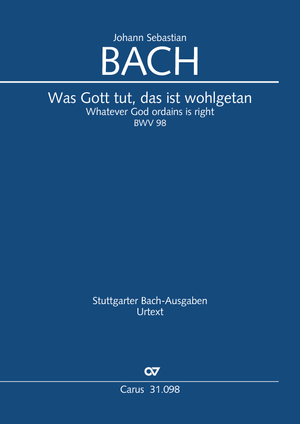
Whatever God ordains is right
Cantata for the 21st Sunday after Trinity BWV 98, 1726
The song “Was Gott tut, das ist wohlgetan” (Whatever God ordains is right) appears three times as the opening movement of a Bach cantata, namely in BWV 98-100. While BWV 99 and 100 are chorale cantatas, the subsequent free poetry in BWV 98 (composed for the 21st Sunday after Trinity) is by an author only identified a few years ago as the Leipzig student Christoph Birkmann. After the opening chorus, the text turns from sorrow (Recitative 1) to the exhortation “Hört, ihr Augen, auf zu weinen” (Cease now, eyes, from all your weeping) (Aria 1) to confidence “Gott hat ein Herz, das des Erbarmens Überfluss” (God has a heart that always is compassionate) (Recitative 2) to the confession “Meinen Jesum lass ich nicht” (Never will I leave my Lord), which Bach sets as an aria featuring (embellished) chorale quotations, so that a final chorale is omitted. Apart from the string ensemble, Bach only asks for 2 oboes and taille (English horn); oboe 2 and taille are merely there to reinforce the choir in the first movement.
Explore
 View
View

 Additional material
- Purchase additional material as a download product.
-
 Digital text (without sheet music) incl. printing licence, html file, singing text, english translationhtml file, singing text, english translation (Sample)1 Coro (Choral)
Whatever God ordains is right,
2 Recitativo (Tenore)
his will is just forever.
What he decides is my delight,
I will obey his scepter.
My God indeed, who helps in need,
knows most well to preserve me;
the reign I give him gladly.O God, when will the time once be,
when I from agony,
from all my fear be rescued?
How long yet shall I day and night
for help beseech you?
Is there no Saviour here!
The Lord to those is always near,
who in his might and in his grace are trusting.
In God I place my confidence,
in him I will be resting.
Most faithfully his own he tends....
-
Digital text (without sheet music) incl. printing licence, html file, singing text, originalhtml file, singing text, original (Sample)1 Coro (Choral)
Was Gott tut, das ist wohlgetan,
2 Recitativo (Tenore)
es bleibt gerecht sein Wille;
wie er fängt meine Sachen an,
will ich ihm halten stille.
Er ist mein Gott,
der in der Not
mich wohl weiß zu erhalten;
drum lass ich ihn nur walten.Ach Gott! wenn wirst du mich einmal
von meiner Leidensqual,
von meiner Angst befreien?
wie lange soll ich Tag und Nacht
um Hilfe schreien?
Und ist kein Retter da!
Der Herr ist denen allen nah,
die seiner Macht
und seiner Huld vertrauen.
Drum will ich meine Zuversicht...
Purchase
Additional product information
-
Composer
Johann Sebastian Bach
| 1685-1750Johann Sebastian Bach is one of the most important composers of Western music history. He came from a widely ramified musical dynasty, which produced numerous musicians and organists in the Thuringian-Saxon area.
Bach vocal
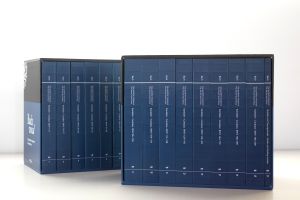
Ever since Carus-Verlag was founded in 1972, publishing the music of Johann Sebastian Bach has been a special focus for us. In the 2017 Reformation anniversary year we completed the Bach vocal project. Bach’s complete sacred vocal works are now available in modern “Urtext” editions, together with performance material. A complete edition of all the full scores is also available in a high quality box set.
Personal details
-
Editor
Reinhold Kubik
| 1942-2024
-
Continuo realization
Paul Horn
| 1922-2016Paul Horn war ein deutscher Kirchenmusiker, Organist, Komponist und Musikwissenschaftler. Er studierte Kirchenmusik und Orgel an der Evangelischen Kirchenmusikschule Esslingen am Neckar bei Hans-Arnold Metzger und Musikwissenschaft, Theologie und Geschichte an der Universität Tübingen. Seine berufliche Laufbahn begann als Kantor an der Evangelischen Michaelskirche in Stuttgart-Degerloch. 1954 wurde er Kantor an der Evangelischen Stadtkirche Ravensburg, eine Position, die er bis zu seiner Pensionierung innehatte. Als Musikwissenschaftler arbeitete Horn bis ins hohe Alter eng mit Carus zusammen. So stammen zahlreiche Carus-Klavierauszüge aus seiner Feder. Personal details
-
Translator
Jutta Wicker
Reviews on our website can only be submitted by customers with a registered user account. A check whether the rated products were actually purchased does not take place.
No feedback available for this product.
Frequent questions about this work
 There are no questions and answers available so far or you were unable to find an answer to your specific question about this work? Then click here and send your specific questions to our Customer Services!