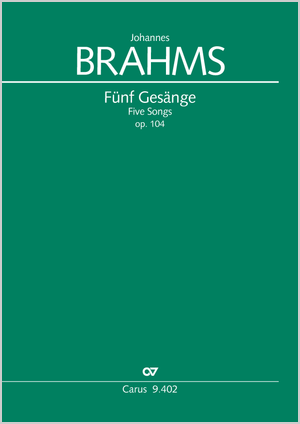
Five Songs
for mixed choir a cappella op. 104
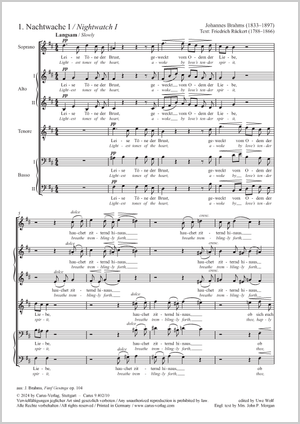
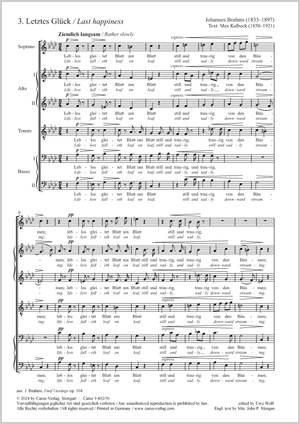
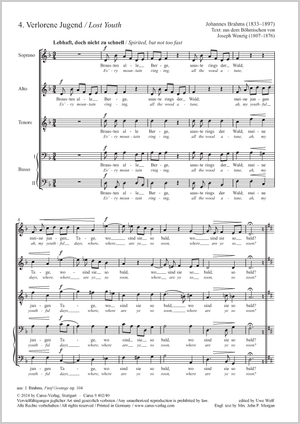
“Lösche die Lampe getrost, hülle in Frieden dich ein” (“Put out thy lamp with good heart, lay thee then peacefully down”) – Johannes Brahms’s final cycle of secular songs for mixed choir a cappella paints a striking picture of mortality, ultimate happiness and lost youth. The 4- to 6-part songs fascinate with their immense power and range of expression, which runs from short, quiet, melancholy phrases (“breathe tremblingly forth”, “O lifeless falleth”) to elements of folk song (the horn calls in Nightwatch II) to mighty climaxes and double-choir effects produced with great economy of means. The closing movement In Autumn, with its idiosyncratic harmonies, is certainly one of Brahms’s best secular compositions.
All the songs are also available separately and as digital editions. The accompanying English text is the translation authorized by the composer himself.


 Listen
(2)
Listen
(2)
- Nightwatch I
- Nightwatch II
Contents


-
Composer
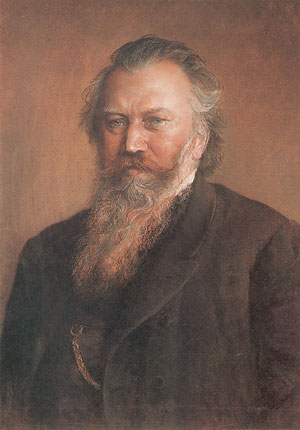
Johannes Brahms
| 1833-1897Johannes Brahms' study of musical tradition was of crucial importance to his output: he combined church modes, canonic technique, Baroque style and diction, Bach's counterpoint and Beethoven's thematic-motivic work with the harmonic and expressive achievements of Romanticism to form his own distinctive style. In this respect his choral songs and vocal quartets (e.g. the “Liebeslieder Waltzes” and “New Liebeslieder Waltzes”), often to folk song texts, in which a musical microcosm unfolds, are examplary. His “Deutsches Requiem”, available from Carus in several different versions, constitutes one of the most fascinating confessions of faith in the history of music. Personal details
-
Editor
Uwe Wolf
| 1961As a musicologist, Dr. Uwe Wolf is particularly at home in the 17th and 18th centuries. The focus of his work ranges from the time of Monteverdi and Schütz to Bach and the generation of Bach's sons and pupils through to Viennese Classicism. He has been head of the editorial department at Carus-Verlag since October 2011. Prior to this, he worked in Bach research for over 20 years. Personal details
-
Songwriter / Librettist
Friedrich Rückert
| 1788-1866Friedrich Rückert, born 1788 in Schweinfurt, died 1866 near Coburg. Poet and translator. Professor of oriental philology in Erlangen. Personal details
-
Translator
John P. Morgan
Reviews on our website can only be submitted by customers with a registered user account. A check whether the rated products were actually purchased does not take place.
Frequent questions about this work
 There are no questions and answers available so far or you were unable to find an answer to your specific question about this work? Then click here and send your specific questions to our Customer Services!