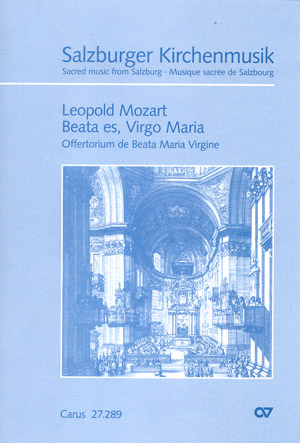
Beata es, Virgo Maria
Offertorium de Beata Maria Virgine um 1760
 View
View

-
Composer
Leopold Mozart
| 1719-1787Johann Georg Leopold Mozart was born in 1719 to a respectable Augsburg family. He received his basic musical and humanistic education at the St. Salvator Jesuit College in Augsburg. In 1737 he went to Salzburg to study philosophy and law at the Benedictine University. He was hired into the service of Johann Baptist, Count of Thurn-Valsassina and Taxis, as valet and musician in 1740 at the latest. In the fall of 1743 he obtained a position as the fourth violinist in the Court Orchestra of the Princely Archbishop of Salzburg. He took over violin instruction at the Kapellhaus in 1756 and, in 1758, moved up to the position of second violinist. In 1763, following the death of the Court Music Director, Johann Eberlin, and the appointment of Giuseppe Lolli as his successor, he advanced to Assistant Court Music Director. However, his lifelong desire to become Music Director of the Court Orchestra was never fulfilled. After Wolfgang moved to Vienna in 1781, Leopold Mozart led a reclusive life in the so-called “dancing master’s” house (“Mozart’s House” on Makartplatz today), dedicated himself to teaching and, in his final years, to raising his grandson. Leopold Mozart died in Salzburg on 28 May 1787. Personal details
-
Editor
Armin Kircher
| 1966-2015Armin Kircher studied church music at the Mozarteum in Salzburg. Until his death he was Director of the Church Music Department of the Archdiocese of Salzburg, and since 1992 he had been administrative director of the Österreichische Werkwoche für Kirchenmusik (Austrian Week for Church Music). He was also Director of Music at St Peter's Abbey, Salzburg and organist at the Cajetan Church in Salzburg. The collections he edited for the Catholic liturgy have become established standard works, in particular the choral collections Chorbuch Mozart • Haydn, the Chorbuch Kirchenjahr (Choirbook for the Church Year) and publications for organ and choir for the new Catholic hymnbook Gotteslob. Armin Kircher also made a name as an arranger of beautiful settings for choir and organ. Personal details
-
Vocal score arranger
Paul Horn
| 1922-2016Paul Horn war ein deutscher Kirchenmusiker, Organist, Komponist und Musikwissenschaftler. Er studierte Kirchenmusik und Orgel an der Evangelischen Kirchenmusikschule Esslingen am Neckar bei Hans-Arnold Metzger und Musikwissenschaft, Theologie und Geschichte an der Universität Tübingen. Seine berufliche Laufbahn begann als Kantor an der Evangelischen Michaelskirche in Stuttgart-Degerloch. 1954 wurde er Kantor an der Evangelischen Stadtkirche Ravensburg, eine Position, die er bis zu seiner Pensionierung innehatte. Als Musikwissenschaftler arbeitete Horn bis ins hohe Alter eng mit Carus zusammen. So stammen zahlreiche Carus-Klavierauszüge aus seiner Feder. Personal details
-
Continuo realization
Paul Horn
| 1922-2016Paul Horn war ein deutscher Kirchenmusiker, Organist, Komponist und Musikwissenschaftler. Er studierte Kirchenmusik und Orgel an der Evangelischen Kirchenmusikschule Esslingen am Neckar bei Hans-Arnold Metzger und Musikwissenschaft, Theologie und Geschichte an der Universität Tübingen. Seine berufliche Laufbahn begann als Kantor an der Evangelischen Michaelskirche in Stuttgart-Degerloch. 1954 wurde er Kantor an der Evangelischen Stadtkirche Ravensburg, eine Position, die er bis zu seiner Pensionierung innehatte. Als Musikwissenschaftler arbeitete Horn bis ins hohe Alter eng mit Carus zusammen. So stammen zahlreiche Carus-Klavierauszüge aus seiner Feder. Personal details
Reviews
Salzburg war im 17. und 18. Jahrhundert ein Zentrum der Pflege mehrstimmiger Offertoriumsvertonungen und des mehrsätzigen Offertorienkonzertes. Diese Formtypen entwickelten sich im süddeutschen Raum zu einer eigenständigen Gattung - ähnlich den klassischen Ordinariumsvertonungen. In Salzburg war Leopold Mozart, viele Jahre Vizekapellmeister in der fürsterzbischöflichen Hofkapelle. Die Bestimmung des Offertoriums für den Salzburger Dom scheint naheliegend, wofür die "solemne" Besetzung mit Trompeten und Pauken spricht. [...] Herrliche Musik, die sich mit relativ wenig Aufwand zu vielen Ordinariumsvertonungen der Salzburger Klassik kombinieren lässt.
Quelle: Singende Kirche 2007/2
Reviews on our website can only be submitted by customers with a registered user account. A check whether the rated products were actually purchased does not take place.
Frequent questions about this work
 There are no questions and answers available so far or you were unable to find an answer to your specific question about this work? Then click here and send your specific questions to our Customer Services!