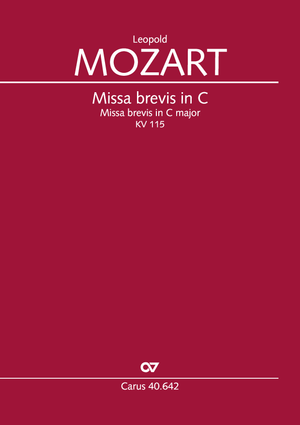
Missa brevis in C major
KV 115
The Missa brevis in C Major, for 4 vocal parts and organ, was long considered one of young Mozart's excercises in The Italian style of church music. Karl Pfannhauser, after his studies of Leopold Mozart's masses, was the first to discover that the C-major fragment had been incorporated into the latter's Missa solemnis in C Major. As Mozart was only 8 years old at the time his father wrote this mass, he cannot be deemed the composer of the fragmentary C-major mass that is listed as KV 115. The mass contains only the Kyrie, Gloria, Credo and Sanctus, the last of which breaks off in bar 9. For the present edition our aim was to draw upon Leopold's own works for the missing parts.
Explore
 View
View

Purchase
Additional product information
-
Composer
Leopold Mozart
| 1719-1787Johann Georg Leopold Mozart was born in 1719 to a respectable Augsburg family. He received his basic musical and humanistic education at the St. Salvator Jesuit College in Augsburg. In 1737 he went to Salzburg to study philosophy and law at the Benedictine University. He was hired into the service of Johann Baptist, Count of Thurn-Valsassina and Taxis, as valet and musician in 1740 at the latest. In the fall of 1743 he obtained a position as the fourth violinist in the Court Orchestra of the Princely Archbishop of Salzburg. He took over violin instruction at the Kapellhaus in 1756 and, in 1758, moved up to the position of second violinist. In 1763, following the death of the Court Music Director, Johann Eberlin, and the appointment of Giuseppe Lolli as his successor, he advanced to Assistant Court Music Director. However, his lifelong desire to become Music Director of the Court Orchestra was never fulfilled. After Wolfgang moved to Vienna in 1781, Leopold Mozart led a reclusive life in the so-called “dancing master’s” house (“Mozart’s House” on Makartplatz today), dedicated himself to teaching and, in his final years, to raising his grandson. Leopold Mozart died in Salzburg on 28 May 1787. Personal details
Reviews on our website can only be submitted by customers with a registered user account. A check whether the rated products were actually purchased does not take place.
No feedback available for this product.
Frequent questions about this work
 There are no questions and answers available so far or you were unable to find an answer to your specific question about this work? Then click here and send your specific questions to our Customer Services!