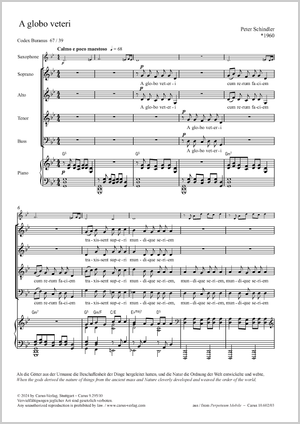

Composer Peter Schindler on this separate edition from Perpetuum mobile:
“A globo veteri” from the Codex Buranus (text no. 67) both asks and answers the questions “Where from?” and “Why?” about the beginnings of life: our destiny is predetermined, no one can escape it. All events or developments have already been anticipated or foreseen by creation (iam preconceperat).
The music flows calmly, majestically and solemnly. Its serene progress concludes in a tender interpretation of text no. 39 from the Codex Buranus, “Quod cinis es memento” (Remember, man, that thou art dust).
So right at the beginning of Perpetuum mobile we are reminded of the transience of life and the inevitability of death in an ancient context, just as it is already written in Genesis 3:19.
Explore


 Listen
(1)
Listen
(1)
- A globo veteri
Purchase
Additional product information
-
Composer
Peter Schindler
| 1960Composer, pianist and organist Peter Schindler writes and performs music for ballets and theatrical performances, films and dramatic recordings, instrumental and choral arrangements, chansons and sacred works. He is particularly passionate about his compositions for children and young adults, which has come to comprise hundreds of humourous children’s songs (Kinderhits mit Witz). His full-length musicals include Geisterstunde auf Schloss Eulenstein (Witching Hour at Eulenstein Castle), Max und die Käsebande (Max and the Cheese Gang), König Keks (Cookie King), Zirkus Furioso (Circus Allegro), and SCHOCKORANGE. These musicals are some of the most frequently played pieces of their kind by children’s and youth choirs in German-speaking theaters and schools. With his first English musical Circus Allegro, Peter’s hugely sucessful work for all kids under 100 is now also accessible to audiences around the world.
For further information visit: http://peter-schindler.de/
We asked the composer 6 questions, read them here in our blog: https://blog.carus-verlag.com/en/personalities/5-questions-for-peter-schindler/
Personal details
Reviews on our website can only be submitted by customers with a registered user account. A check whether the rated products were actually purchased does not take place.
No feedback available for this product.
Frequent questions about this work
 There are no questions and answers available so far or you were unable to find an answer to your specific question about this work? Then click here and send your specific questions to our Customer Services!