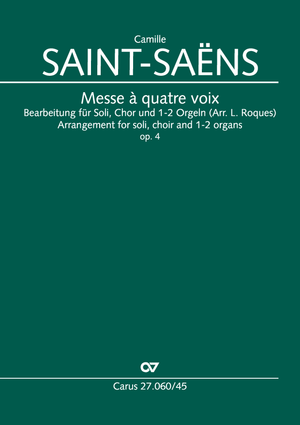
Messe à quatre voix
op. 4, 1856
Carus-Verlag is now publishing this early work by Camille Saint-Saëns in a critical new edition. Among the sacred works by Saint-Saëns there are just two settings of the mass: the "Messe de Requiem" op. 54 from his middle period (1878), and the Mass op. 4 dating from 1856. This was first performed on 21 April 1857.
Camille Saint-Saëns was a devoted follower of historicism as part of the reform movement in French church music. This is more evident in the mass published here than anywhere else. The model for this work is the unison "Messe Royale" by Henry DuMont (1610–1683). Saint-Saëns combined its Gregorian style in a convincing manner with contemporary elements of Romantic composition, an expressive chromaticism, which determines the harmonic progression.
Alongside the orchestral forces, the Grand Orgue plays an important role. Used as a solo instrument, it is an equal partner in the composition.
The organ part included the performance material of the present edition consists of the Organo I (grand orgue) and Organo II (ripieno) parts, so that in cases where a second instrument is unavailable, the parts can also be performed by a single organ.
If there is no orchestra, you can also perform this piece with one or two organs (Carus 27.060/45)
.

 Additional material
- Purchase additional material as a download product.
-
 Digital text (without sheet music) incl. printing licence, html file, singing text, english translationhtml file, singing text, english translation (Sample)
1 Kyrie (Soli e Coro) Lord, have mercy on us.
Christ, have mercy on us.
Lord, have mercy on us.2 Gloria (Soli SA e Coro) Glory be to God on high
and on earth peace to men of good will.
We bless thee; we glorify thee.
We give thee thanks for thy great glory.
Lord God, heavenly King,
God the almighty Father.
O Lord, the only-begotten Son, Jesus Christ,
O Lord God, Lamb of God, Son of the Father.
Thou who takest away the sins of the world, have mercy upon us.
Receive our prayer.
Thou that sittest at the right hand of God the Father, have mercy upon us.
For thou alone art the Holy One,
thou alone art the Lord, thou alone art the Most High, Jesus Christ.
...
-
Digital text (without sheet music) incl. printing licence, html file, singing text, german translationhtml file, singing text, german translation (Sample)
1 Kyrie (Soli e Coro) Herr, erbarme dich unser.
Christus, erbarme dich unser.
Herr, erbarme dich unser.2 Gloria (Soli SA e Coro) Ehre sei Gott in der Höhe
und Friede auf Erden den Menschen, die guten Willens sind.
Wir preisen dich, wir rühmen dich.
Wir danken dir, denn groß ist deine Herrlichkeit.
Herr und Gott, König des Himmels,
Gott, allmächtiger Vater.
Herr Jesus Christus, eingeborener Sohn,
Herr und Gott, Lamm Gottes, Sohn des Vaters.
Du nimmst hinweg die Sünden der Welt, erbarme dich unser;
Nimm an unser Gebet.
Du sitzest zur Rechten des Vaters: erbarme dich unser.
Denn du allein bist der Heilige,
du allein der Herr, du allein der Höchste, Jesus Christus.
Mit dem Heiligen Geist, zur Ehre Gottes, des Vaters.
Amen....
-
Digital text (without sheet music) incl. printing licence, html file, singing text, originalhtml file, singing text, original (Sample)
1 Kyrie (Soli e Coro) Kyrie eleison.
Christe eleison.
Kyrie eleison.2 Gloria (Soli SA e Coro) Gloria in excelsis Deo.
Et in terra pax hominibus bonae voluntatis.
Benedicimus te. Glorificamus te.
Gratias agimus tibi propter magnam gloriam tuam.
Domine Deus, Rex coelestis,
Deus Pater omnipotens.
Domine Fili unigenite, Jesu Christe.
Domine Deus, Agnus Dei, Filius Patris.
Qui tollis peccata mundi, miserere nobis.
Suscipe deprecationem nostram.
Qui sedes ad dexteram Patris, miserere nobis.
Quoniam tu solus Sanctus,
tu solus Dominus, tu solus Altissimus, Jesu Christe.
Cum Sancto Spiritu, in gloria Dei Patris.
...
-
Composer
Camille Saint-Saëns
| 1835-1921Camille Saint-Saëns was a true multi-talent. He was a pianist, conductor, organist, musicologist, music teacher and composer and became famous above all for the Carnival of the Animals and the opera Samson et Dalila.
He composed his Symphony in A major at the age of 15 and was accepted to the University of Paris at the age of 16. Saint-Saëns studied piano, organ and composition at the Paris Conservatoire and became organist of Saint-Séverin in Paris in 1852. In the same year, he also met Franz Liszt, who subsequently exerted an influence on Saint-Saëns' compositional work. A year later, he celebrated his musical debut as a composer. The opera Samson et Dalila, which premiered in Weimar in 1877, brought him lasting success in opera houses to this day. His Christmas oratorio Oratorio de Noël, which is available from Carus-Verlag, is probably the best-known of his sacred works. Personal details
-
Editor
Dieter Zeh
| 1942
-
Vocal score arranger
Sven Hiemke
Reviews
... Die Edition ist tadellos, mit dreisprachigem, nicht allzu ausladendem Vorwort.
Gabriel Dessauer, Musik & Kirche, März/April 2018
Reviews on our website can only be submitted by customers with a registered user account. A check whether the rated products were actually purchased does not take place.
Frequent questions about this work
Are two organs definitely required for a performance?
Is a harp definitely required?
Can the scoring be reduced in any other way?
Is there also an arrangement for chamber orchestra?
 There are no questions and answers available so far or you were unable to find an answer to your specific question about this work? Then click here and send your specific questions to our Customer Services!