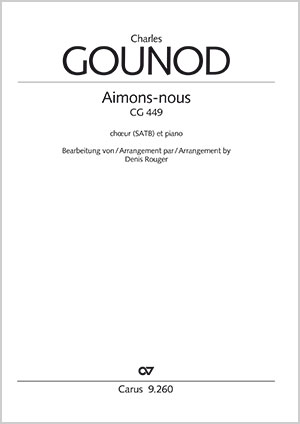
The three verses of Aimons-nous, separated by piano interludes, are cheerful and amorous, an invitation to everlasting mutual love. The text portrays this almost as a law of nature: rivers and streams combine, the sun embraces the earth, and the birds snuggle close to each other in their nest. Light, rippling syncopations in the piano accompany Gounod’s typical catchy melodic writing in the vocal parts. The writer Jules Barbier was Gounod’s favored opera librettist (Faust, Roméo et Juliette), but many other 19th century opera composers also set his texts, including Camille Saint-Saëns, Giacomo Meyerbeer, and Jacques Offenbach.
This art song was originally composed not for chamber choir, but for solo voice and piano. Denis Rouger has carefully adapted it to suit the requirements and expressive possibilities offered by a larger ensemble, without losing the any of the qualities of the original in the process. Each part in the choir has a melodic line drawn from the harmonic and rhythmic framework. In the process, the variety and refinement of the choral language combines with an enormous flexibility in form and expression, as French melodies or German art song demand from a soloist and pianist.
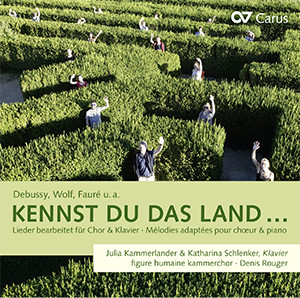
The songs have been recorded by the figure humaine chamber choir on the CD Kennst du das Land... (Carus 83.495).
Explore
 View
View
 Listen
(1)
Listen
(1)
- Aimons-nous
 Practise
-
Pronouncing Aid
- Aimons-nous
 Additional material
- Purchase additional material as a download product.
-
 Digital text (without sheet music) incl. printing licence, html file, singing text, french translationhtml file, singing text, french translation (Sample)
Au fleuve le ruisseau se mêle,
Et le fleuve à la mer,
Au vent la brise unit son aile,
Se confond dans l’air.Femme, c’est la loi suprême !
Ange, c’est la douce loi !
Tout veut s’unir à ce qu’il aime !
M’aimes-tu, dis-moi?Vois les cieux dorer les cimes !
Vois s’unir les flots heureux !
Vois se pencher sur les abîmes
Ces lierres amoureux !Le soleil étreint la terre !
L’oiseau chante et pleure, hélas !
Pourquoi ce divin mystère
Si tu n’aimes pas !Comme ces rayons de flamme,
Et ces flots, et ces zéphyrs,
Mon âme cherche dans ton âme
L’écho de ses soupirs !...
-
Digital text (without sheet music) incl. printing licence, html file, singing text, german translationhtml file, singing text, german translation (Sample)
Der Bach verschmilzt mit dem Fluss,
und der Fluss mit dem Meer,
die Brise vereint ihren Flügel mit dem
Wind und vermischt sich in der Luft.Frau, das ist das oberste Gesetz!
Engel, das ist das liebliche Gesetz!
Alles möchte sich mit dem, was es liebt, vereinen!
Sage mir, liebst du mich?Sieh den Himmel die Wipfel vergolden!
Sieh die glücklichen Fluten sich vereinen!
Sieh diesen verliebten Efeu sich über
die Abgründe neigen!Die Sonne umarmt die Erde!
Der Vogel singt und, ach, weint!
Warum dieses göttliche Mysterium,
wenn du nicht liebst!Wie diese Strahlen der Flamme
und diese Fluten und diese Zephire,
sucht meine Seele in deiner Seele
das Echo ihrer Seufzer!...
Purchase
Additional product information
-
Composer
Charles Gounod
| 1818-1893Charles Gounod is known today especially as the composer of the operas Faust (1859) and Roméo et Juliette (1867), and of the very popular Méditation sur le 1er prélude de piano de J. S. Bach (1852), arranged in 1859 as an Ave Maria. The fact that Gounod is regarded primarily as an important opera composer does not do justice to his extensive œuvre, which encompasses all genres. His creative output is dominated by his church music, which overshadows that of all other 19th-century composers. Personal details
-
Songwriter / Librettist
Jules Barbier
| 1825-1901
-
Arranger
Denis Rouger
| 1961Denis Rouger gained his initial musical experience as the son of a Parisian family of musicians and during his studies at the Conservatoire National Supérieur de Musique de Paris, where he received first prizes in harmony, fugue and counterpoint.
He was a lecturer and choirmaster at the University of Paris-Sorbonne for 20 years and choirmaster at Notre-Dame de Paris Cathedral for 10 years. He is honorary conductor of the Parisian church La Madeleine. He also collaborates with numerous ensembles in Germany. He has been invited as a guest conductor by radio choirs, the Balthasar-Neumann-Chor, the Baden-Württemberg State Youth Choir and the Stuttgart Philharmonic Orchestra, among others. Concerts have taken him to Italy, the Netherlands, Canada, Russia, the United Arab Emirates and Switzerland (Lucerne Festival).
He gives master classes in Sweden, Bulgaria, France, Germany, as well as in Switzerland.
Denis Rouger has been Professor of Choral Conducting at the Stuttgart State University of Music and Performing Arts since 2011. The chamber choir he founded at the university in the fall of 2011 won first prize at the International Choir Competition in Mosbach (Germany) in 2014.
In addition to his work as a choirmaster, he composes and arranges French and German songs for choir. His arrangements on the CDs Kennst Du das Land ... and ... wo die Zitronen blühn (Carus) were well received by the press and radio. In collaboration with Carus-Verlag, he has edited the choir book Französische Chormusik, which received the German Music Edition Award “Best Edition” in 2019.
In 2016, Denis Rouger founded the figure humaine kammerchor (www.figurehumaine.de), with which he regularly gives concerts at renowned festivals.
Personal details
Reviews on our website can only be submitted by customers with a registered user account. A check whether the rated products were actually purchased does not take place.
No feedback available for this product.
Frequent questions about this work
 There are no questions and answers available so far or you were unable to find an answer to your specific question about this work? Then click here and send your specific questions to our Customer Services!