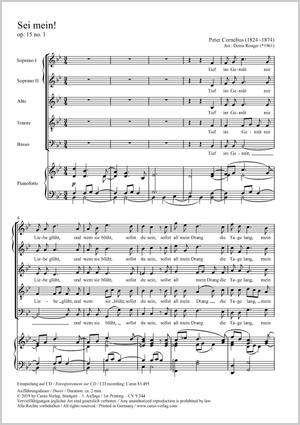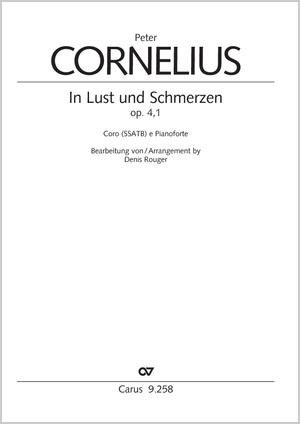
Peter Cornelius once described himself as a “poet-composer”, for he wrote the texts for many of his songs himself. This is the case with In Lust und Schmerzen, the first song of the three „Liebeslieder“ (Love songs) which make up op. 4. Cornelius composed these songs in 1854 in Weimar, where he was living near Franz Liszt whom he greatly admired. Liszt’s influence can be discerned in the urgent piano accompaniment and the cumulative chromaticism which Cornelius chose as a means of expressing the emotional content of the text in music, alternating between “Lust und Leiden”, between “Kampf und Ruh”. The marking “Leidenschaftlich bewegt” (passionately agitated) aptly describes the character of the song.
This art song was originally composed not for chamber choir, but for solo voice and piano. Denis Rouger has carefully adapted it to suit the requirements and expressive possibilities offered by a larger ensemble, without losing the any of the qualities of the original in the process. Each part in the choir has a melodic line drawn from the harmonic and rhythmic framework. In the process, the variety and refinement of the choral language combines with an enormous flexibility in form and expression, as French melodies or German art song demand from a soloist and pianist.
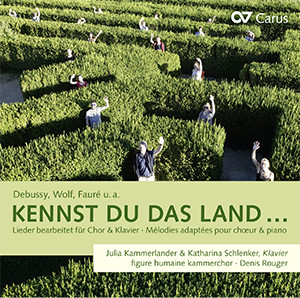
The songs have been recorded by the figure humaine chamber choir on the CD Kennst du das Land... (Carus 83.495).
Explore
 View
View
 Listen
(1)
Listen
(1)
- In Lust und Schmerzen
 Additional material
- Purchase additional material as a download product.
-
 Digital text (without sheet music) incl. printing licence, html file, singing text, originalhtml file, singing text, original (Sample)
In Lust und Schmerzen,
In Kampf und Ruh
Steht eins fest im Herzen,
Und das bist du!
Das sind deine Augen,
Das ist ein Mund,
Das ist deiner Seele
Tiefinnerster Grund.
Das ist deine Liebe,
Sie winkt mir zu,
In Lust und Leiden,
In Kampf und Ruh.Gott, der die Welten im Herzen trägt,
Hat mir ins Herz deine Liebe gelegt;
Gott hielt die Welt eines Heilands wert,
Er hat auch mir deine Liebe beschert.
Und ob die Welt uns zu trennen meint,
Wir sind in Gott treuinnig vereint.Peter Cornelius (1824–1874)
...
-
Digital text (without sheet music) incl. printing licence, html file, singing text, french translationhtml file, singing text, french translation (Sample)
Dans la joie et dans les douleurs,
Dans le combat et le repos,
Quelque chose se tient dans mon cœur,
Et c’est toi !
Ce sont tes yeux,
C’est ta bouche,
C’est le centre profond
De ton âme.
C’est ton amour
Qui me fait signe
Dans la joie et les souffrances,
Dans le combat et le repos.Dieu qui porte les mondes en son cœur
M’a laissé dans le cœur ton amour;
Dieu a trouvé que le monde méritait un Sauveur,
Il m’a aussi donné ton amour.
Et si le monde pense nous séparer,
Nous sommes rassemblés en Dieu.Peter Cornelius (1824–1874)
Traduction: Christiane Rouger-Ortwein...
Purchase
Additional product information
-
Composer
Peter Cornelius
| 1824-1874Peter Cornelius, born in Mainz in 1824, died there in 1874. Son of an actors' couple. Initially also took up this profession, but then studied counterpoint with S. Dehn in Berlin from 1844 to 1846. His church music dates mainly from this period and from the years after 1852, when he went to Liszt in Weimar, who encouraged his work as a church composer. Cornelius became one of the most important pioneers of the New German School. He followed Wagner to Munich in 1865, where he worked as a composition teacher at the newly founded Royal School of Music from 1867 on. Today, his opera ‘Der Babier von Bagdad’ (1858) and his ‘Weihnachtslieder’ op. 8 are particularly well known. Personal details
-
Songwriter / Librettist
Peter Cornelius
| 1824-1874Peter Cornelius, born in Mainz in 1824, died there in 1874. Son of an actors' couple. Initially also took up this profession, but then studied counterpoint with S. Dehn in Berlin from 1844 to 1846. His church music dates mainly from this period and from the years after 1852, when he went to Liszt in Weimar, who encouraged his work as a church composer. Cornelius became one of the most important pioneers of the New German School. He followed Wagner to Munich in 1865, where he worked as a composition teacher at the newly founded Royal School of Music from 1867 on. Today, his opera ‘Der Babier von Bagdad’ (1858) and his ‘Weihnachtslieder’ op. 8 are particularly well known. Personal details
-
Arranger
Denis Rouger
| 1961Denis Rouger gained his initial musical experience as the son of a Parisian family of musicians and during his studies at the Conservatoire National Supérieur de Musique de Paris, where he received first prizes in harmony, fugue and counterpoint.
He was a lecturer and choirmaster at the University of Paris-Sorbonne for 20 years and choirmaster at Notre-Dame de Paris Cathedral for 10 years. He is honorary conductor of the Parisian church La Madeleine. He also collaborates with numerous ensembles in Germany. He has been invited as a guest conductor by radio choirs, the Balthasar-Neumann-Chor, the Baden-Württemberg State Youth Choir and the Stuttgart Philharmonic Orchestra, among others. Concerts have taken him to Italy, the Netherlands, Canada, Russia, the United Arab Emirates and Switzerland (Lucerne Festival).
He gives master classes in Sweden, Bulgaria, France, Germany, as well as in Switzerland.
Denis Rouger has been Professor of Choral Conducting at the Stuttgart State University of Music and Performing Arts since 2011. The chamber choir he founded at the university in the fall of 2011 won first prize at the International Choir Competition in Mosbach (Germany) in 2014.
In addition to his work as a choirmaster, he composes and arranges French and German songs for choir. His arrangements on the CDs Kennst Du das Land ... and ... wo die Zitronen blühn (Carus) were well received by the press and radio. In collaboration with Carus-Verlag, he has edited the choir book Französische Chormusik, which received the German Music Edition Award “Best Edition” in 2019.
In 2016, Denis Rouger founded the figure humaine kammerchor (www.figurehumaine.de), with which he regularly gives concerts at renowned festivals.
Personal details
Reviews on our website can only be submitted by customers with a registered user account. A check whether the rated products were actually purchased does not take place.
No feedback available for this product.
Frequent questions about this work
 There are no questions and answers available so far or you were unable to find an answer to your specific question about this work? Then click here and send your specific questions to our Customer Services!