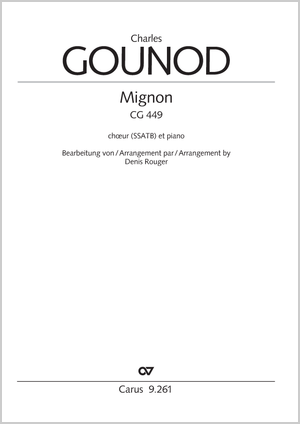
In Goethe’s novel Wilhelm Meister’s Apprenticeship, the girl Mignon embodies the longing for Italy. In the novel, she sings the song “Kennst du das Land, wo die Zitronen blühn” (Do you know the country where the lemon trees flower). Charles Gounod set a free translation of the text by Louis Gallet in 1871. At the appassionato, melodies heavy with longing over a piano part with flowing triplet figurations express the wanderlust for the country where “die Orangen wie Gold glänzen!” (where the oranges shine like gold!)
This art song was originally composed not for chamber choir, but for solo voice and piano. Denis Rouger has carefully adapted it to suit the requirements and expressive possibilities offered by a larger ensemble, without losing the any of the qualities of the original in the process. Each part in the choir has a melodic line drawn from the harmonic and rhythmic framework. In the process, the variety and refinement of the choral language combines with an enormous flexibility in form and expression, as French melodies or German art song demand from a soloist and pianist.
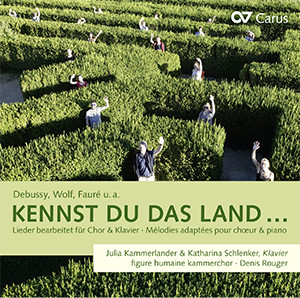
The songs have been recorded by the figure humaine chamber choir on the CD Kennst du das Land... (Carus 83.495).
Explore
 View
View
 Listen
(1)
Listen
(1)
- Mignon
 Practise
-
Pronouncing Aid
- Mignon
 Additional material
- Purchase additional material as a download product.
-
 Digital text (without sheet music) incl. printing licence, html file, singing text, originalhtml file, singing text, original (Sample)Mignon
Connais-tu le pays où dans l’immense plaine
Brille comme de l’or le fruit des orangers,
Où sous des cieux bénis une amoureuse haleine
Recueille et porte au loin le parfum des vergers ?Ce pays où le jour plus radieux se lève,
Le connais-tu, dis-moi, le connais-tu ?
C’est là, mon bien-aimé que m’emporte mon rêve ! …
Ah ! c’est là ! c’est là !
que je voudrais m’en aller avec toi !Connais-tu la maison toute blanche et posée
Dans les bosquets de myrte aimés des papillons
Et les champs lumineux où la fraîche rosée
Sème ses diamants dans l’herbe des sillons ?Louis Gallet (1835–1898) après J. W. von Goethe
...
-
Digital text (without sheet music) incl. printing licence, html file, singing text, german translationhtml file, singing text, german translation (Sample)
Kennst du das Land,
wo auf der weiten Ebene die Orangen wie Gold glänzen,
wo unter dem gesegneten Himmel ein verliebter Atem
den Duft der Obstgärten aufnimmt und in die Ferne trägt?Dieses Land, wo der Tag strahlender aufgeht,
kennst du es, sage mir, kennst du es?
Dahin, mein Geliebter, zieht mich mein Traum! …
Ah! dahin! dahin!
möcht’ ich mit dir zieh’n!Kennst du das weiße Haus,
das zwischen den von Schmetterlingen geliebten Myrtenbüschen steht
und die lichtdurchfluteten Felder, auf denen der frische Tau
seine Diamanten in das Gras der Furchen sät?Louis Gallet (1835–1898) nach J. W. von Goethe
Übersetzung: Christiane Rouger-Ortwein
...
Purchase
Additional product information
-
Composer
Charles Gounod
| 1818-1893Charles Gounod is known today especially as the composer of the operas Faust (1859) and Roméo et Juliette (1867), and of the very popular Méditation sur le 1er prélude de piano de J. S. Bach (1852), arranged in 1859 as an Ave Maria. The fact that Gounod is regarded primarily as an important opera composer does not do justice to his extensive œuvre, which encompasses all genres. His creative output is dominated by his church music, which overshadows that of all other 19th-century composers. Personal details
-
Songwriter / Librettist
Louis Gallet
| 1835-1898
-
Songwriter / Librettist
Johann Wolfgang Goethe
| -1832Johann Wolfgang von Goethe is today a dazzling figure in world literature. He was born in Frankfurt am Main and initially studied law, but then followed his inclination towards poetry. With the drama Götz von Berlechingen and the epistolary novel The Sorrows of Young Werther, he made important contributions to the literary movement of Sturm und Drang.
From 1775 onwards, Goethe was employed at the court of Duke Carl August in Weimar. In addition to his work at court as a minister and director of the Weimar Court Theatre, he wrote his major works here, including the drama Faust, other novels and many poems, which are still a source of inspiration for musical adaptations today. His poems were a source of inspiration for composers, especially in the 19th century, such as Franz Schubert. Schubert alone set 52 of Goethe's works to music, the best known of which are probably the songs Gretchen am Spinnrade and Erlkönig. Goethe also became acquainted with several composers of the time. He was particularly enthusiastic about the young Felix Mendelssohn-Bartholdy, who also set Goethe's lines to music in the ballad Die erste Walpurgisnacht (The First Walpurgis Night). Personal details
-
Arranger
Denis Rouger
| 1961Denis Rouger gained his initial musical experience as the son of a Parisian family of musicians and during his studies at the Conservatoire National Supérieur de Musique de Paris, where he received first prizes in harmony, fugue and counterpoint.
He was a lecturer and choirmaster at the University of Paris-Sorbonne for 20 years and choirmaster at Notre-Dame de Paris Cathedral for 10 years. He is honorary conductor of the Parisian church La Madeleine. He also collaborates with numerous ensembles in Germany. He has been invited as a guest conductor by radio choirs, the Balthasar-Neumann-Chor, the Baden-Württemberg State Youth Choir and the Stuttgart Philharmonic Orchestra, among others. Concerts have taken him to Italy, the Netherlands, Canada, Russia, the United Arab Emirates and Switzerland (Lucerne Festival).
He gives master classes in Sweden, Bulgaria, France, Germany, as well as in Switzerland.
Denis Rouger has been Professor of Choral Conducting at the Stuttgart State University of Music and Performing Arts since 2011. The chamber choir he founded at the university in the fall of 2011 won first prize at the International Choir Competition in Mosbach (Germany) in 2014.
In addition to his work as a choirmaster, he composes and arranges French and German songs for choir. His arrangements on the CDs Kennst Du das Land ... and ... wo die Zitronen blühn (Carus) were well received by the press and radio. In collaboration with Carus-Verlag, he has edited the choir book Französische Chormusik, which received the German Music Edition Award “Best Edition” in 2019.
In 2016, Denis Rouger founded the figure humaine kammerchor (www.figurehumaine.de), with which he regularly gives concerts at renowned festivals.
Personal details
Reviews on our website can only be submitted by customers with a registered user account. A check whether the rated products were actually purchased does not take place.
No feedback available for this product.
Frequent questions about this work
 There are no questions and answers available so far or you were unable to find an answer to your specific question about this work? Then click here and send your specific questions to our Customer Services!