

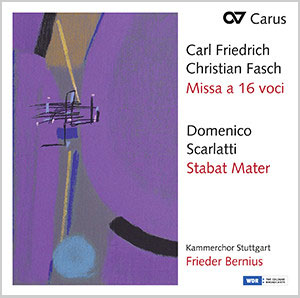

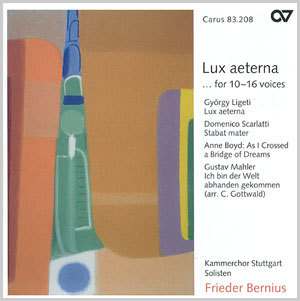
The unique spatial structure and large scale of Scarlatti’s “Stabat Mater” place it amongst the very grandest musical creations of the first half of the 18th century. Its particular musical interest and charm lie in the independence of the ten vocal parts. The equal importance of the two vocal groups, variety in the vocal ranges, and different combinations of voices, ensuring a sensitive and subtle differentiation of vocal colors, all contribute to an impressive overall effect.
Simply practice. Anytime. Everywhere.
Whether at home on your tablet or PC or on the road on your smartphone: with carus music, the Choir Coach, you always have your choral works with you to practice! With the carus music choir app, you can listen to your score together with a first-class recording on any device and easily practice your own choir part with a coach. With carus music, your concert preparation is easy, efficient and fun to master!
Performers: Kammerchor Stuttgart - Frieder Bernius
Simply practice. Anytime. Everywhere.
Whether at home on your tablet or PC or on the road on your smartphone: with carus music, the Choir Coach, you always have your choral works with you to practice! With the carus music choir app, you can listen to your score together with a first-class recording on any device and easily practice your own choir part with a coach. With carus music, your concert preparation is easy, efficient and fun to master!
Performers: Kammerchor Stuttgart - Frieder Bernius
Explore
 Listen
(10)
Listen
(10)
- Stabat Mater
- Cujus animam gementem
- Quis non posset
- Eja Mater, fons amoris
- Sancta Mater, istud agas
- Fac me vere tecum flere
- Juxta crucem
- Inflammatus
- Fac tu animae
- Amen
 Additional material
- Purchase additional material as a download product.
-
 Digital text (without sheet music) incl. printing licence, html file, singing text, originalhtml file, singing text, original (Sample)Nr. 1
Stabat Mater dolorosa
Nr. 2
juxta crucem lacrimosa,
dum pendebat Filius.Cujus animam gementem
contristatam et dolentem
pertransivit gladius.O quam tristis et afflicta
fuit illa benedicta
Mater Unigeniti!Quae maerebat et dolebat,
et tremebat, dum videbat
nati poenas inclyti.Quis est homo qui non fleret,
Nr. 3
Christi Matrem si videret
in tanto supplicio?Quis non posset contristari,
Christi Matrem contemplari...
-
Digital text (without sheet music) incl. printing licence, html file, singing text, english translationhtml file, singing text, english translation (Sample)No. 1
A weeping mother was standing
No. 2
full of sorrow beside the cross,
while her Son was hanging on it.Through her grieving heart,
No. 3
anguished and lamenting,
a sword had passed.
Oh, how sad and afflicted
was that blessed Mother
of an only Son!
She mourned and grieved
and trembled as she saw
the suffering of her glorious Son.
Who is the man who would not weep,
seeing the mother of Christ
in such torment?Who would not feel compassion,
watching the loving mother...
-
Digital text (without sheet music) incl. printing licence, html file, singing text, german translationhtml file, singing text, german translation (Sample)Nr. 1
Christi Mutter stand mit Schmerzen
Nr. 2
bei dem Kreuz und weint' von Herzen,
als ihr lieber Sohn da hing.Durch die Seele voller Trauer,
Nr. 3
schneidend unter Todesschauer,
jetzt das Schwert des Leidens ging.
Welch ein Weh der Auserkornen,
da sie sah den Eingebornen,
wie er mit dem Tode rang!
Angst und Trauer, Qual und Bangen,
alles Leid hielt sie umfangen,
das nur je ein Herz durchdrang.
Wer könnt' ohne Tränen sehen
Christi Mutter also stehen
in so tiefen Jammers Not?Wer nicht mit der Mutter weinen,
seinen Schmerz mit ihrem einen,...
-
Digital text (without sheet music) incl. printing licence, html file, Introductory text, englishhtml file, Introductory text, english (Sample)Abridged Foreword of the Edition Carus 40.472
Robert Scandrett
Of the trio of great composers born in 1685, only Domenico Scarlatti continues to present an incomplete biographical profile. Unlike his well-documented contemporaries Handel and Bach, knowledge of Scarlatti’s life is obscured by lack of primary sources. The short recital of his significant appointments and honors is little amplified by contemporary accounts, personal letters or autograph materials. Even the great collection of keyboard works does not exist in an autograph. The single authenticated autograph is the “Miserere” in g minor in the Vatican Library, and this is not one of his major works.
Scarlatti’s musical output falls into two broad periods: the Italian and Portuguese years (until 1729) which were dedicated primarily to vocal works for church and theatre; and the years spent in the Spanish court, which were notable for the keyboard works which form the basis of his reputation today. Attributing dates to any of his works is a difficult procedure, and particularly those from the Portuguese period, since we must assume that many manuscripts were destroyed in the Lisbon earthquake of 1755. Newspaper accounts document some performances,
...
-
Digital text (without sheet music) incl. printing licence, html file, Introductory text, germanhtml file, Introductory text, german (Sample)Gekürztes Vorwort der Augabe Carus 40.472
Robert Scandrett
Übersetzung: Willi SchulzeVon den drei großen Komponisten, die im Jahre 1685 geboren wurden, weist die Biografie Domenico Scarlattis immer noch große Lücken auf. Verglichen mit seinen quellenmäßig gut belegten Zeitgenossen Bach und Händel ist die Kenntnis über Scarlattis Leben durch das Fehlen von Primärquellen nur spärlich belegt. Die kurze Aufzählung seiner bedeutenden Ernennungen und Ehrungen wird durch zeitgenössische Berichte, persönliche Briefe oder andere autographe Quellen kaum ergänzt. Sogar die große Sammlung seiner Werke für Tasteninstrumente ist nicht autograph überliefert. Das einzige gesicherte Autograph ist das Miserere in g-Moll in der Vatikanischen Bibliothek, und dieses gehört nicht zu seinen größeren Werken.
Scarlattis musikalische Werke entstanden in zwei ausgedehnten Schaffensperioden: den Jahren in Italien und Portugal (bis 1729), die er vor allem der Vokalmusik für Kirche und Theater widmete, und der Zeit am spanischen Hofe, bedeutsam für seine Klavierwerke, die bis heute die Grundlage seines Ansehens bilden. Seine Werke zu
...
Purchase
Additional product information
Contents

-
Composer
Domenico Scarlatti
| 1685-1757Domenico Scarlatti, born in the same year as Johann Sebastian Bach and George Frideric Handel, was the son of the composer Alessandro Scarlatti, who was extremely well-known and prolific in his day. He was trained as a musician by his father and by B. Pasquini in Rome. In 1715 he received his appointment as Kapellmeister at St Peter's Church in Rome, where he conducted the famous Cappella Giulia. He later travelled throughout Europe as a highly sought-after harpsichordist and teacher. During his time at the Cappella Giulia and later, when he worked at the court of John V in Lisbon, church music was one of his main areas of activity. The works that have become known so far only reveal part of his valuable church music œuvre, which ranges from the simple Miserere Psalm to the ten-part Stabat Mater. Personal details
-
Choir
Kammerchor Stuttgart
The Kammerchor Stuttgart is regarded as one of the best ensembles of its kind. Over its fifty-year existence, Frieder Bernius has developed the choir into an exceptional ensemble acclaimed by audiences and press alike. This has led to invitations for the choir to perform at all the important European festivals. In Germany the chamber choir performs at festivals and in concert halls in repertoire ranging from the 17th to the 21st century. Frieder Bernius and his ensemble have received numerous accolades for their contribution to new music. The Kammerchor Stuttgart has made over 80 CDs and LPs, numerous of which have been awarded international recording prizes (including the Edison award, Diapason d’or, Gramophone Choice, Classical Internet Award, International Classical Music Award, and German Record Critics’ Award prizes). The International Federation for Choral Music has invited the ensemble to sing at the 1st, 4th and 10th World Symposia on Choral Music in Vienna, Sydney and Seoul. Regular tours of North America and Asia since 1988 and a South America tour reflect the Kammerchor Stuttgart’s international reputation. Since 1984 the top ensemble has also been invited to Israel biennially. Personal details
-
Conductor
Frieder Bernius
| 1947Frieder Bernius’s work has earned great worldwide recognition. He is in demand internationally as a conductor and as a teacher. His principal artistic collaborators are the ensembles he founded himself, the Kammerchor Stuttgart, the Barockorchester Stuttgart, the Hofkapelle Stuttgart and the Klassische Philharmonie Stuttgart. As a guest conductor, he has collaborated repeatedly with, for example, the SWR Vokalensemble Stuttgart, the Deutsche Kammerphilharmonie Bremen, the Stuttgarter Kammerorchester and the Streicherakademie Bozen. Great stylistic versatility is Frieder Bernius’s hallmark. Whether he conducts vocal works by Monteverdi, Bach, Händel, Mozart, Beethoven, Fauré and Ligeti, stage music by Mendelssohn or symphonies by Haydn, Burgmüller and Schubert, his work always aims for a sound that is at once unmistakably personal and at the same time oriented towards the original period sound ideal. He devotes himself equally to the rediscovery of 18th century operas and to first performances of contemporary compositions. He is particularly interested in the musical history of southwestern Germany. Carus-Verlag has awarded Frieder Bernius a Golden CD for his complete recording of the sacred music of Felix Mendelssohn Bartholdy. The award was presented to him during the German Choir Festival in Stuttgart 2016. The sale of over 250,000 recordings, which has been acclaimed with a number of awards, has made a not insignificant contribution to what today is the obvious presence of Mendelssohn's complete œuvre in the concert repertoire. Personal details
Reviews on our website can only be submitted by customers with a registered user account. A check whether the rated products were actually purchased does not take place.
No feedback available for this product.
Frequent questions about this work
 There are no questions and answers available so far or you were unable to find an answer to your specific question about this work? Then click here and send your specific questions to our Customer Services!