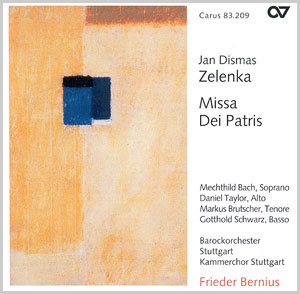
Missa Dei Patris
ZWV 19
Awarded the Preis der deutschen Schallplattenkritik
Awarded the Diapason d'Or
 Listen
(20)
Listen
(20)
- Kyrie I
- Christe eleison
- Kyrie II
- Gloria
- Domine Deus
- Domine Fili
- Qui sedes
- Quoniam
- Cum Sancto Spiritu
- Credo
- Et incarnatus est
- Crucifixus
- Et resurrexit
- Et vitam venturi saeculi
- Sanctus
- Benedictus
- Osanna
- Agnus Dei
- Agnus Dei
- Dona nobis pacem
Contents
-
Composer
Jan Dismas Zelenka
| 1679-1745The Bohemian composer Jan Dismas Zelenka was a double bass player and church music composer at the Saxon court of the Elector August the Strong and his son Friedrich August II. In the years after 1721 he composed an extensive repertoire of Catholic church music together with the Kapellmeister Johann David Heinichen. These works, together with the Dresden operas composed by Johann Adolf Hasse in quick succession from 1731 onwards, established the reputation of the Saxon court as one of the most important musical centers of the late Baroque period. Personal details
-
Preface writer
Thomas Kohlhase
| 1941
-
Choir
Kammerchor Stuttgart
The Kammerchor Stuttgart is regarded as one of the best ensembles of its kind. Over its fifty-year existence, Frieder Bernius has developed the choir into an exceptional ensemble acclaimed by audiences and press alike. This has led to invitations for the choir to perform at all the important European festivals. In Germany the chamber choir performs at festivals and in concert halls in repertoire ranging from the 17th to the 21st century. Frieder Bernius and his ensemble have received numerous accolades for their contribution to new music. The Kammerchor Stuttgart has made over 80 CDs and LPs, numerous of which have been awarded international recording prizes (including the Edison award, Diapason d’or, Gramophone Choice, Classical Internet Award, International Classical Music Award, and German Record Critics’ Award prizes). The International Federation for Choral Music has invited the ensemble to sing at the 1st, 4th and 10th World Symposia on Choral Music in Vienna, Sydney and Seoul. Regular tours of North America and Asia since 1988 and a South America tour reflect the Kammerchor Stuttgart’s international reputation. Since 1984 the top ensemble has also been invited to Israel biennially. Personal details
-
Orchestra
Barockorchester Stuttgart
The Barockorchester Stuttgart, which was founded by Bernius in 1985, specializes in 18th century music. The musicians are among the leading representatives of historical performance practice and perform exclusively on original instruments. The ensemble dedicates itself to a large extent to the revival of 18th century operas. It has performed at numerous international festivals, among others in Rome, Dresden and Göttingen. Personal details
-
Conductor
Frieder Bernius
| 1947Frieder Bernius’s work has earned great worldwide recognition. He is in demand internationally as a conductor and as a teacher. His principal artistic collaborators are the ensembles he founded himself, the Kammerchor Stuttgart, the Barockorchester Stuttgart, the Hofkapelle Stuttgart and the Klassische Philharmonie Stuttgart. As a guest conductor, he has collaborated repeatedly with, for example, the SWR Vokalensemble Stuttgart, the Deutsche Kammerphilharmonie Bremen, the Stuttgarter Kammerorchester and the Streicherakademie Bozen. Great stylistic versatility is Frieder Bernius’s hallmark. Whether he conducts vocal works by Monteverdi, Bach, Händel, Mozart, Beethoven, Fauré and Ligeti, stage music by Mendelssohn or symphonies by Haydn, Burgmüller and Schubert, his work always aims for a sound that is at once unmistakably personal and at the same time oriented towards the original period sound ideal. He devotes himself equally to the rediscovery of 18th century operas and to first performances of contemporary compositions. He is particularly interested in the musical history of southwestern Germany. Carus-Verlag has awarded Frieder Bernius a Golden CD for his complete recording of the sacred music of Felix Mendelssohn Bartholdy. The award was presented to him during the German Choir Festival in Stuttgart 2016. The sale of over 250,000 recordings, which has been acclaimed with a number of awards, has made a not insignificant contribution to what today is the obvious presence of Mendelssohn's complete œuvre in the concert repertoire. Personal details
-
Soloist - soprano
Mechthild Bach
The soprano Mechthild Bach was born in Limburg/ Lahn and studied singing with Elsa Cavelti at the Frankfurt Musikhochule. She also studied under Elisabeth Schwarzkopf, Laura Sarti and Vera Rosza. From 1986 she was the recipient of a grant from the German National Studies Foundation (SDV). Opera engagements took her to various German theaters where she mastered a broad repertoire as a lyric soprano. As a concert singer, Mechthild Bach regularly collaborates with renowned artists and ensembles throughout Europe. Her artistic achievements are preserved on numerous radio and CD recordings. A recording of Zelenka’s Missa Dei Patris in which she was a soloist was awarded the German Record Critics’ Prize in 2002. Personal details
-
Soloist - alto
Daniel Taylor
Daniel Taylor is one of the most sought-after countertenors worldwide. He performs with numerous international ensembles and symphony orchestras. As a recitalist, he has performed in the Konzerthaus Vienna, at the Frick Collection New York, in the Forbidden Concert Hall Beijing, Lufthansa Baroque Festival and Wigmore Hall London. He appeared in Jeremy Podeswa’s prize-winning film Five Senses. As an opera singer he has performed at Glyndebourne (Handel’s Theodora), the Metropolitan Opera New York (Handel’s Giulio Cesare), the Bavarian State Opera (Handel’s Rinaldo), Edinburgh (Gluck’s Orfeo), Welsh National Opera (Handel’s Jephtha) and the Canadian Opera (Handel’s Tolomeo). Daniel Taylor studied literature, music and philosophy before studying completing his exams in music and religious studies at the University of Montreal. Daniel Taylor is a professor at the Conservatoire de musi que in Montreal. Personal details
-
Soloist - tenor
Markus Brutscher
Markus Brutscher received his early musical training as a choirboy with the Regensburger Domspatzen and the Augsburg Domsingknaben, before going on to study singing in Berlin, London and Maastricht. He is in constant demand, singing with leading orchestras in Europe and America and with outstanding conductors. His extensive repertoire encompasses works from all musical periods from early Baroque to contemporary. A discography of over 50 recordings illustrates the singer’s versatility. Personal details
-
Soloist - bass
Gotthold Schwarz
Gotthold Schwarz received his first musical training at the Dresden Kirchenmusikschule and at the Hochschule für Musik Felix Mendelssohn Bartholdy in Leipzig. This bass studied singing with Gerda Schriever and conducting with Max Pommer and Hans-Joachim Rotzsch. He appears regularly throughout Europe with such celebrated artists as Frieder Bernius, Peter Schreier and Philippe Herreweghe. In additoin to his extensive concert activity, some of it in the USA, he has given courses in the interpretation of Bach’s works. Numerous CD and radio productions document his wide repertoire, which along with concert and opera singing includes song recitals featuring literature ranging from the baroque era to the present day. Personal details
Reviews
Zelenka, Jan Dismas: Missa Dei Patris ZWV 19


Zelenka, Jan Dismas: Missa Dei Patris ZWV 19
Seiner hochgeschätzten Zelenka-Reihe fügt Frieder Bernius mit der vorliegenden Einspielung eine weitere bedeutsame Folge bei. Die Missa Dei Patris ist die erste einer ursprünglich auf sechs Messen angelegten Reihe, den so genannten Missae ultimae. Dass Zelenka bei der vorliegenden Komposition den Gipfel seines Schaffens erreicht hat, ist offensichtlich: Die kluge Disposition innerhalb der einzelnen Ordinariumsteile mit konzertanten, lyrischen und fugierten Elementen ist souverän und mit konzisem Einsatz der musikalischen Mittel gelöst. Bernius belegt dies auch im eröffnenden Kyrie, das mit der klanglichen Fülle eines Händel eine regelrechte Glaubensemphase erreicht. Der Kammerchor Stuttgart beweist Substanz und Leuchtkraft, singt auch bei den Koloraturen locker und insgesamt ohne Manierismen. Das auf historischen Instrumenten spielende Barockorchester überzeugt mit reichen Valeurs und gehörigem Furor – beispielhaft im Et resurexit (Tr. 13), bei dem auch die Vokalsolisten ihre Qualitäten unter Beweis stellen. Im ausgreifenden Agnus Dei (Tr. 18) füllt Damel Taylor die Bitte um Erbarmen mit beseeltem Schönklang.
Norbert Rüde
Quelle: Klassik heute
Gewaltige Ausdruckskraft
Es muss so ungefähr vor zwei Jahren gewesen sein. Da dirigierte Frieder Bernius in der Leonhardskirche eine Aufführung von Jan Dismas Zelenkas „Missa Dei Patris”, die das Prädikat „denkwürdig” verdient. Für viele war dieses Konzert so etwas wie eine Initialzündung in Sachen Zelenka. Man war sich bis dahin sicher gewesen: Es gibt, was die barocke Kirchenmusik anbelangt, nichts, was auch nur einigermaßen an Bachs h-Moll-Messe und die Passionen heranreicht. Und nun Zelenka. Sechs so genannte „Missae ultimae” wollte der Dresdner Hofkomponist schreiben, drei sind es geworden. Die beiden anderen Messen hat Bernius bereits als CD aufgenommen, mit der „Missa Dei Patris” vollendet er seine Zelenka-Trias – und setzt damit einen Markstein. Ähnlich wie zuvor Monteverdi zieht Zelenka hier eine Summe der kompositorischen Errungenschaften seiner Zeit und gelangt zu einer gewaltigen Ausdruckskraft mit einer verblüffenden Vielfalt an Stilen, Formen und Satztechniken. Die bemerkt man nur, wenn so lebendig, beseelt und genau musiziert wird wie vom Barockorchester Stuttgart, dem fabelhaften Kammerchor Stuttgart und vier exquisiten Vokalsolisten. Wer Zelenka nicht kennt und sich einen ersten Eindruck von der Größe dieser Musik – und dieser Aufnahme – machen möchte, der höre beispielsweise das Altsolo im „Benedictus”, Takt 18: Es ist kaum vorstellbar, von diesen überirdisch schönen Klängen nicht angerührt zu sein.
Quelle: Stuttgarter Zeitung, 16.11.2000
Jan Dismas Zelenka: Missa Dei Patris
Jan Dismas Zelenka wurde 1679 in Launowitz (Böhmen) geboren. Nach seiner Ausbildung am Jesuiten-Kolleg Clementinum in Prag stand er im Dienst des Grafen Hartig, ab 1710/11 wirkte er am kursächsischen Dresdner Hof als Kontrabassist und Komponist. 1715 wurde er auf eine Studienreise nach Wien und Italien geschickt. Dort betrieb er ausführliche Kompositionsstudien bei J.J. Fux und A. Lotti. Zurückgekehrt wurde er 1721 Vizekapellmeister der Kirchenmusik, 1733 „Compositeur”, 1735 „Kirchen-Compositeur”, bewarb sich aber vergeblich um das Amt des Kirchenkapellmeisters. 1745 starb Zelenka in Dresden.
Zelenkas kirchenmusikalisches Schaffen ist zu Lebzeiten nicht gedruckt worden, überlieferte Abschriften im Besitz bedeutender Musiker wie z.B. J.S. Bach und Telemann legen allerdings eine gewisse Verbreitung nahe. Seit den späten 1970er Jahren werden die ca. 150 kirchenmusikalischen Werke meist nach autographen Partituren der Sächsischen Landesbibliothek erschlossen.
Die eingespielte Missa Dei Patris ist ein Werk eines ursprünglich auf sechs „Missae ultimae” angelegten Zyklus, von dem allerdings nur drei überliefert sind. Sie zeugt von hohem kompositorischen Können und einer tiefreligiösen Haltung. Eine große Vielfalt formaler Struktur offenbart sich in den vier großen Chorkonzerten, sieben Chorfugen, vier Chornummern dramatischer oder lyrischer Art, zwei Terzetten und drei Arien.
Sowohl im künstlerischen und aufnahmetechnischen Bereich hat die Aufnahme unter der Leitung von Frieder Bernius Bestnoten verdient. Schwungvolle Tempi, sehr schön ausmusizierte lyrische Teile machen das Hören zum Erlebnis. Bei den Solisten bietet vor allem der Countertenor Daniel Taylor besonderen Hochgenuss. Besonders im Beginn des Agnus Dei überzeugt er mit einer ausgezeichneten Balance zwischen lyrischer Stimmführung und konsequenter Artikulation. Barockorchester und Kammerchor Stuttgart musizieren sehr klar, durchsichtig und sauber artikuliert. Eine der historischen Aufführungspraxis entsprechende Interpretation, ausgezeichnet gelungen und sehr empfehlenswert.
Stefan Glaser
Quelle: Musik im Bistum Essen 1/2001, S. 57f.
[ ] La lecture brillante et contrastée conduite par Frieder Bernius offre une référence difficilement surpassable [ ] Perfectionniste mais loin de tout formalisme, Bernius sait fort bien faire passer l'esprit de rupture dont vit cette architecture fastueuse et ambiguë, qui vit son partage emblématique entre le sanctuaire et la scène avec moins de déchirement que de gourmandise [ ].
Intégrant tous les éléments (Kammerchor Stuttgart comme toujours souple, éloquent et virtuose, quatuor de solistes emmené par le soprano ailé de Mechthild Bach) le chef sud-allemand impose une authentique spiritualité à un mystérieux souffle lyrique, qui renvoie à Prague, cité magique vers laquelle ont convergé toutes les composantes de la Mitteleuropa, depuis Rodolphe II.
Roger Tellart
Quelle: Diaposon 2/02
Reviews on our website can only be submitted by customers with a registered user account. A check whether the rated products were actually purchased does not take place.
Frequent questions about this work
 There are no questions and answers available so far or you were unable to find an answer to your specific question about this work? Then click here and send your specific questions to our Customer Services!