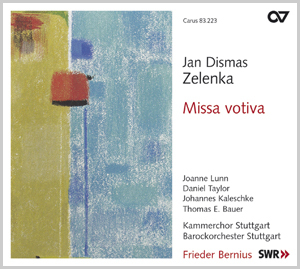
Missa votiva
ZWV 18, 1739
Awarded the Preis der deutschen Schallplattenkritik
Awarded the Diapason d'Or
 Listen
(20)
Listen
(20)
- Kyrie I (Coro)
- Christe eleison (Solo S)
- Kyrie II (Coro)
- Kyrie III (Coro)
- Gloria (Soli e Coro SATB)
- Gratias agimus tibi (Soli e Coro SATB)
- Qui tollis (Solo S)
- Qui sedes (Coro)
- Quoniam to solus sanctus (Solo B)
- Cum Sancto Spiritu I (Coro)
- Cum Sancto Spiritu II (Coro)
- Credo (Coro)
- Et incarnatus est (Solo A)
- Crucifixus (Coro)
- Et resurrexit (Soli e Coro SATB)
- Sanctus (Coro)
- Benedictus (Solo S)
- Osanna in excelsis (Coro)
- Agnus Dei (Soli e Coro SATB)
- Dona nobis pacem (Coro)
Contents
-
Composer
Jan Dismas Zelenka
| 1679-1745The Bohemian composer Jan Dismas Zelenka was a double bass player and church music composer at the Saxon court of the Elector August the Strong and his son Friedrich August II. In the years after 1721 he composed an extensive repertoire of Catholic church music together with the Kapellmeister Johann David Heinichen. These works, together with the Dresden operas composed by Johann Adolf Hasse in quick succession from 1731 onwards, established the reputation of the Saxon court as one of the most important musical centers of the late Baroque period. Personal details
-
Preface writer
Thomas Kohlhase
| 1941
-
Choir
Kammerchor Stuttgart
The Kammerchor Stuttgart is regarded as one of the best ensembles of its kind. Over its fifty-year existence, Frieder Bernius has developed the choir into an exceptional ensemble acclaimed by audiences and press alike. This has led to invitations for the choir to perform at all the important European festivals. In Germany the chamber choir performs at festivals and in concert halls in repertoire ranging from the 17th to the 21st century. Frieder Bernius and his ensemble have received numerous accolades for their contribution to new music. The Kammerchor Stuttgart has made over 80 CDs and LPs, numerous of which have been awarded international recording prizes (including the Edison award, Diapason d’or, Gramophone Choice, Classical Internet Award, International Classical Music Award, and German Record Critics’ Award prizes). The International Federation for Choral Music has invited the ensemble to sing at the 1st, 4th and 10th World Symposia on Choral Music in Vienna, Sydney and Seoul. Regular tours of North America and Asia since 1988 and a South America tour reflect the Kammerchor Stuttgart’s international reputation. Since 1984 the top ensemble has also been invited to Israel biennially. Personal details
-
Orchestra
Barockorchester Stuttgart
The Barockorchester Stuttgart, which was founded by Bernius in 1985, specializes in 18th century music. The musicians are among the leading representatives of historical performance practice and perform exclusively on original instruments. The ensemble dedicates itself to a large extent to the revival of 18th century operas. It has performed at numerous international festivals, among others in Rome, Dresden and Göttingen. Personal details
-
Conductor
Frieder Bernius
| 1947Frieder Bernius’s work has earned great worldwide recognition. He is in demand internationally as a conductor and as a teacher. His principal artistic collaborators are the ensembles he founded himself, the Kammerchor Stuttgart, the Barockorchester Stuttgart, the Hofkapelle Stuttgart and the Klassische Philharmonie Stuttgart. As a guest conductor, he has collaborated repeatedly with, for example, the SWR Vokalensemble Stuttgart, the Deutsche Kammerphilharmonie Bremen, the Stuttgarter Kammerorchester and the Streicherakademie Bozen. Great stylistic versatility is Frieder Bernius’s hallmark. Whether he conducts vocal works by Monteverdi, Bach, Händel, Mozart, Beethoven, Fauré and Ligeti, stage music by Mendelssohn or symphonies by Haydn, Burgmüller and Schubert, his work always aims for a sound that is at once unmistakably personal and at the same time oriented towards the original period sound ideal. He devotes himself equally to the rediscovery of 18th century operas and to first performances of contemporary compositions. He is particularly interested in the musical history of southwestern Germany. Carus-Verlag has awarded Frieder Bernius a Golden CD for his complete recording of the sacred music of Felix Mendelssohn Bartholdy. The award was presented to him during the German Choir Festival in Stuttgart 2016. The sale of over 250,000 recordings, which has been acclaimed with a number of awards, has made a not insignificant contribution to what today is the obvious presence of Mendelssohn's complete œuvre in the concert repertoire. Personal details
-
Soloist - soprano
Jean Lunn
-
Soloist - countertenor
Daniel Taylor
Daniel Taylor is one of the most sought-after countertenors worldwide. He performs with numerous international ensembles and symphony orchestras. As a recitalist, he has performed in the Konzerthaus Vienna, at the Frick Collection New York, in the Forbidden Concert Hall Beijing, Lufthansa Baroque Festival and Wigmore Hall London. He appeared in Jeremy Podeswa’s prize-winning film Five Senses. As an opera singer he has performed at Glyndebourne (Handel’s Theodora), the Metropolitan Opera New York (Handel’s Giulio Cesare), the Bavarian State Opera (Handel’s Rinaldo), Edinburgh (Gluck’s Orfeo), Welsh National Opera (Handel’s Jephtha) and the Canadian Opera (Handel’s Tolomeo). Daniel Taylor studied literature, music and philosophy before studying completing his exams in music and religious studies at the University of Montreal. Daniel Taylor is a professor at the Conservatoire de musi que in Montreal. Personal details
-
Soloist - tenor
Johannes Kaleschke
Johannes Kaleschke studied singing in Stuttgart and Mannheim, and has specialized in sacred music and oratorio. His repertoire ranges from Claudio Monteverdi’s Vespers to Mauricio Kagel’s Sankt-Bach-Passion. He also gives song recitals and appears in opera and operetta, including performing at the Ludwigsburg Schlossfestspiele and the Stauffer Festspiele in Göppingen. Personal details
-
Soloist - bass
Thomas E. Bauer
Thomas E. Bauer, who today is one of the most sought-after baritones, began singing as a member of the Regensburger Domspatzen. Important performances of contemporary music have left an indelible mark on his artistic profile. He has participated in world premieres of works by Nono, Killmayer and Rihm and he was awarded the Schneider- Schott Musikpreis in 2003 for his outstanding achievements in this area. His repertoire as an opera singer encompasses great title roles, including Monteverdi’s Orfeo, Rossini’s Il barbiere di Siviglia and Berg’s Wozzeck. However, his great passion is singing lieder. He regularly gives lied recitals in Japan (Aoyama Music Award) and – together with the fortepiano specialist Jos van Immerseel – in Paris, Brugge and Brussels. Personal details
Reviews


[...] Animierend.
(DIE ZEIT, Zeit-Mitarbeiter empfehlen ..., 9. Dezember 2010)
The Missa votiva is a late work, composed in 1739 [...] There's old-fashioned counterpoint, sometimes severe, and contemporary galanterie, sometimes jolly. [...] Joanne Lunn shines in all three of her solos and Thomas E. Bauer is splendidly bluff in ‚Quoniam tu solus sanctus’. Daniel Taylor is hypnotically beautiful in ‚Et incarnatus’, the strings' paired quavers reminiscent of a Lullian sommeil scene. Bernius and his Stuttgart forces make a strong case for this quirky piece. [...]
(gramophone, November 2010)
The Stuttgart Chamber Choir is one of the best in the world, and that again shows in this recording. [...] Zelenka's music never disappoints, and I don't hesitate to label this mass a masterpiece. The performance displays this work in its full glory. Of all recordings of Zelenka's music this disc is one of the best.
(MusicWeb international, Recording of the month, Oktober 2010)
[...] This is an outstanding performance of an intriguing Mass by an imaginative composer.
(David Vickers, Gramophone, Awards Issue, Oct. 2010)
[...] Die Aufnahme besticht durch tänzerischen Schwung und strahlende Klangpracht, inniger Ausdruck blüht auf aus konzentrierter Ruhe. Die Dynamik ist fein gestaffelt, die Artikulation konsequent. Virtuos bewegliche Chorstimmen, elastisch federnde Streicherpassagen und dazu betörende Bläserfarben tragen zu dieser überaus beredten Interpretation bei. [...]
(Frankfurter Allgemeine Zeitung, 05.08.2010)
[...] Ein ungemein frisches, energiegeladenes, stets vorantreibendes Werk, das hier mustergültig interpretiert wird.
(Die Rheinpfalz, 22. Mai 2010)
[...] Neben dem glasklar und spritzig intonierenden Barockorchester Stuttgart bewegt sich der Bass eindrucksvoll sicher und klangvoll durch die Koloraturen dieses Bravourstücks. Der Dirigent Frieder Bernius sorgt in der gesamten Messe für zünftige Tempi und scharfe Akzente und betont so die in der Komposition bereits angelegte dramatische Grundhaltung. Die greifen auch die Solisten gerne auf [...]
(Jan Ritterstaedt, WDR 3 TonArt, 29. Juni 2010)
[...] Equipe à l'unisson, soprano supérieurement gracieuse (et sans mièvrerie s'il vous plaît), choeur et orchestre somptueux. La belle vie!
(Gaetan Naulleau, Diaposon, septembre 2010)
[...] No question: This recording has „best choral disc of 2010“ written all over it. Don't miss.
(www.classicstoday.com, 8.6.2010)
[...] There is [...] something special about any Zelenka recording that involves Frieder Bernius - perhaps he shares my passion for the music? Most impressive of many pleasures was the voice of Joanne Lunn: here is a full-blooded soprano voice that can both project the melismas, add tasteful ornaments, and warm individual notes where appropriate. She is not alone, though - the other soloists, the wonderfully disciplined choir and the fabulous orchestra combine to bring life to another fine mass by Zelenka that deserves to he better known.
(Early Music Review, August 2010)
Reviews on our website can only be submitted by customers with a registered user account. A check whether the rated products were actually purchased does not take place.
Frequent questions about this work
 There are no questions and answers available so far or you were unable to find an answer to your specific question about this work? Then click here and send your specific questions to our Customer Services!