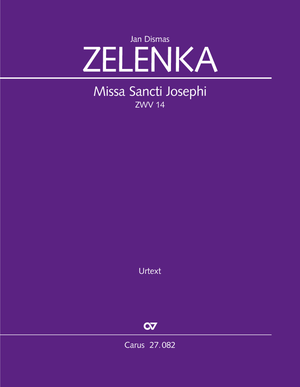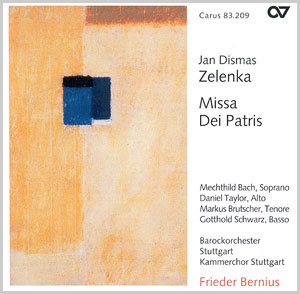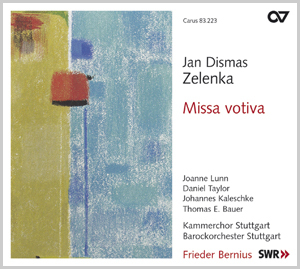
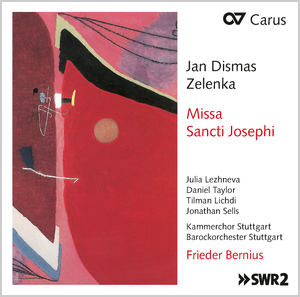
Missa Sancti Josephi (Bernius)
 Listen
(19)
Listen
(19)
- Missa Sancti Josephi ZWV 14. Kyrie - Christe – Kyrie
- Gloria in excelsis Deo
- Et in terra pax
- Laudamus te
- Qui tollis
- Qui sedes
- Quoniam tu solus sanctus
- Cum Sancto Spiritu
- Sanctus - Pleni sunt coeli - Osanna I
- Benedictus
- Agnus Dei I/II
- Dona nobis pacem
- De profundis ZWV 50. De profundis
- Si iniquitates
- Sustinuit
- Requiem aeternam
- In exitu Israel ZWV 84. In exitu Israel
- Simulacra gentium
- Sicut erat
 Additional material
- Purchase additional material as a download product.
-
 Digital text (without sheet music) incl. printing licence, html file, singing text, english translationhtml file, singing text, english translation (Sample)
Kyrie
1. Kyrie – Christe – Kyrie (Soli SA, Coro SATB) Lord, have mercy on us.
Christ, have mercy on us.
Lord, have mercy on us.Gloria
2. Gloria in excelsis Deo (Soli SATB, Coro SATB) Glory be to God on high.
3. Et in terra pax (Soli SAB, Coro SATBB) And on earth peace to men of good will.
4. Laudamus te (Soli SATB) We praise thee.
We bless thee.
We adore thee.
We glorify thee.
We give thee thanks
for thy great glory.
Lord God,
...
-
Digital text (without sheet music) incl. printing licence, html file, singing text, german translationhtml file, singing text, german translation (Sample)
Kyrie
1. Kyrie – Christe – Kyrie (Soli SA, Coro SATB) Herr, erbarme dich unser.
Christus, erbarme dich unser.
Herr, erbarme dich unser.Gloria
2. Gloria in excelsis Deo (Soli SATB, Coro SATB) Ehre sei Gott in der Höhe.
3. Et in terra pax (Soli SAB, Coro SATBB) Und Friede auf Erden den Menschen, die guten Willens sind.
4. Laudamus te (Soli SATB) Wir loben dich.
Wir preisen dich.
Wir beten dich an.
Wir rühmen dich.
Wir danken dir,
denn groß ist deine Herrlichkeit.
Herr und Gott,
...
-
Digital text (without sheet music) incl. printing licence, html file, singing text, originalhtml file, singing text, original (Sample)
Kyrie
1. Kyrie – Christe – Kyrie (Soli SA, Coro SATB) Kyrie eleison.
Christe eleison.
Kyrie eleison.Gloria
2. Gloria in excelsis Deo (Soli SATB, Coro SATB) Gloria in excelsis Deo.
3. Et in terra pax (Soli SAB, Coro SATBB) Et in terra pax hominibus bonae voluntatis.
4. Laudamus te (Soli SATB) Laudamus te.
Benedicimus te.
Adoramus te.
Glorificamus te.
Gratias agimus tibi
propter magnam gloriam tuam.
Domine Deus,
Rex coelestis,
...
-
Digital text (without sheet music) incl. printing licence, html file, Introductory text, englishhtml file, Introductory text, english (Sample)Abridged text from the CD Carus 83.279
Wolfgang Horn
Translation: Gudrun & David KosvinerThe Bohemian Jan Dismas Zelenka (1679–1745) was a double bass player and composer in the service of the Dresden court during the reign of Augustus the Strong (1694–1733) and his son Frederic Augustus II (1733–1763). Today, he is rightly regarded as one of the most important composers of late Baroque orchestral masses who brought the development of the so-called “number mass” type to its culmination. In 1733, J. S. Bach dedicated a mass of this type – the Mass in B minor (BWV 232/I), consisting of Kyrie and Gloria – to the heir to the throne of Dresden. The masses of Zelenka and his Dresden colleague Johann
...
-
Digital text (without sheet music) incl. printing licence, html file, Introductory text, germanhtml file, Introductory text, german (Sample)Gekürzter Booklet-Text der CD Carus 83.279
Wolfgang Horn
Der Böhme Jan Dismas Zelenka (1679–1745) war Kontrabassist und Komponist in Diensten des Dresdner Hofes zur Zeit Augusts des Starken (1694–1733) und seines Sohnes Friedrich August II. (1733–1763). Er gilt heute zu Recht als einer der bedeutendsten Komponisten spätbarocker Orchestermessen, die den Typus der sogenannten „Nummernmesse“ zu seiner höchsten Entfaltung gebracht haben. J. S. Bach hat 1733 dem Dresdner Thronfolger eine Messe dieses Typs gewidmet, die Missa in h-Moll (BWV 232/I), bestehend aus Kyrie und Gloria. Die Messen Zelenkas und seines Dresdner Kollegen Johann David Heinichen (1683–1729) gaben die Umrisse vor, in denen Bach seine eigene Kunst entfalten konnte.
Jan Dismas Zelenka wurde geboren in Louňovice
...
-
Digital text (without sheet music) incl. printing licence, html file, singing text, english translationhtml file, singing text, english translation (Sample)
1. De profundis (Coro BBB) Out of the depths have I cried unto thee, O Lord.
Lord, hear my voice:
let thine ears be attentive to the voice of my supplications.2. Si inquitates (Coro SATB) If thou, Lord, shouldest mark iniquities,
O Lord, who shall stand?
But there is forgiveness with thee,
that thou mayest be feared. I wait for the Lord.3. Sustinuit (Soli AT) My soul doth wait, and in his word do I hope;
my soul waiteth for the Lord.
From the morning watch, even until night,
let Israel hope in the Lord;
for with the Lord there is mercy,
and with him is plenteous redemption.4. Et ipse redemet (Coro SATB) And he shall redeem Israel from all his iniquities.
5. Requiem aeternam (Coro SATB) Lord, grant them eternal rest,
...
-
Digital text (without sheet music) incl. printing licence, html file, singing text, german translationhtml file, singing text, german translation (Sample)
1. De profundis (Coro BBB) Aus den Tiefen ruf ich zu dir, o Herr,
Herr, erhöre meine Stimme.
Lass Acht haben dein Ohr auf die Stimme meines Flehens!2. Si inquitates (Coro SATB) Wenn du Acht haben wolltest auf die Missetaten, o Herr,
wer könnte dann bestehen?
Aber bei dir ist Versöhnung,
und um deines Gesetzes willen harr ich auf dich, o Herr!3. Sustinuit (Soli AT) Meine Seele harret auf sein Wort;
meine Seele hoffet auf den Herrn.
Von der Morgenwache bis in die Nacht
hoffe Israel auf den Herrn;
denn bei dem Herrn ist Barmherzigkeit,
und bei ihm ist überreiche Erlösung.4. Et ipse redemet (Coro SATB) Und er wird Israel erlösen von allen seinen Sünden.
...
-
Digital text (without sheet music) incl. printing licence, html file, singing text, originalhtml file, singing text, original (Sample)
1. De profundis (Coro BBB) De profundis clamavi ad te Domine;
Domine, exaudi vocem meam.
Fiant aures tuae intendentes in vocem deprecationis meae.2. Si inquitates (Coro SATB) Si iniquitates observaveris Domine,
Domine, quis sustinebit?
Quia apud te propitiatio est;
et propter legem tuam sustinui te, Domine.3. Sustinuit (Soli AT) Sustinuit anima mea in verbo ejus:
speravit anima mea in Domino.
A custodia matutina usque ad noctem,
speret Israel in Domino.
Quia apud Dominum misericordia,
et copiosa apud eum redemptio.4. Et ipse redemet (Coro SATB) Et ipse redimet Israel ex omnibus iniquitatibus ejus.
...
-
Digital text (without sheet music) incl. printing licence, html file, Introductory text, englishhtml file, Introductory text, english (Sample)Abridged text from the CD Carus 83.279
Wolfgang Horn
Translation: Gudrun & David KosvinerThe Bohemian Jan Dismas Zelenka (1679–1745) was a double bass player and composer in the service of the Dresden court during the reign of Augustus the Strong (1694–1733) and his son Frederic Augustus II (1733–1763). Today, he is rightly regarded as one of the most important composers of late Baroque orchestral masses who brought the development of the so-called “number mass” type to its culmination. In 1733, J. S. Bach dedicated a mass of this type – the Mass in B minor (BWV 232/I), consisting of Kyrie and Gloria – to the heir to the throne of Dresden. The masses of Zelenka and his Dresden colleague Johann
...
-
Digital text (without sheet music) incl. printing licence, html file, Introductory text, germanhtml file, Introductory text, german (Sample)Gekürzter Booklet-Text der CD Carus 83.279
Wolfgang Horn
Der Böhme Jan Dismas Zelenka (1679–1745) war Kontrabassist und Komponist in Diensten des Dresdner Hofes zur Zeit Augusts des Starken (1694–1733) und seines Sohnes Friedrich August II. (1733–1763). Er gilt heute zu Recht als einer der bedeutendsten Komponisten spätbarocker Orchestermessen, die den Typus der sogenannten „Nummernmesse“ zu seiner höchsten Entfaltung gebracht haben. J. S. Bach hat 1733 dem Dresdner Thronfolger eine Messe dieses Typs gewidmet, die Missa in h-Moll (BWV 232/I), bestehend aus Kyrie und Gloria. Die Messen Zelenkas und seines Dresdner Kollegen Johann David Heinichen (1683–1729) gaben die Umrisse vor, in denen Bach seine eigene Kunst entfalten konnte.
Jan Dismas Zelenka wurde geboren in Louňovice pod Blaníkem, das ca. 70 km südöstlich von Prag
...
-
Digital text (without sheet music) incl. printing licence, html file, singing text, english translationhtml file, singing text, english translation (Sample)
1. In exitu Israel (Coro SATB) When Israel went out of Egypt, the house of Jacob from a people of strange language;
Judah was his sanctuary, and Israel his dominion.
The sea saw it, and fled: Jordan was driven back.
The mountains skipped like rams, and the little hills like lambs.
What ailed thee, O thou sea, that thou fleddest? thou Jordan, that thou wast driven back?
Ye mountains, that ye skipped like rams; and ye little hills, like lambs?
Tremble, thou earth, at the...
-
Digital text (without sheet music) incl. printing licence, html file, singing text, german translationhtml file, singing text, german translation (Sample)
1. In exitu Israel (Coro SATB) Da Israel aus Ägypten zog, das Haus Jakob aus dem fremden Volk,
da ward Juda sein Heiligtum, Israel seine Herrschaft.
Das Meer sah es und floh; der Jordan wandte sich zurück;
die Berge hüpften wie die Lämmer, die Hügel wie die jungen Schafe.
Was war dir, du Meer, dass du flohest, und du, Jordan, dass du dich zurückwandtest,
ihr Berge, dass ihr hüpftet wie die Lämmer, ihr Hügel wie die jungen Schafe?
Vor dem Herrn bebte die Erde,...
-
Digital text (without sheet music) incl. printing licence, html file, singing text, originalhtml file, singing text, original (Sample)
1. In exitu Israel (Coro SATB) In exitu Israel de Aegypto, domus Jacob de populo barbaro:
Facta est Judaea sanctificatio ejus, Israel potestas ejus.
Mare vidit, et fugit: Jordanis conversus est retrorsum.
Montes exsultaverunt sicut arietes: et colles sicut agni ovium.
Quid est tibi mare quod fugisti? Et tu, Jordanis, quia conversus es retrorsum?
Montes, exsultastis sicut arietes et colles sicut agni ovium?
A facie Domini mota est terra,...
-
Digital text (without sheet music) incl. printing licence, html file, Introductory text, englishhtml file, Introductory text, english (Sample)Abridged text from the CD Carus 83.279
Wolfgang Horn
Translation (abridged): Gudrun & David KosvinerThe Bohemian Jan Dismas Zelenka (1679–1745) was a double bass player and composer in the service of the Dresden court during the reign of Augustus the Strong (1694–1733) and his son Frederic Augustus II (1733–1763). Today, he is rightly regarded as one of the most important composers of late Baroque orchestral masses who brought the development of the so-called “number mass” type to its culmination. In 1733, J. S. Bach dedicated a mass of this type – the Mass in B minor (BWV 232/I), consisting of Kyrie and Gloria – to the heir to the throne of Dresden. The masses of Zelenka and his Dresden colleague Johann
...
-
Digital text (without sheet music) incl. printing licence, html file, Introductory text, germanhtml file, Introductory text, german (Sample)Gekürzter Booklet-Text der CD Carus 83.279
Wolfgang Horn
Der Böhme Jan Dismas Zelenka (1679–1745) war Kontrabassist und Komponist in Diensten des Dresdner Hofes zur Zeit Augusts des Starken (1694–1733) und seines Sohnes Friedrich August II. (1733–1763). Er gilt heute zu Recht als einer der bedeutendsten Komponisten spätbarocker Orchestermessen, die den Typus der sogenannten „Nummernmesse“ zu seiner höchsten Entfaltung gebracht haben. J. S. Bach hat 1733 dem Dresdner Thronfolger eine Messe dieses Typs gewidmet, die Missa in h-Moll (BWV 232/I), bestehend aus Kyrie und Gloria. Die Messen Zelenkas und seines Dresdner Kollegen Johann David Heinichen (1683–1729) gaben die Umrisse vor, in denen Bach seine eigene Kunst entfalten konnte.
Jan Dismas Zelenka wurde geboren in Louňovice
...
Contents

-
Composer
Jan Dismas Zelenka
| 1679-1745The Bohemian composer Jan Dismas Zelenka was a double bass player and church music composer at the Saxon court of the Elector August the Strong and his son Friedrich August II. In the years after 1721 he composed an extensive repertoire of Catholic church music together with the Kapellmeister Johann David Heinichen. These works, together with the Dresden operas composed by Johann Adolf Hasse in quick succession from 1731 onwards, established the reputation of the Saxon court as one of the most important musical centers of the late Baroque period. Personal details
-
Choir
Kammerchor Stuttgart
The Kammerchor Stuttgart is regarded as one of the best ensembles of its kind. Over its fifty-year existence, Frieder Bernius has developed the choir into an exceptional ensemble acclaimed by audiences and press alike. This has led to invitations for the choir to perform at all the important European festivals. In Germany the chamber choir performs at festivals and in concert halls in repertoire ranging from the 17th to the 21st century. Frieder Bernius and his ensemble have received numerous accolades for their contribution to new music. The Kammerchor Stuttgart has made over 80 CDs and LPs, numerous of which have been awarded international recording prizes (including the Edison award, Diapason d’or, Gramophone Choice, Classical Internet Award, International Classical Music Award, and German Record Critics’ Award prizes). The International Federation for Choral Music has invited the ensemble to sing at the 1st, 4th and 10th World Symposia on Choral Music in Vienna, Sydney and Seoul. Regular tours of North America and Asia since 1988 and a South America tour reflect the Kammerchor Stuttgart’s international reputation. Since 1984 the top ensemble has also been invited to Israel biennially. Personal details
-
Orchestra
Barockorchester Stuttgart
The Barockorchester Stuttgart, which was founded by Bernius in 1985, specializes in 18th century music. The musicians are among the leading representatives of historical performance practice and perform exclusively on original instruments. The ensemble dedicates itself to a large extent to the revival of 18th century operas. It has performed at numerous international festivals, among others in Rome, Dresden and Göttingen. Personal details
-
Conductor
Frieder Bernius
| 1947Frieder Bernius’s work has earned great worldwide recognition. He is in demand internationally as a conductor and as a teacher. His principal artistic collaborators are the ensembles he founded himself, the Kammerchor Stuttgart, the Barockorchester Stuttgart, the Hofkapelle Stuttgart and the Klassische Philharmonie Stuttgart. As a guest conductor, he has collaborated repeatedly with, for example, the SWR Vokalensemble Stuttgart, the Deutsche Kammerphilharmonie Bremen, the Stuttgarter Kammerorchester and the Streicherakademie Bozen. Great stylistic versatility is Frieder Bernius’s hallmark. Whether he conducts vocal works by Monteverdi, Bach, Händel, Mozart, Beethoven, Fauré and Ligeti, stage music by Mendelssohn or symphonies by Haydn, Burgmüller and Schubert, his work always aims for a sound that is at once unmistakably personal and at the same time oriented towards the original period sound ideal. He devotes himself equally to the rediscovery of 18th century operas and to first performances of contemporary compositions. He is particularly interested in the musical history of southwestern Germany. Carus-Verlag has awarded Frieder Bernius a Golden CD for his complete recording of the sacred music of Felix Mendelssohn Bartholdy. The award was presented to him during the German Choir Festival in Stuttgart 2016. The sale of over 250,000 recordings, which has been acclaimed with a number of awards, has made a not insignificant contribution to what today is the obvious presence of Mendelssohn's complete œuvre in the concert repertoire. Personal details
-
Soloist - soprano
Julia Lezhneva
-
Soloist - alto
Daniel Taylor
Daniel Taylor is one of the most sought-after countertenors worldwide. He performs with numerous international ensembles and symphony orchestras. As a recitalist, he has performed in the Konzerthaus Vienna, at the Frick Collection New York, in the Forbidden Concert Hall Beijing, Lufthansa Baroque Festival and Wigmore Hall London. He appeared in Jeremy Podeswa’s prize-winning film Five Senses. As an opera singer he has performed at Glyndebourne (Handel’s Theodora), the Metropolitan Opera New York (Handel’s Giulio Cesare), the Bavarian State Opera (Handel’s Rinaldo), Edinburgh (Gluck’s Orfeo), Welsh National Opera (Handel’s Jephtha) and the Canadian Opera (Handel’s Tolomeo). Daniel Taylor studied literature, music and philosophy before studying completing his exams in music and religious studies at the University of Montreal. Daniel Taylor is a professor at the Conservatoire de musi que in Montreal. Personal details
-
Soloist - tenor
Tilman Lichdi
Tilman Lichdi grew up near Heilbronn; he started singing lessons with Alois Treml at the age of 18 and studied trumpet for four years with Günther Beetz in Mannheim. In 1999, he decided to study singing with Charlotte Lehmann in Würzburg, graduating with distinction. Tilman Lichdi is in demand worldwide for both concerts and opera roles. Personal details
-
Soloist - bass
Jonathan Sells
Jonathan Sells is a concert and opera singer, artistic director and conductor. The British-Swiss bassbaritone has performed in some of the world’s most famous concert halls, including the Sydney Opera House, Royal Albert Hall, Lincoln Center and Carnegie Hall, collaborating with, among others, William Christie, John Eliot Gardiner, Ton Koopman, Roger Norrington and Frieder Bernius. He has appeared on the opera stage at the Teatro Real in Madrid, Glyndebourne Festival Opera and Zurich Opera, among others. After studying music and musicology at the University of Cambridge and singing and opera at the Guildhall School in London, Jonathan Sells attended the International Opera Studio in Zurich. In 2008, Sells founded the British collective Solomon’s Knot, a group that performs music from the 17th and 18th centuries with an innovative programming approach. The ensemble does without a conductor and sings from memory in order to communicate the special power of the music as directly as possible. Personal details
-
Soloist - bass
Sönke Tams Freier
-
Soloist - bass
Mathis Koch
Reviews
Samuel Scheidt: Cantiones Sacrae

... Bernius beweist hier wieder einmal, ein gutes Gefühl für das Idiom von Zelenka zu haben. ... Diese CD ist eine besonders wichtige und fesselnde Erweiterung der Zelenka-Diskographie.
Johan van Veen, Toccata, Mai - Juni 2020
... Neben den bezaubernden Klangfarben des historischen Instrumentariums überzeugt insbesondere die sich stets vom liturgischen Text leitende Dramaturgie der Interpretation Bernius’.
Markus Eberhardt, DIE BESPRECHUNG, 03/2020
... La magni-tude poignante des parties chorales, quand Bernius confie l’entrée aux seuls solistes, et la vélocité des dif-férents solos (hautbois) y demeurent inégalées.
Jérémie Bigorie, Classica, April 2019
... Bernius arbeitete mit exzellenten Solisten zusammen, darunter erstmals mit der jungen Sopranistin Julia Lezhneva.
Tiroler Tageszeitung, 04.03.2019
... Image sonore relativement large, belle cohésion de l’ensemble. Sur le devant de la scène, des solistes en proportions adéquates avec l’orchestre et le choeur, aux timbres plaisants mais moyennement définis.
Gaetan Naulleau, Diapason, 03/2019
... Wie immer besticht der Kammerchor Stuttgart mit seinem sehr homogenen und individuellen Chorklang. Dabei bleibt er uneitel und ist ausschließlich dem Werk verpflichtet. Dazu kommt, dass auch die Solisten und das Orchester sich perfekt einfügen, so dass alles wie aus einem Guss erscheint. ... Eine absolute Empfehlung!
Astrid Belschner, kulturradio, 22.01.2019
... Bernius verfügt wieder über erstklassige musikalische Kräfte, allen voran seinen Stuttgarter Kammerchor, der virtuos und makellos agiert, klanglich schlackenlos und elegant wie eh und je. ... Das Stuttgarter Barockorchester agiert in gleichem Sinn.
Gero Schreier, klassik.com, 01.01.2019
... chef-d’œuvre absolu contrastant avec le geste épique d’In exitu Israel, deux visages de l’art saisissant de ce génie du baroque.
Jean-Charles Hoffelé, Artamag', 30.11.2018
... In der jüngst erschienenen „Missa Sancti Jospehi” zeigt sich die schwäbische Disziplin und Unaufgeregtheit.
Helmut Mauró, Süddeutsche Zeitung, 23.11.2018
... Zusammen mit dem Chor und dem Orchester gelingt eine phasenweise geradezu mitreißende Wiedergabe dieser großartigen, aber immer noch recht unbekannten Musik Zelenkas.
Frank Pommer, Die Rhein-Pfalz, 17.11.2018
... Der Kammerchor Stuttgart und Barockorchester Stuttgart überzeugen einmal mehr durch ihrberedtes, kommunikatives Musizieren. Der Ton bleibt stets schlank, klar mit schönen Tönungen. Dem Chor und dem Orchester steht das ausgezeichnete und vorallem stimmlich schön ausbalancierte Solistenquartett in Nichts nach.
Guy Engels, pizzicato, 31.10.2018
... Meditatives Tänzeln und ein scheinbar benommener, visionärer Stil von milder Begeisterung prägt die Musik - so wie Frieder Bernius sie hier mit Kammerchor und Barockorchester Stuttgart wunderbar umstandslos und leichtgängig präsentiert ... Eine Entdeckung!
Robert Fraunholzer, Rondo, 5/2018
Reviews on our website can only be submitted by customers with a registered user account. A check whether the rated products were actually purchased does not take place.
Frequent questions about this work
 There are no questions and answers available so far or you were unable to find an answer to your specific question about this work? Then click here and send your specific questions to our Customer Services!