Dum medium silentium, based on a text from the Book of Wisdom, addresses silence as a prerequisite for the birth of the Word of God in the world and in the soul. Buchenberg creates a finely nuanced interplay of quiet passages, expressive climaxes, and harmonious transitions that transport the listener into a meditative sphere. The double choir is lifted into a realm where the word of God becomes accessible.
Challenging Choral Works 20th and 21st Century
The choral works published by Carus offer a wide range of styles and levels of difficulty. The challenging compositions from the twentieth and twenty-first centuries presented here demand vocal precision, a deep understanding of polyphony and musical structures, and an intensive engagement with language and text. With these works, ambitious choirs can develop and expand their musical potential.
-
Buchenberg: Dum medium silentium
-
Mocnik: Acclamatio
Damijan Mocnik's work, originally composed for SSAA choir, is also published in versions for mixed choir (SSAATTBB) and male choir. The piece begins with a musically effective invocation of Christ, develops rhythmically and dynamically with rich contrasts, and concludes with a colorful and heartfelt final sequence.
-
Schoenberg: Friede auf Erden
Friede auf Erden (Peace on Earth), Op. 13, the last tonal composition by Arnold Schoenberg, is one of the few choral works of the Second Viennese School. The text is based on a Nativity poem by Conrad Ferdinand Meyer and expresses a vision of “pure harmony among people,” a view from which Schoenberg later distanced himself. What remains is a composition of great artistic power and depth – a showpiece for accomplished choirs!
-
Ravel/Gottwald: La vallée des cloches
-
Hoybye: Psalm 151
John Hoybye's Psalm 151 for eight-part choir and solo violin presents a dialogue between the voice of God (violin) and humanity (choir), inspired by the poetry of Edward Broadbridge. The three movements and themes range from calm Dorian melodies through narrative passages to jazz-inflected harmonies that make God's love and creation come to life in music.
-
Sandström: Messiah
Sven-David Sandström's Messiah is based on the English libretto by Charles Jennens and combines modern tone colors with traditional form. The work features four soloists with a six-part choir and orchestra, and it employs an expressive musical language and unusual sound effects, including differentiated percussion and specific performance instructions.
-
Grau: Aqua
Gonzalo Grau's oratorio Aqua, commissioned by the International Bach Academy Stuttgart, explores the global theme of water and its ambivalent role as both a source and a destroyer of life. This multicultural work for narrator, soloists, choir, orchestra, synthesizer and computer combines various musical styles, from Gregorian chant to Indian and African sounds, to reflect diverse cultural perspectives on water.
-
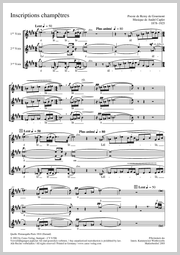
Caplet: Inscriptions champêtres
This composition for three voices (with divisions), based on Remy de Gourmont’s poetic text, combines impressionistic soundscapes with rich musical expressiveness. Changing tempi and sophisticated rhythms along with creative tone-painting effects, such as bouche fermée, demand the utmost precision and sensitivity in performance.
-
Distler: Die Weihnachtsgeschichte
Hugo Distler's Weihnachtsgeschichte, Op. 10, is a striking a cappella work which intertwines the Christmas story with seven variations on Es ist ein Ros entsprungen (Lo, How A Rose E’er Blooming). Based on the Gospels of Luke and Matthew, the piece depicts the events surrounding the birth of Jesus and the visit of the Magi, employing both solo and choral singing. It is scored for four-part choir, from which all the solos (Evangelist, Mary, Elizabeth, Herod, Simeon) can be drawn, and it is proof that the Christmas message can be expressed just as brilliantly in modern compositions as in the works of the old masters.
-
Schanderl: Zarathustra
Hans Schanderl's two-part composition Zarathustra I and II is a sonically complex exploration of Zoroastrianism, combining archaic spirituality with a contemporary soundworld. The first part, Ahura Mazdah, is striking with its meditative passages alongside the deliberate use of expressive tone colors, while in the second part, Asha, additional effects, including glissando octave leaps and precise articulation with the tongue, create a delicately balanced soundscape.
-
Fußeder: Sofdu Unga Ástin Mín
-
Letelier: Soliloquy
-
Vogler: Clockwork
-
Birzer: Afterwards
Lucia Birzer's composition Afterwards is based on Sara Teasdale's poem There Will Come Soft Rains, which depicts a world after the end of humanity. While Teasdale was inspired by World War I, Birzer sets the text in the context of the climate crisis. Musically, the piece begins with soloists singing in a recitative style, then builds to a dramatic climax and ends in contemplative silence.
-
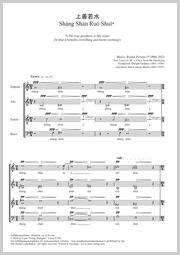
Piritore: Shàng Shàn Ruò Shui
In her work Shàng Shàn Ruò Shui, composer Rosita Piritore creates an atmospheric sound world that is repeatedly interrupted by whispered syllables. Due to its short length and clear structure, the work is well suited for rehearsals. The text is based on the Daodejing, using an easily singable transliteration of the Chinese, and it promotes the idea of harmonious coexistence and world peace.