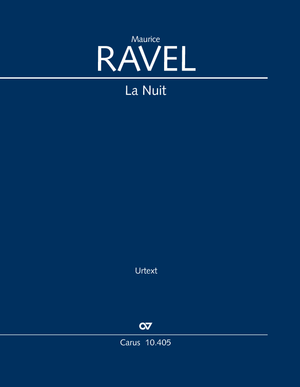
La Nuit
1902
 Practise
-
Pronouncing Aid
- La Nuit
-
Composer
Maurice Ravel
| 1875-1937Maurice Ravel was an important French composer and one of the main representatives of Impressionism in music.
He was born on March 7, 1875 in Ciboure near Saint-Jean-de-Luz and showed musical talent at an early age. He began taking piano lessons at the age of seven. His first works were written during composition lessons with Charles-René. In 1889, he was accepted at the Paris Conservatoire, where he initially pursued a career as a pianist, but later concentrated on composition. The extensive knowledge gained from his pianistic training is later evident in Ravel's piano writing and his understanding of orchestration, e.g. in his arrangement of Mussorgsky's Pictures at an Exhibition.
Ravel's compositional style is characterized by refined timbres, innovative harmonies and masterful orchestration. Despite his importance for the music history of the 20th century, he often remained controversial during his lifetime. Most of his works, with their unusual rhythms and harmonies, were initially met with incomprehension by the general public, but were praised by some critics for their innovative power. Nevertheless, works such as La Valse, Bolero and his two piano concertos became popular during his lifetime. In addition to his instrumental and stage works, Ravel also created vocal music, including the choral piece L'Aurore.
In the last years of his life, a progressive physical decline increasingly prevented him from performing in public and composing new works. He died in Paris on December 28, 1937.
Personal details
-
Editor
Marc Rigaudière
Marc Rigaudière is a professor of musicology at the University of Reims Champagne-Ardenne (URCA) and at the Center for Research and Higher Education in Cultural History (CERHiC) there. As early as 1993, Marc Rigaudière was the first prize-winner in the subject of musical analysis at the Paris Conservatoire (CNSMDP). This was followed by a doctorate from the University of Paris Sorbonne in 2002 and a habilitation in 2019. Marc Rigaudière has held teaching positions at various universities, including the conservatory in Metz and the Sorbonne in Paris. His main fields of research are music theory and musical analysis, among other things, he is concerned with Franco-German cultural transfer in the field of music theory. Since 2002, he has devoted himself to the scholarly editing of musical works in collaboration with Carus-Verlag. His complete list of publications can be found here: https://cv.hal.science/marc-rigaudiere Personal details
-
Songwriter / Librettist
Auguste Lacaussade
| 1815-1897
Reviews on our website can only be submitted by customers with a registered user account. A check whether the rated products were actually purchased does not take place.
Frequent questions about this work
 There are no questions and answers available so far or you were unable to find an answer to your specific question about this work? Then click here and send your specific questions to our Customer Services!