The story about the Missa Papae Marcelli being performed at the Council of Trent (1545–1563) and “saving” polyphony in church music is nothing more than a charming legend. Nevertheless, this Mass has become symbolic of the Council, which gave significant impetus to the Catholic Counter-Reformation and thus shaped the culture – and with it, the music – of the following century.
Favorite Pieces 17th Century
Dr. Uwe Wolf, head of the editorial department at Carus, is a musicologist specializing in the seventeenth and eighteenth centuries. His research ranges from the era of Monteverdi and Schütz, through Bach and the whole generation of his sons, to the Viennese Classical period. He has compiled a list of his personal favorites from the seventeenth century.
“From a musical perspective, the seventeenth century is full of musical highlights for me,” he says. “I am particularly fond of the early years. What tremendous revolutionary power lies in this music: so much that was new, even extreme, was created in such a short time! The rest of the century consolidated, smoothed things out, developed structures, paved the way for Bach, among others, but without ever completely abandoning its beginnings. On my journey through the century, I chose some of my favorite works, while also looking a little beyond the boundaries of the century. However, as is always the case with any selection, there are so many more works that could have been included….!”
-
ca. 1565: Giovanni Pierluigi da Palestrina
-
1597 / 1615: Giovanni Gabrieli
The music of the seventeenth century was already emerging in the late 1500s, for instance, in the polychoral works of Giovanni Gabrieli, in which expansive soundscapes were beginning to displace contrapuntal composition. The potential of Gabrieli's polychoral style can be seen in his posthumously published collection Hodie completi sunt from 1615, in which the expansive texture breaks open and concertato elements emerge. The new century has fully dawned.
-
1605: Claudio Monteverdi
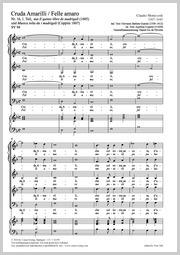
Years before its first publication, Monteverdi's madrigal Cruda amarilli provided ammunition for his fiercest adversary, Giovanni Maria Artusi, who saw it as an example of the irregularity of Monteverdi's compositions. Perhaps this is precisely why this madrigal is one of Monteverdi's best-known works, both then and now. It appeared in 1605 in Monteverdi's Fifth Book of Madrigals and was also included in the collection of sacred Latin madrigal contrafacta published two years later by Aquilino Coppini, one of his friends. Our edition offers both the secular Italian and the sacred Latin texts. More delightful madrigals are to be found in the Choral collection Monteverdi.
-
1610: Claudio Monteverdi
The early seventeenth century was filled with musical innovations: monody, concertato style, basso continuo, expansive soundscapes, the evolution and development of musical instruments, and breathtaking virtuosity – even in sacred music! All these new elements representing everything that was musically possible shortly after 1600 are uniquely concentrated in Monteverdi's sacred music publication of 1610, a portfolio – an ultimately unsuccessful job application – submitted to Rome. From a Dutch parody mass (Missa in illo tempore) based on themes by Nicolas Gombert to the highly virtuosic Duo Seraphim (from Vespro della Beata Vergine) and the Magnificat, with similarly virtuosic obbligato instrumental parts composed over the liturgical cantus firmus – it is this tension, this exploration of possibilities in all directions and always pushed to the limits, that makes these key works of music history so fascinating and captivating, right up to today.
-
1619: Heinrich Schütz / Michael Praetorius
With Heinrich Schütz's Psalmen David and Michael Praetorius's Polyhymnia caduceatrix, the “new style” finally arrived in Germany by 1619. Both composers combine expansive polychoral settings with concertato elements in the deliberate employment of particular instruments. Yet the collections are very different in character. Schütz wrote psalms that were absolutely of equal standing with the compositions of his Italian colleagues: it is only the German language which marks them as German Protestant music. Praetorius, on the other hand, mixes multiple choirs, concertato music, ritornello form, and other techniques borrowed from his Italian role models, with hymns by Martin Luther – thus laying the foundation for the later development of Protestant church music, up to and including the chorale cantata. It’s fascinating to contemplate what these two gentlemen may have talked about when they played music together in Dresden in 1617 on the occasion of the 100th anniversary of the Reformation.
-
1623: Johann Hermann Schein
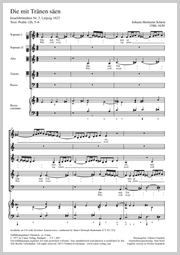
The Italian art of the madrigal also found its way to Germany. While the poetic form of the madrigal is difficult to translate into German, the madrigal style, with its so-called “madrigalisms” – the vivid tone-painting in the interpretation of certain words, often associated with “licenses” or liberties in compositional technique – influenced both secular and sacred composition in Germany. This is particularly evident in the compositions from Schein's Fontana d'Israel or Israels Brünnlein: motets written auff Italian-Madrigalische Manir (in the Italian madrigal manner). A striking example is Die mit Tränen säen (They that sow with tears) with its almost languishing chromaticism.
-
1640: Giacomo Carissimi
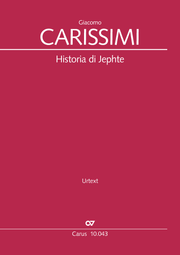
In today's concert repertoire the oratorio begins in the eighteenth century: Bach's Christmas Oratorio, the oratorios of Haydn and Mendelssohn, or Spohr and Franck. But the history of the oratorio began much earlier. One of its roots lies in historical narratives based on biblical material, of which Schütz's two historical works in particular are still performed today: the Resurrection History (1623) and the Christmas History (published in 1664). This early period also includes Giacomo Carissimi's Historia di Jephte, about the harrowing story of the military leader Jephthah, who sacrifices his daughter in fulfillment of a vow. It’s one of the earliest and, at the same time, one of the most powerful works in the history of the Italian oratorio.
-
1648: Heinrich Schütz
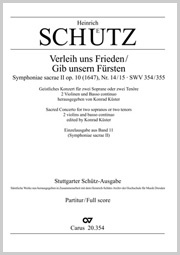
The year 1648 appears in every history book: it marks the year of the Peace of Westphalia and the end of the Thirty Years' War, the devastating impact of which brought culture and music to a standstill in large parts of Europe. Heinrich Schütz experienced the war firsthand and contributed music to several diplomatic meetings during wartime, such as Da pacem Domine (SWV 465) for the Electoral Diet (Kurfürstentag) at Mühlhausen in 1627, and Herr, du bist vormals genädig gewest (SWV 461) for the Assembly of Protestant Electors in Leipzig in 1631. The longing for peace also resonates in every note of Schütz's motet Verleih uns Frieden genädiglich (Grant us peace graciously) (SWV 372) based on Luther's hymn. This motet is inseparable from its second part, Gib unsern Fürsten (Give our princes) SWV 373, because even then it was clear that peace in the world depends on its rulers.
-
1671: Andreas Hammerschmidt
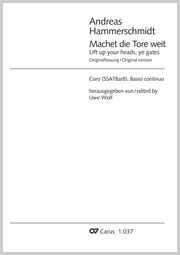
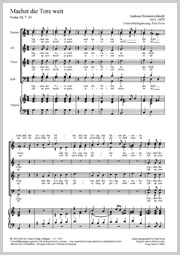
Hammerschmidt's Machet die Tore weit (Lift up your heads, ye gates) has been a choral favorite since the early twentieth century, helped by a version shortened by about half its original length, making it easier to perform. But Hammerschmidt's works also enjoyed broad and lasting popularity in the seventeenth century, due to their small-scale forms and his catchy accessible music which was tailored precisely to the needs of Protestant worship, while also brimming with musical inventiveness and memorable melodies. His compositions remained in the repertoire, particularly of smaller church choirs, well into the eighteenth century.
-
The final third of the seventeenth century: Johann Christoph Bach
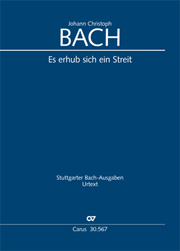
In the second half of the century the Bach family appeared on the scene with a whole generation of composers, some of whom we find it difficult to distinguish from one another today. Several pieces have therefore been attributed to different “Bachs.” In addition to numerous motets, several larger-scale compositions have also survived. One genuine highlight is the sacred concerto for Michaelmas, Es erhub sich ein Streit (There arose then a war in heaven), most likely by Johann Christoph Bach (1642–1703). It is an impressive, polychoral work in which two vocal choirs and a string choir are joined by a trumpet choir in a musically dramatic setting of the battle between Michael and the dragon.
-
1680: Dietrich Buxtehude
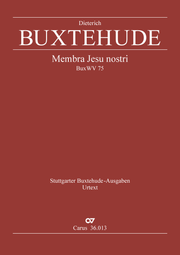
Buxtehude's North German devotional music Membra Jesu nostri, based on Latin meditations on the parts of the crucified Christ's body, each paired with verses from scripture, is a deeply beautiful Passion music of a very special kind. The scoring is limited to five vocal parts (both solo and choir) with two violins, violone and continuo. But in the sixth movement, Ad Cor (to the heart), Buxtehude introduces a five-part consort of viols – an uneconomical addition, but tremendously effective. Buxtehude's music points forward to Bach (who famously walked all the way to Lübeck specifically to hear Buxtehude), but there are also considerable echoes here of Monteverdi: for example, at the end of the fifth movement.
-
1692: Henry Purcell / Marc-Antoine Charpentier
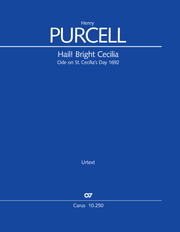
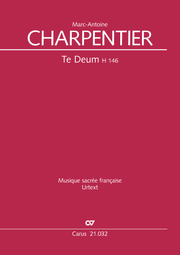
Two exceptionally festive compositions were written around 1692, one in London and the other in Paris: Purcell's Hail! Bright Cecilia. Ode on St Cecilia’s Day 1692 and Charpentier's famous Te Deum. Purcell's ode is a thoroughly lively cantata full of contrasts, emotion, musical tone painting, and triumphant choruses: a good fifty minutes of thrilling music! Charpentier composed a series of Te Deum settings, including THE Te Deum, the one with the opening theme now universally recognized as the “Eurovision fanfare.” Its martial tone probably reflects the occasion for which it was composed: the victory of the French army at Steinkerque. The result is a varied, cantata-like composition with both triumphant and contemplative movements, featuring everything that could be expected in a courtly festive composition – for in a Te Deum, the court of Louis XIV naturally celebrates itself above all else.
-
1708: Johann Sebastian Bach
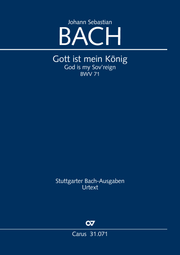
In our modern perception the eighteenth century is first and foremost the century of Johann Sebastian Bach. One of his earliest vocal compositions, the Mühlhausen council election cantata Gott ist mein König is, like Charpentier's Te Deum, political music: it celebrates the appointment of the new council. And there is still a lot of the seventeenth century in this “congratulatory sacred motet.” At the same time, it is also clearly a “genuine” work by Bach, albeit one that stands quite alone in his oeuvre, especially in its unusually choral treatment of the orchestra.